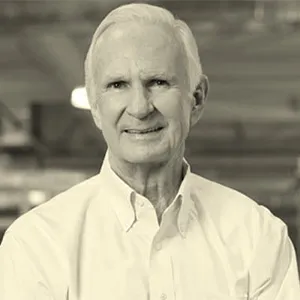
Engineer, Entrepreneur, and Founder of RL Hudson & Company
Rick Hudson, founder of RL Hudson & Company, shares how he built his now $80M manufacturing firm from humble beginnings in his garage and the lessons he's learned along the way in both life and business.
Rick Hudson was born in Ottawa, Ontario, Canada. His family moved to Chamblee, Georgia, a suburb of Atlanta, in 1948.
After graduating from Georgia Tech, Rick accepted a job with Parker Seal Company as an engineer working on sealing applications in the military, aerospace, and commercial aviation industries.
In 1969, Rick moved to Tulsa to take on the role of Territory Sales Manager. In 1980, he started a distributorship known as RL Hudson & Company. The company’s product lines evolved from sealing products to custom molded rubber and plastic component assemblies.
In 2019, the company purchased Rapid Production Tooling in Berthoud, Colorado, a manufacturer of high-quality precision injection molds for the medical and electronic industries.
In 2003, he was honored with the Tulsa Small Businessperson of the Year award, and a year later, he was recognized as Oklahoma's Small Businessperson of the Year in 2004.
Since 2006, he has served on the Tulsa Metropolitan Utility Authority.
Full Interview Transcript
Chapter 1 - Introduction
Announcer: Rick Hudson was born in Ottawa, Ontario, Canada. His family moved to Chamblee, Georgia, a suburb of Atlanta, in 1948.
After graduating from Georgia Tech, Rick accepted a job with Parker Seal Company as an engineer working on sealing applications in the military, aerospace, and commercial aviation industries.
In 1969, Rick moved to Tulsa to take on the role of Territory Sales Manager. In 1980, he started a distributorship known as RL Hudson & Company. The company’s product lines evolved from sealing products to custom molded rubber and plastic component assemblies.
In 2019, the company purchased Rapid Production Tooling in Berthoud, Colorado, a manufacturer of high-quality precision injection molds for the medical and electronic industries.
In addition to Rick telling you about his company, he will talk about his China connection, flying helicopters, and the airport yellow line on the podcast and oral history website – Voices of Oklahoma.
Chapter 2 - Education
John Erling (JE): Well, my name is John Erling and today's date is January 17, 2024. So Rick, would you state your full name, please?
Rick Hudson (RH): My name is Richard Lowe Hudson. I'm better known as Rick.
JE: And we're recording this interview in the facilities of Voices of Oklahoma here in Tulsa. Your birth date?
RH: December 10th, 1943.
JE: And your present age is?
RH: My present age is 80.
JE: And where were you born?
RH: I was born in Ottawa, Ontario, Canada.
JE: And we'll find out why you were born there in a minute, but let's talk about your mother. Your mother's name.
RH: Was Ruth May Lowe, and she was born and raised in Mahanoy City, Pennsylvania. It was a coal town in the coal region of Pennsylvania.
JE: And what was her personality like? How would you describe her?
RH: My mother was wonderful. She was strong. Her father died when she was 2 years old. She was born in 1922. Her father died in 1924. My grandmother worked at a department store every day and walked to the department store, didn't make very much money. So my mother grew up in tough circumstances. She was very strong. She was a loving, supportful mother. She didn't work. She was a stay at home mother, but she was always supportive of me all throughout my life.
JE: Yeah. Then your father's name.
RH: My father was Lloyd Barry Hudson Jr. and he was raised in Washington DC.
JE: And then his personality. What was he like?
RH: He was an outgoing personality. He was a loving man, funny, had a great personality. Everyone loved my dad. He was a strict father though. He didn't put up with any foolishness on the part of my brother or I.
JE: So it was just you and your brother?
RH: No, we had 2 sisters come along a little bit later, so there were 4 of us. My brother just passed away last October, so I still have 2 sisters who live in the Atlanta area.
JE: And your brother's name?
RH: Was Buddy.
JE: And how old was he when he died?
RH: He was 77.
JE: Then your sisters’ names?
RH: My sister is Kathy. She lives in Loganville, Georgia. She's 71 maybe, and I have a baby sister who was a pleasant surprise. She's 19 years younger than me, so I think she must be 61.
JE: But didn't your father's family live in the Washington DC area?
RH: Yes, my father was raised in Washington DC. My grandfather worked for the War Department. During the war he had previously fought in the Spanish-American War and then he was sent to Haiti with the government. I don't know in what capacity, but I have a lot of his letters that he wrote while he was in Haiti. He also was a contractor after the war and built houses and developments in the Washington area. They moved to Falls Church, Virginia. And my mother and father were married in the Falls Church, which is an Episcopalian church in Falls Church, Virginia.
JE: You had an aunt Clara
RH: I did have an Aunt Clara.
JE: And she managed a restaurant?
RH: She managed a restaurant in downtown Washington, and most days Clyde Tolson and J. Edgar Hoover would eat lunch there. I remember she told me one time that my cousin Georgia Dean was there and she had an opportunity to meet Mr. Hoover and he asked, "What would you like to do?" And she said, "I'd like to be an FBI agent," and he said, "Well, we don't have any female FBI agents." He smiled. She later became an architect and was one of the main architects for the Capitol.
JE: I'm reading a book about women in the CIA in the early beginnings and how females were so instrumental in the CIA; and I also knew that J. Edgar Hoover was kind of competing with the at the beginning of the CIA. Interesting how women were being used back then. Talk about your education, grade school. Where was that?
RH: Well, I started off at Brookhaven Elementary School in the 1st grade. I don't remember much about that.
JE: And that town was…?
RH: That's in Atlanta, a suburb of Atlanta. And then in the 2nd through the 4th grades, I went to Chamblee Elementary High School, which was eliminated and I transferred to Skyland Elementary School. In the 7th and 8th grades, I went to Northwoods Elementary School and which was a junior high, more or less, kind of a middle school. We didn't call it middle school back then. And in 9th grade I went to Chamblee High School in Chamblee, Georgia, which is a suburb of Atlanta.
JE: All right, and you graduated in what year?
RH: 1961.
JE: So were you interested in sports at all in high school?
RH: I loved sports in high school. I was the youngest kid in my class. I was 17 when I graduated, and I was skinny and I was slow, so I never thought I would—I was always the youngest one and I was smaller than everybody else, but finally I started to catch up. In the 8th grade, I was still at Northwoods Elementary School and we were asked to try out for the Chamblee High School football team, which was a real honor. And we went over and they—Chamblee was a kind of lower middle income school. So we got our first uniforms and I got a leather helmet with no face mask. And shoulder pads and hip pads and knee pads, they don't even wear knee pads now, they wear shorts out in the field. After about 3 weeks, I got a plastic helmet with 1 bar for a face mask.
JE: So you excelled then in football.
RH: Well, not at first. I tried hard. I was still younger and skinny. I tried hard. Chamblee had a terrible football history. We had a couple of really good players. Our quarterback was wonderful, and we had a guy that was an end and a tackle, and they were good. And I tried hard and I made the B team, and the Chamblee Varsity lost the first 5 games of the year. Our great coach, Coach Tony Palma, he became frustrated, so he elevated all of us up to the varsity. We start, end up starting, and we promptly lost the last 5 games a year.
JE: But basketball and track too you were interested in.
RH: Yes, I also played basketball and I ran track.
JE: After you graduate from high school, what happens to you?
RH: Well, I grew up in Chamblee, Georgia, which the main employer was the Buick Oldsmobile Pontiac plant -- BOP plant -- and most of my friends' parents worked there and I thought, well, that's what I'll do. I wasn't subjected to opportunities other than I'll go to work for the BOP plant. Fortunately I started to blossom as a football player. I made all-state. And then I was offered a scholarship to a couple of schools, Chattanooga and Vanderbilt. I talked to West Point and Dartmouth, but I accepted a scholarship to Vanderbilt University to play football.
JE: OK, and how did that go?
RH: Not too well. I was skinny and I was slow and I had trouble competing against boys that were a year older than me and no matter how much I ate, I just couldn't gain weight. I don't have that problem now, but I was—I'm actually bigger than I was. I'm bigger now. I weigh 175. I weighed 170 pounds and I was 6 ft 2 inches when I was at Vanderbilt. I did OK on the freshman team. I caught a touchdown pass against the University of Kentucky freshman football team, but that was otherwise a nondescript freshman season. The coach came to me. He said, "Rick, you're not gonna be able to play at this level." And I lost my scholarship. And that was, as you can imagine, heartbreaking to me and heartbreaking to my parents because they weren't in a financial situation to send me to college. I did go back for my sophomore year and I played on the B team at Vanderbilt there, but I couldn't, I had to pay. My parents had to pay, and it was an expensive school. So it was apparent that I wasn't gonna go anywhere in football. So I dropped out of Vanderbilt. I came back to Atlanta, and I decided to go to Georgia Tech, where I always wanted to go to college in the first place.
JE: And then at Georgia Tech, did that click with you?
RH: Well, I wasn't accepted at Georgia Tech at first. My grades at Vanderbilt were just average C's and D's. So when I applied to Georgia Tech, they didn't accept me. They did say, however, that they would accept me to go to night school and if my grades after one year were acceptable, they would let me in day school. So I got a job working at Rich's department store in the warehouse, and I would price parts and take them out in the showroom and that's how I worked during the day and then I would go to school from 6 o'clock to 10 o'clock at night. And I was up in the at Rich’s department store. I was up in the TV area when I heard about President Kennedy being assassinated. That's how I heard it.
JE: How did that affect you and the people around you?
RH: It was terrible. It was 4 days of the worst times that we could imagine, equal, of course, to 9/11, but that was a terrible time. I was in the ROTC. And President Kennedy came to Vanderbilt to speak and so as such, we were an honor guard and I was as close to the president as you and I are and I saluted him and he kind of gave me a little grin like "you, you're a little so and so," but it was nice to see him. He was a very handsome guy, very charismatic.
Chapter 3 - First Job
John Erling (JE): So then you did the night work.
Rick Hudson (RH): I worked hard. At that point, I started to really begin to concentrate. Well, you need to start growing up and working on the rest of your life. And I—so I started studying hard. I made A's and B's and I was accepted into the day school and accepted to Georgia Tech, which is a wonderful school. But I still had to work. My parents—I had my little sisters now, and there were 4 children, and paying for college was pretty tough. They did help, but I also had to work, so I would go to school during the day and then I went to work at DuPont. They had a dye laboratory. Georgia and the South was big in textiles and there were a lot of rug plants, textile manufacturing plants, and so there was a big demand for dyes. So I worked in the dye laboratory and we would match colors. It was a real interesting job. That's how I learned my love of chemistry was working in that laboratory matching colors and mixing them and then we would submit the recipes to the factories. And they would buy the DuPont dyes.
JE: Your studies at Georgia Tech, what were they? What were you…?
RH: I studied industrial management. Now that's like a business, heavy in business with a minor in engineering. I took physics, chemistry, industrial engineering classes. It was a very good plant experience. It was oriented towards people that were gonna be in manufacturing and business.
JE: Little did you know. That was your platform for what you ended up doing.
RH: Yes, it was. I had no idea what I really wanted to do, but fortunately, Georgia Tech had a great employment program in the last quarter of my senior year. We were invited to sign up for various companies to interview, and I must have done pretty well because I got some wonderful trips. I interviewed these companies: Fairchild Semiconductor, and they brought me to San Francisco; First National City Bank took me to New York City; Nalco Chemical Company took me to Chicago; 3M took me up into Midland, Michigan. Monsanto took me to Saint Louis; US Steel to Birmingham; and then Parker Hannifin took me to Cleveland, and that's who I ultimately went to work for.
JE: You must have graduated with a pretty good grade point.
RH: I did. I had a 2.6 out of 3, which doesn't sound that impressive, but it was good enough to be in the upper third of my class.
JE: And you graduated from Georgia Institute of Technology in what year?
RH: 1967. I was on the long program. (Chuckling)
JE: Oh well, but you completed it. You finished it.
RH: Yes.
JE: Then you took your first job with...
RH: Well, I was offered a job by Parker Hannifin, which is a big hydraulics company in Cleveland, Ohio, an aerospace manufacturer, and they had a division in California called Parker Seal Company, a rubber manufacturing company. They transferred me to Parker Seal to Culver City, California. When I graduated in '67, that was my first job.
JE: So you're in Culver City, California. Something happened to you that made a light bulb go on in your brain.
RH: Well, it was the very first night I had moved to the Los Angeles area. Parker put us up in the Marina del Rey Hotel, which is a wonderful facility, and I had been invited to come down and meet with the other Parker salespeople and we were having drinks. I had a Bloody Mary and we had appetizers, and I was not subjected to that type of environment, being around all the guys and all of a sudden this Cadillac drives up and—good looking man, well tanned, had a yellow sweater, I remember that detail, over his shoulders and he came out and everybody said, "There's Bob Porter. Hey, here comes Bob Porter." And I'm looking at him and who, who is Bob Porter? And one of my friends said, "He's our distributor, he's our biggest distributor." And I said, "What's a distributor?" And he said, "Well, he buys our products. And he resells them to customers and he's quite rich." And I thought to myself, "Hm, I want to be a distributor."
JE: Right (Chuckling). And you wanted to own your own company.
RH: I wanted to own my own company. I didn't know I wanted to own my own company at that point, but after several years of working for Parker, I didn't see myself working my way up through the corporate structure. I saw myself more as an independent business person.
JE: So then, do you stay there in California, or what happens to you then?
RH: Well, I went on a 6 month training program in California. Then they moved me to Berea, Kentucky to work in their factory there, manufacturing O-rings, mixing rubber, working in the plant, working in engineering. And then I was transferred to their corporate offices in Cleveland and I got to work in sales, inside sales, taking care of customers. And then my first sales job was I was transferred in 1968 to Milwaukee, Wisconsin in the wintertime. It was my—it was like Tulsa, Oklahoma today. It was cold. And in 1969, I was transferred to Tulsa, Oklahoma. It was my first job and I had been an engineer with Parker at that time. In fact, when I was in California, I worked on metal seals that went on rocket engines. The space program was growing at that time and so I was fortunate to be an engineer. And when I came to Tulsa, I was a sales engineer. We were called territory managers. So we called on customers and we called on distributors.
JE: So here in Tulsa then, what was it that you actually did here?
RH: I was actually a sales engineer. I was making sales calls on customers working with their engineering department, calling on distributors...
JE: ...but that didn't satisfy you. You actually moved on to go into business, didn't you?
RH: I had to work with the distributor and I didn't think that the distributor that I was working with in Oklahoma—they're now defunct—I didn't think they were very good, so I got with my boss, Don McDowell out of Saint Louis, Missouri. And I had this idea that we could set up our own distributorship being a Parker distributor, and I think we could do very well doing this. And Don, he wasn't as inclined to go into business as I was, so he brought in two people from Kansas City who were more experienced and who had some money, so we all went in as partners. I wasn't very happy about that situation. I didn't think we needed them. We didn't need their money. We didn't need their expertise, but Don insisted on it and it wasn't gonna happen unless we brought these two gentlemen in from Kansas City. But the business was pretty successful right from the get-go. And as luck would have it—bad luck for Bob Porter. Mr. Porter, the man to whom I previously reported, mentioned his business got in trouble. He tried to get into manufacturing and he overextended and his business went bankrupt and so Parker was desperate to have a replacement distributor. So they called my boss Don McDowell, my partner, and they offered to set him up in business in the Bay Area of California. So he wanted me to go with him. So we went to California in November of 1971.
JE: What kind of money did you put into that for that business?
RH: I think I put in $15,000. I had saved up $15,000.
JE: Very good. So that was a good amount for you, wasn't it?
RH: Yes, it was. Well, actually, I had been married at that time and my father-in-law, Doctor Frank Alquist of Miami, he loaned me part of the money. He actually co-signed the note. I borrowed the money and I paid him back.
Chapter 4 - Nine-Year Lawsuit
John Erling (JE): So long in here, we ought to talk about this person that you met by the name of Diane, right? Tell us about her and what happened.
Rick Hudson (RH): Well, I met Diane in early 1971. They didn't have liquor by the drink and they opened up a new club—they called them—called the Vault. It's on 31st Street and I went out one night and I met Diane and we got along pretty well. We had a few dates and then in the spring, she invited me to go up with her family up to Grand Lake, which began a lifelong love of Grand Lake. I liked Diane a lot. We dated the whole year, but then I had this opportunity to go into business, which meant that I was gonna move to San Francisco in November. Her father had helped me acquire the loan for Seal Company Enterprises -- Sealco -- and so I couldn't go to California without her. I wouldn't go to California without her, but she says, "I'm not going with you unless I'm married." So we married November 7th, 1971 and we've been married for 52 years.
JE: And you have children out of that marriage.
RH: We have two sons and we have four grandchildren.
JE: Two sons and their names?
RH: Jason Hudson is my oldest. He's 48 years old. He's now CEO of RL Hudson Company. And my youngest son is Blake Hudson, he's 45 years old. And he works for a company called OneStream. He takes care of the federal government for his software manufacturing company up in Morristown, New Jersey.
JE: Oh, how many grandchildren do you have?
RH: I have 4 grandchildren. Twins here, 14-year-old twins, a boy and a girl, Levi and Olivia, Jason's twins, and then Blake has a son, Carter, who is 13 years old. And a daughter, Tatum, and they live in Morristown, New Jersey.
JE: OK. So back into the business, Sealco, tell us about your percentage of that company.
RH: Well, I owned 25% of Sealco, and the deal we made was with the Kansas City people that after they would come in and they would help set up a business, and after one year, McDowell and I demanded the right to buy the company. And we would have to pay them the original investment back, their $30,000, and then we would also have to pay them an increase in whatever the company increased. I convinced them that we could sell, we could do very well, we could grow the business, which in fact we did. And then McDowell and I were given this opportunity to move to California. And we opened that business called McDowell and Company, which is still in business. And we were living in Foster City, California, and the company was in San Mateo and Don and I—he wanted to be the controlling partner. He had 51%. I had 49%. We couldn't take any money out of the business. We were living in San Francisco. It was pretty tough. It was a cold winter. I didn't like it. Diane didn't like it, and we decided that we wanted to live in Oklahoma. So I made a deal with Don that I would give him my 49% of McDowell and Company if he would give me his 25% of Sealco. And we made the deal and we moved back to Tulsa and then we announced to the Kansas City people that we were exercising our agreement to buy the company. And that didn't go very well with them. They said, "Well, now our agreement, we were going to help you get a distributorship. You got the distributorship. We want to keep Sealco." And I said, "Well, that's not the way the agreement is written. The agreement is written that we have the right to buy and I now control 50% of the company. I want to buy Sealco and I want to run it." They were running the company. They had possession and possession is 99% of the law. And so I had to enter into a lawsuit against them which I fought for almost 9 years.
JE: Wow.
RH: The Kansas City people went to Parker Seal and they took—they said that I was going to buy the company. They didn't want to sell it, and Parker took their side. They said Rick Hudson is too young.
JE: How old were you?
RH: I think I was—1971—I was 27, something like that. Anyway, I was young. I was inexperienced, which was true, and I was undercapitalized, all of which were true. But I had the contract. Sealco was my idea. And I wanted to own that company and run it. And so I didn't have enough money to file a lawsuit, but I had a lawyer friend, Paul Hodgson, who was a dear man. He's deceased now. And he took it on a contingency basis. And we fought that from 1972 until 1979 was when we won it and it was very tough because I didn't have to pay legal fees, but I did have to pay the cost of depositions and supplies and things like that. So what I did in the meantime is I accepted the job with a polyurethane manufacturing company in Manchester, New Hampshire. It was a German company, a part of Freudenberg, a big German seal manufacturer, and it was a wonderful experience working for Disogrin Industries. I traveled the Southeast. But my biggest break in that came when the man who had this territory was sadly killed in a car wreck and they asked me to come back to this territory here. Atlanta was not a manufacturing area. Tulsa -- Oklahoma and Kansas and Texas were much better manufacturing areas. So this gave me an opportunity to make more money and so I was able to stay afloat while I was fighting this lawsuit.
JE: So then the lawsuit was decided and you won in '79.
RH: Yes.
JE: So then you gave up your work with...
RH: I left Disogrin. I'm still very good friends with the former president of Disogrin. And I decided that I was gonna try to go into my own business for a short period of time. I worked with my friend John Roche in the oil business. He was buying a rig and I was in charge of buying that rig, but I really didn't know that business, so I took the money that I had received from the lawsuit which after taxes and the lawyer's share was $100,000.
Chapter 5 - RL Hudson
Rick Hudson (RH): And in 1980 I started RL Hudson Company in my bedroom. And my first warehouse was my garage.
John Erling (JE): But you had $100,000.
RH: I had $100,000.
JE: As you started that business. Yes, so it was worth the wait, wasn't it?
RH: Yes, it was. Now that $100,000 went down to about $3,000 before it started turning around. So that was a stressful time for me. I would wake up at 2 or 3 in the morning and get up and go to the office and prepare myself to go out and make sales calls. I didn't have any employees then. And I did get my first warehouse about 4 months later; I moved over on 94th East Avenue in a small office warehouse complex and I hired my first assistant and that was about in August of 1980.
JE: RL Hudson now is where you're operating now, right?
RH: Yes.
JE: So you'd go out and make calls to sell?
RH: Yes, the business that I knew was selling O-rings and seals. And I didn't have any customers. I didn't go out and steal any business from anybody. I just started calling on customers. I would get up in the morning, prepare myself, and I would drive about 50,000 miles a year. What you do is you call on customers, you tell them what your experience is, and if you really get an opportunity, you get to work with the engineers. And engineers, they know their products, but they don't necessarily know a lot about rubber and how it works and how seals works. And I was an engineer and I—I might not be highly intelligent, but I'm pretty knowledgeable about rubber products and how they're designed. And so I was able to bring a lot to the table and they saw that I knew my business and I did what I said I was gonna do. I worked hard and the business grew and it's grown every year.
JE: So then when they say, "Yeah, we'll order O-rings from you," what do you do then? Where do you get them? Do you manufacture them or what do you do?
RH: We became a distributor for the Acushnet Company, which is better known as the company that manufactured the Titleist golf balls. Parker, which was the biggest seal manufacturer, wouldn't give me the franchise. Sealco had the—they retained the franchise. And so I had to find a smaller manufacturer, so Acushnet was in the rubber business and they also made the Titleist golf balls and they had a rubber company so I would sell them. But the business evolved. You can't make a living—well, actually I did make a good living. I was able to support my family. Fortunately, every city has to change and every business has to change. And by working with engineers they have problems and if you can solve their problem, then you have an opportunity to grow and expand your product line, expand your business. Which I did. I was able to get into the plastics business and the hose business, and those businesses offered a lot more opportunity to make a better profit than the O-ring business, which was—it was who could sell the cheapest price.
JE: So who were your customers?
RH: My biggest break was I was calling on customers in Shawnee, Oklahoma. I was having lunch at McDonald's and I looked across the street and I saw this company called Barton Valve, and I walked in and talked to the guy, and they were in the valve business. They were copying a valve called a WKM valve in Houston. And I happen to know a lot about that valve and this company. They were trying to duplicate that valve, but they didn't know the seals that were used in there and I did. And so they became my big customer and then I developed a relationship with the Charles Machine Works out in Perry, Oklahoma, the manufacturer of the Ditch Witch, and I became very good friends with Ed Malzahn, who you interviewed. I love that interview.
JE: Yep, yep, he was a wonderful man. That's for sure.
RH: They became my biggest customers.
JE: Oh really?
RH: Yes.
JE: So what products then did they deal with you on?
RH: Well, they—I started selling them polyurethane bearings. They use—it's a very dirty environment, so they need to have bearings, and the bearings were made of polyurethane, which would withstand the grit and the dirt that they would be subjected to. And then we started calling on Mercury Marine, who had a plant in Stillwater. And we started selling them O-rings and then our real break came when—actually to back up a little bit—we started selling Mercury Marine and some other customers and they told us that, "We love your service, we love your products, but your prices are high. You need to develop offshore facilities to manufacture your products." So that was the early '90s. I wasn't particularly happy about that. That was the way business was going.
JE: All right, well, there's got to be a big story here then. So where did you develop a relationship for suppliers?
RH: Well, the first one was in Taiwan. I had heard about O-ring manufacturers. We had also developed a product line called shaft seals, which are rotary seals. And I went over there. I didn't go over there to look to buy cheap products. I wanted to find good suppliers and I wanted to develop them. So for the next 20-plus years I went over to Taiwan and then that evolved into China and I would spend anywhere from 2 to 4 weeks over there finding, working with, and developing manufacturers. And I became very good friends with them.
JE: Let's get down to the nitty-gritty. Your first time you go to Taiwan, did you have somebody you knew you were gonna meet that knew you were coming, or how did you set that up?
RH: Yes, I had one contact, a man named Dada Lin, and he set me up and he took me around and he introduced me to several different companies. I would just do my research and I would contact these people. I made friends and my friends would help me and it was just a—I built a network.
JE: In Taiwan?
RH: In Taiwan first.
JE: How could you make friends in Taiwan and are they all English speaking?
RH: Most—well, all English speaking, yes, everybody over there speaks English, so I developed some very good relationships and then the big break came when Mercury Marine came to me. And they said that their major supplier of hoses was going out of business and they had 6 months to find another supplier of hoses. And I went over and I spent 4 weeks traveling in Taiwan and China and I found some hose suppliers. And actually their supplier, Dayco, gave them 6 months, but they cut them off in 3 months and we were able to—we had to slide into home plate, but we were able to find them a supplier and we found 3 suppliers. We still do business with those companies today and that got us into the hose business which really helped us open up our product line and start developing new products. And it gave us entrees and new customers that were—not customers that we would sell O-rings to, but you know, now instead of selling O-rings, we were selling hoses and custom molded rubber and eventually plastic parts.
JE: So the day they told you, "You need to lower your cost," you thought, "I need to go overseas." That wasn't a very good day probably for you. I mean, that would be kind of a daunting thing for somebody who had never done business in those countries.
RH: No, it was a daunting thing. Everything about business is daunting though, John. I remember the first time I started early, you know, working 7 days a week for the 1st 10 years, everything is—everything's a challenge, and you just have to—you just have to meet the obligation, and you have to do what you have to do. And I went over and I developed friendships that I have today, suppliers that I have today. And it wasn't just for cheap prices—yes, working in a rubber factory in America is not particularly attractive so costs are higher here and the costs are lower in Asia—but we also had to develop them because they didn't have the quality techniques and we had to work with them and develop them. One of our suppliers—one of our hose suppliers—was supplying hoses to us into Volkswagen of Shanghai and we helped them with their quality system and they were able to land all that business with Volkswagen of Shanghai and they became so big they couldn't handle our business anymore so we had to go out and find another supplier.
JE: So then how does that get here to the United States? Let's get down to the nitty-gritty. You order from them and how does it come here?
RH: We would place orders with them. We would obviously have to have orders, so by this time I had gone out and started calling on customers in Georgia, calling on customers in Ohio, Chicago, and I was starting to develop a customer base outside of Oklahoma. One of the things that happened to me was in 1987 I had a salesperson who worked for me who left the company and who took confidential information on pricing and walked away with about 10% of my business and that really set me back on my haunches. It scared me to death over the next 2 to 3 weeks. I lost about 10 or 15 pounds and I got a letter from my mother one day. She knew I was struggling and she said, "You know, you've had setbacks before. You lost your scholarship. You didn't get into a fraternity that you wanted to get into. And now you've got a challenge, and every time you've been knocked on your fanny, you picked yourself up. You've dusted yourself off and you got back in the game." And that's kind of been the key to my life. Nobody wins every time. If you play golf, you're not gonna win every time. You're gonna lose, you're gonna learn from losing and you're going to accept those losses in a gentlemanly fashion and you get back in the game and continue. And that's been the way I've lived my life.
Chapter 6 - China
John Erling (JE): You have a particular interest because in the news here in 2024 is much of China and Taiwan and whether or not China is going to take over Taiwan, which is a democracy. So when you hear about that, that's really got you interested.
Rick Hudson (RH): Well, the first thing that happened was the Trump tariffs. They added 25% onto the cost of our product and things change. At one point they said you've got to go to China. And then the whole paradigm shifted and they said, "Now we want to buy American and we want you to start sourcing again in America." And they did that until they saw the price. For example, we manufacture or we supply every rubber part that goes on an E-Z-GO golf cart except the tires. We make the floor mats and some bearings that go in there and we make the shock absorbers. So they were a little bit worried about the potential for conflict between China and Taiwan. They wanted us to source it domestically until they saw the price.
JE: When you say “they”—
RH: E-Z-GO and several other customers, Mercury, you know...
JE: ...come back to the United States and they saw the price and then they said, "No, continue."
RH: Yeah, that's correct. But then we made the decision. We saw the writing on the wall 7 years ago. We said we have a good business buying and selling products that we design and our customer supply designs to. Some we developed some big customers—our major customers are Cummins Engine, Polaris, E-Z-GO, Volvo Powertrain, Kawasaki, Kohler. So we have some big customers. Nobody local except AAON. We do manufacture fans for AAON, but that's our only local customer. We do have a lot of international customers: Husqvarna and Volvo in Sweden.
JE: So back to—are you in touch with your friends in Taiwan?
RH: Oh, all the time.
JE: … and as to what they're feeling about China wanting to take over Taiwan and all, have you been in that conversation with them?
RH: We don't talk about that conversation very much. They remain resolute in their belief that Taiwan will remain independent. I have Chinese friends and I just had a couple of them come over and they're very adamant. They said, "Oh no, Taiwan is part of China." They believe in their hearts that Taiwan is part of China. My personal feeling on that situation is that China cannot really afford to take over Taiwan because of the international outcry. It would affect business. Europeans would obviously move away from them, as would we, but that would be a tough, tough thing for China and for the United States. So economically, I think it's gonna be a very tough row to hoe for Xi Jinping. He's a very smart man. There are 1.6 billion people in China. Many of them have been raised out of poverty because of having American and European customers, but there's still a lot of people that are left in poverty. And if Xi Jinping ruins their economy by invading Taiwan, I think it might cause a lot of upheaval for him.
JE: And we should say that Taiwan just had an election where they elected a president who was very much determined to remain independent from China. Remember you and I had lunch one day and you were talking to me about the China connection. And a man overheard our conversation. And what was it he said when he walked past us?
RH: It was something like "traitor" or something. It was very hostile. I didn't view it that way as far as—did I like going to China to buy my products? Well, you have to understand that I'm working in a rubber factory in the United States. People don't wanna do it. It's hot. It's tiring work. So the work that was moving over to Asia was not necessarily high-tech business. It was low-tech business that was very labor-intensive. People want to buy at the lowest cost, so who's the villain here? Is it us who goes over and buys product from Asia and sells it to people like Mercury Marine? But the end customer is the one who really wants to buy it cheap. People want to pay the lowest possible price. You know, there are certain things that change that. For example, when the pandemic, when the supply chain problems hit, we were paying $2,000 to $4,000 for a 40-foot container and that price went up to $24,000 to $25,000 for a 40-foot container, so the cost changed there. So we made a decision as a company—we were doing pretty well, we were growing nicely, and I had assembled a wonderful management team—and we made a decision that we would begin manufacturing in the United States. And I knew plastics because we had started to—we had opportunities, "They sell us these rubber parts, we buy these plastic parts too, can you sell us those?" and we were sourcing those in China and Taiwan. Well, the good thing about plastics is the material costs are the same. Rubber costs are much greater because it's labor-intensive to mix it, but essentially plastic, when you mold plastic, you buy the plastic materials from DuPont, Phillips, and the manufacturers, and you just have to process it by only injection molding it. So there was no big cost advantage to manufacturing plastic products in Taiwan or China, so we bought our first machine about 7 years ago and it's now become a major part of our business. We have 10 machines. We have 2 new ones on order. We have 6 machines at our factory up in Colorado. So plastic injection molding has become the major thrust of our business. And the nice thing about that is because we supply so many rubber components and now we supply plastic components and we put those together in assemblies. And our customers, they don't want to assemble parts; their business is they want to make the final assembly. And they don't want to have to assemble these individual little components like oil fill tubes or coolant tanks or fuel tanks and or bearing assemblies, things like this. So we now have a nice business assembling parts that we send to our customers. They take our finished part and put it in their part. So that's how our business has evolved.
JE: You know, I'm listening to you talk and how much you had going for you personally, the knowledge you had as an engineer, and when you could go in and talk—but I'd call it, you have a salesman's personality. You can meet and talk to anybody and very approachable and not everybody's like that. So you had a lot of things personally going for you.
RH: Well, I have 4 things that I'm good at. I do like people. You and I have been friends for a long time. We've kidded each other and teased each other. I do like people. I make friends well, so I was a good salesman. But another quality is I was a hard worker. I worked every weekend for the 1st 7 to 10 years. I never missed my kids' soccer, football, or baseball games, but I did work. I was a hard worker. The other thing I had—I have a vision, and I would go up to my wife's parents' lake house and I would wake up early in the morning and I could see where I was gonna be in 5 years. Actually, I envisioned every step along the way and it's all come true. Now that we're an $80 million company, that's a lot harder to envision. But my 4th and probably my best characteristic is I have a great vision for people. I can find people, I treat them well, and I've assembled a great manufacturing and a management team. And we've got a great culture at RL Hudson. We treat our employees, our suppliers, and our customers with equal respect.
JE: How many employees now?
RH: 150 here in Tulsa and about 50 up in Colorado.
JE: So do you think you have an intuition that when somebody comes to you and wants a job, you can kind of size them up fairly fast, or is there something there about them that you're able to spot?
RH: Well, I've made a lot of mistakes. Good judgment comes from experience and experience comes from bad judgment, but I have a pretty good nose when I see someone who has the capabilities to and the desire to come in and work hard. I'm a pretty easy guy to work for. I'll hire you, I'll give you the job, I'll give you the responsibility and the authority. And if a tough decision needs to be made, I can make that decision, but I am a—I'm kind of a soft touch. You got to really make a few mistakes before I'll take a harsh move.
JE: So you have employees that have been with you 20, 30 years?
RH: 30 years. I have several employees who have been with me over 30 years. I have one employee who's been with me 42 years.
JE: So you're not doing any business in China and Taiwan now?
RH: Oh no, we still buy a lot of products from Taiwan and China and Malaysia and also now India. It's everything. It's just a cumulative effect when you start doing business with a customer and they—you do a good job for them, they say, "Well, we need help on this part," and some of these parts just need to be sourced in that area. But our major thrust now is our plastic injection business. We just landed a new, huge deal with Cummins Engine. We're going to be providing their breather assemblies that are going to be used on every Dodge Ram pickup truck, the diesel engine, and so that's gonna be a new whole assembly line that's gonna automatically assemble these kind of complex plastic components—has 56 parts in them. So our business has evolved and every time we evolve and we do a good job on that project, it tends to lead us to another opportunity. And some of those parts are plastic and some of them are rubber, some of them are a combination, so we still do some business—in fact, we still do a lot of business in China.
Chapter 7 - Company Future
John Erling (JE): So this is out in your facilities in Broken Arrow?
Rick Hudson (RH): Yes.
JE: How big a facility do you have there?
RH: I have 108,000 square feet and we started off in 2000 with a 35,000 square foot building and within three years we had outgrown it. So it's—our business, our building's kind of discombobulated because we have trucks in the middle and it's—now we've expanded to 108,000 square feet. We have 4 acres next door and we are now looking at we're going to have to build about a 50,000 square foot either factory or warehouse next door to it, and we've just leased 25,000 square feet. We're really outgrowing our space. Those are good problems, but they're problems.
JE: Right. And your son is the CEO now.
RH: My son is CEO. He's worked at the company—he started working there when he was 13 years old and when he went to Oklahoma State University and he came out and he worked for Bill Meisner at CB Richard Ellis, and then he helped us find this piece of property. And finally I said, "You're doing a good job. You've proven yourself on the outside, so we'd like for you to come to work." And he started as a salesman. And he worked as a salesman for the first probably 5, 6, 7, 8 years, but then we eventually brought him into management. But he doesn't really run RL Hudson Company. We have a management team and we have a very capable president, and his name is Ross Parmley. Ross—we met with him when I said, "You know, my son works here, but you actually have the qualities I'm looking for to be the president," and he looked at me and he said, "Rick, I know who owns the company. I can make this work," and he's made it work for 8 or 9 years now, and it's been a great relationship.
JE: So how active are you in the business today?
RH: They run the company. I go to the office every day. I don't want to watch General Hospital, so I get up to exercise every morning. I'm usually at the office by 10 o'clock. I stay there till 5 or 6. I go out and I speak to every employee every day. I know their names. I love them. I think they have a mutual feeling towards me. It's really important to develop these relationships with your employees. And we have a very stable workforce. We have manufacturing people, we have warehouse people, and we have office people. So I try to speak to everybody and I know what's going on. We do have a family board meeting 4 times a year and plus I know what's going on every day, but I let Ross and our CFO Kimberly Joyce and our COO Sheila Lawson, our chief engineer, our manufacturing manager—they run the business on a day-to-day basis. I don't tell them how to run the business. If I had to tell them how to run the business, I don't need them. I can run the business, but people didn't think I could walk away and delegate, and I've done a very good job and I've been very happy with the results.
JE: I'm thinking about your first warehouse is a garage. And now it's as big as it is today, so you keep expanding, expanding. Is there any thought about "this is as big as we want to get," or is the sky the limit?
RH: Well, that's a big problem because we at one time we looked at, "Do we wanna buy other companies?" And I'm not a greedy person, but one of my main—I could sell my company today probably for some pretty good money, but I don't want to do that. First of all, I wouldn't know what to do with the money. I live, I have a good life, you know, my house is paid for. The second thing is, I wouldn't know what to do with my time. They probably wouldn't let me hang around like I do. Third thing is, what would they do with my employees? I know what these companies do when you sell a company; they're gonna come in and they're gonna eviscerate the culture that we had there. It's really important for me. Our people—I'm very proud to see—I've had people come in in manufacturing or sitting there assembling parts and now one of my ladies, she runs the whole assembly department. So it's important to me for my employees that we take good care of them, that they can live good lives, they can have nice cars, nice house, they can educate their children and so that plays very large in my decision that we're gonna keep RL Hudson as a family-run business for the foreseeable future.
Chapter 8 - Helicopters
John Erling (JE): I know you have hobbies. You like to fly away. And for some reason you do it in a helicopter. Tell us how that came about.
Rick Hudson (RH): Well, I started playing golf. I joined Cedar Ridge Country Club and I was in a golf tournament with Bill Stokely, who had a helicopter. And we were teamed up and we did pretty well in that tournament. And he said, "Do you want to eat this country club food or would you like to go for a helicopter ride?" and that was a Thursday night. I went for a helicopter ride on Thursday night and I bought my first helicopter in 1993, Monday, the following that Thursday, and I have been flying. I've stopped for a while, but now I have my own helicopter and Stokely and I are still good friends and we go off on these wonderful trips. We flew the entire coastline of Lake Michigan two years ago. Last year we flew from Del Rio, Texas to El Paso along the Rio Grande, landed in Mexico and fished in the Rio Grande. Didn't catch anything. These trips are really important. Been to Florida, been all the way to Miami in the helicopter, been to California. Usually go on 7 to 8-day trips. We're planning on going back to the Rio Grande. It's a nice area in the wintertime; we're not gonna go north in a helicopter this winter.
JE: And before you met Bill, you weren't a pilot.
RH: No, my father was a pilot. He was a pilot in the Royal Canadian Air Force, which—I always wanted to be a pilot, but I never had the opportunity to be a pilot. But when I went up in that helicopter, I was hooked.
JE: But then how did you become a pilot?
RH: Well, I started taking lessons...
JE: ...right here in Tulsa?
RH: I bought the helicopter and started taking lessons in my helicopter.
JE: Oh, you bought a helicopter before you could even fly it?
RH: Before I could even fly it. I flew with Stokely on Thursday. And I bought my helicopter on Monday and started taking lessons on Tuesday.
JE: Was that a long project?
RH: It was. It's a little bit like standing on one leg and patting your head, rubbing your belly and chewing gum. You have several controls that you have to master. You have to master the tail rotor, which controls—when you put more power on it, the helicopter wants to rotate. You have a collective that you go up and down with, so you have essentially 5 controls that you have to master. Actually, there's only 4 now because they've automated the throttle, but it took a little getting used to. It's a little scary, but I mastered it and once you do it, it's like riding a bicycle. I had given it up for a while, maybe 10 years, and I got back in the helicopter and it was a little rusty. But I quickly mastered it.
JE: I'm kinda laughing here because I'm saying you bought this helicopter and it must have been at some time, "Wait a minute, I bought this thing. Am I ever going to be able to master this thing or not?"
RH: And I knew I could fly it because I had flown—Stokely would let me take control, so I knew that this was something that I could master.
JE: Yeah. So the long trips like between here and Florida or California, how long can you last? Is it noisy in those helicopters?
RH: No, you have what we call Bose headsets and so we can—it's fairly quiet now. If we took the headset off, it's loud. And those are long trips. People ask me, "Rick, what's your range on there?" and my range is my bladder. We can fly 300 miles, about 3 hours. We fly about 125 miles an hour, 110-115 knots, but after an hour and a half in a helicopter, you're ready to land. And take a bathroom break and stretch your legs.
JE: And where do you land?
RH: We land at airports. There are programs called ForeFlight. We know exactly where we're going. We can see where there are airports with fuel facilities, but we land out in the country too. So one of Stokely's great passions is to land at abandoned houses and going through these old houses. I don't like to do it. I wanna land at an airport. So I'm the one who does all the navigation when we fly and the communication with air traffic control, and he's the one who likes to do more of the exploring. He always takes his fishing pole with him and we'll land sometimes by a stream—as I said, we landed on the Mexican side of the Rio Grande, which was a beautiful, clear green river, and we did a little fishing.
JE: So have you had some interesting -- walking through an abandoned house?
RH: Well, they're not very clean. Stokely likes to tell the story about one day we found one and we kicked the door open and there were 4 people watching television.
JE: (Laughing)
RH: That's not true, but it always gets everybody's attention. I'm still—I just got my medical certificate renewed. It's a fight when you're over 78, 79 years old, and you've had a heart operation that, you know, you have to prove yourself to the FAA. So that's been a battle, but I'm in wonderful shape and I pass all the tests.
JE: So you're certified now?
RH: I'm still certified, yes.
JE: Well, great. And how long can you keep doing that? Is there an age limit?
RH: I don't know if there's an age limit, but I'm still pretty sharp.
JE: (Laughing) Yeah. I know—I don't know what struck me funny. Yes, you are pretty sharp, but you would think that maybe they say with 90 years old, you can't fly a helicopter anymore.
RH: I think we're nearing the end. One thing is we've been about every place. Sometimes, you know, how many times you want to go? So, you asked about hobbies. I do play golf and I'm a bit at the end of that now. I can't play like I used to and it's not fun when you can't shoot in the 70s and 80s.
JE: Was golf good for you in business? Will you be able to play golf in business? Sometimes that's a good business connection.
RH: No, because the people with whom we dealt, the buyers, we really couldn't take them to do that. It was more of a—it was a great experience. One of my greatest experiences was I was good friends with Tom Coburn.
JE: Senator Tom Coburn?
RH: Senator Tom Coburn. He and I played a lot of golf together. He was a good golfer, by the way, and one day he called me. He said, "Rick, Senator Chambliss from Georgia and Senator Isakson, they're coming to Oklahoma because OSU is going to play the University of Georgia. Would you take them to play Southern Hills?" I'd become a member there. Well, that was a pretty quick decision. Would I play golf with 3 US senators? We came out, we had a great golf game at Southern Hills, and we all went to see the University of Georgia play Oklahoma State. And Senator Chambliss, who I became good friends with now—Saxby, I can call him Saxby—Johnny Isakson and Senator Tom Coburn are both deceased now, but Saxby, he's a bit of a fun guy, and he said, "We need to have a bet. If we beat you—we being the University of Georgia—Rick will have us back to Southern Hills. If you beat us, I'll take you to Augusta National." Well, I didn't think that would ever happen, but Oklahoma State beat the University of Georgia. In the fall—I forget the year—but that spring after the Masters, Tom called me one day, he said, "Rick, can you play golf here in May at Augusta National?"
“I could fit that in, Tom.”
So we flew to Augusta commercially and Saxby picked us up and took us and we stayed on the course. And had dinner with Saxby and a man named Tom Bell who was president of the US Chamber of Commerce. We had dinner at Augusta National that night. And then the next day we got up and played the par 3 and then we played 18 holes at Augusta National, which was probably the ultimate golf experience.
JE: It is as great as they say?
RH: Yes.
JE: … to actually be on the grounds.
RH: It is as great as they say to be on the grounds.
JE: Wow.
RH: What was equally as great was Tom Bell had a vineyard in Italy and he brought 4 bottles of wine. I'm not a big drinker; I don't like wine that much, so I stayed pretty sober, but I hear two US senators and the head of the US Chamber of Commerce sitting up on the second floor at the clubhouse at Augusta National, and I heard some pretty interesting concepts being bandied about. Interesting people, smart men, good men.
JE: How is it you became close to Senator Coburn?
RH: I was a runner, as you know. And I decided to stop running in fear of hurting my knee, so I started riding a bicycle. And within 2 weeks I had fallen off my bicycle and I broke my ankle. And I was laying in bed. My wife came in and she said, "Rick, there's a Tom Coburn on the phone. Do you want to talk to him?"
“Yes, I wanna talk to him!”
And he told me he was running for the Senate. He asked me would I be able to support him and not only did I support him, I raised a lot of money for him and we just became good friends. We talked a lot about his faith, about his family, and I got to meet his family and we shared a love of golf, but you know, he had me up to the US Capitol and I had lunch with him at the Senate lunchroom, which was a real interesting experience.
JE: Yeah, we have his interview, you know, on VoicesofOklahoma.com. And I admired him because he was not feeling very well, but I'd met him a year or two before that at a funeral, and he said, "No, I will do that." And then because his cancer had gone away and then it relapsed, he was not feeling well, but he says, "No, I'm going to do this anyway." So I admired him for that. I also admired him because he maintained a friendship with Barack Obama. And we have a Democrat and a Republican, but he liked Barack, and he became his friend. And even though they were distant as far as policy is concerned, he liked the president, and I admired him for doing that.
RH: Not only Tom, but Carolyn, his lovely wife, Miss Oklahoma—Tom and Barack were in the same freshman representative class and at a gathering of the wives, Michelle Obama was there and Carolyn was the first one to reach out to her and that's how they became friends.
JE: Very good. And we need that more today, don't we?
RH: Yeah, I guess so. It's...
JE: Yeah, we do.
RH: It's a different world than what we grew up in, John.
JE: It is a different world.
Chapter 9 - Yellow Line
John Erling (JE): You were appointed to the Tulsa Metropolitan Utility Authority in 2006.
Rick Hudson (RH): Yes sir.
JE: Why were you interested in that?
RH: Well, Kathy Taylor was the mayor and she came to me and I met her. I had been chosen as the 2005 Oklahoma Small Business Person of the Year. She was Secretary of Commerce, and I got to know Kathy then. And then when she ran for mayor, she asked me if I would be a member of this Tulsa Metropolitan Utility Authority. Well, I didn't know much about water, but I was an engineer and I've been on the board now for almost 20 years. We have a wonderful board and most of the members have been on there for a long time and we've done some very important things.
For example, chloramines—the city had to make a decision on how are we going to clarify, clean our water. And the federal government had these regulations that you could only have certain parts per billion if you have chlorine. If you just use chlorine, chlorine will mix with carbon-based materials—animal feces, dead dogs, fish, leaves—and it'll create these secondary disinfection byproducts. And so we had to alter the way that we treated our water and there were several ways. One of them was chloramine, which is adding a drop of ammonia to a bathtub full of water which forms a chloramine. Another way was granulated activated carbon which would have been very expensive.
And we made a decision as a board to go with the chloramines, and this was met with a lot of resistance by a well-meaning but somewhat uninformed group called Tulsans Against Chloramines, and they were aligned with this Erin Brockovich out of California who makes a living going after cities. So, we were able to—we made a good decision on that and 10 years later, it's proven that it was the right decision.
And today we're faced with another big decision. I had Mike Neal call me and he was complaining about his water bill. And I had a TMUA meeting the next day and I went in and I inquired, "Why are these water bills so high?" And they said during the meeting, one of the issues was is that we can't get water meters, readers. And so we're estimating, and so you might get a November bill you're anticipating to be low, but we're estimating it based on your July bill. So the board last year made a very tough decision. We are going to spend almost $80 million and we're going to automatic meter reading where people can drive down the street, because people just don't want to walk out and read meters on hot days, on cold days. So we've made some very important decisions over the years and it's been something that I'm very proud of to be associated with the board. It's a lot of work. Two meetings a month, that's 3 hours plus preparation for it. We have a wonderful board. The mayor is always on our board. We've enjoyed working with our three mayors: Kathy, Dewey Bartlett, and GT has been wonderful to work with.
JE: You were named the Tulsa Small Business Person of the Year in 2003, Oklahoma Small Business Person of the Year in 2004. What are the things you think you're most proud of? Could be one or several of them.
RH: Obviously I'm most proud of my family. All of my children and grandchildren are good people. My wife and I made a commitment that we were going to be a family, and we've stayed married for 52 years and happier now than I think we've ever been. So I'm proud of that. I'm proud of the company that I built. Do I want to see it grow bigger? You know, I'm happy with my life. I don't need more. The only thing I wish I had—I wish I had a jet plane, but I can't afford that. I stop at a helicopter. Well, I'll tell you what else I'm proud of. When you go, you get your baggage out of the Tulsa International Airport and you see that yellow line.
JE: I think of you every time.
RH: That's me, yeah.
JE: And tell them why.
RH: Well, I always was frustrated that you couldn't get your bag. You'd see children get up there close and I was on business. I was caught in a Husqvarna in Sweden. I landed at the Copenhagen Airport and I noticed they had a yellow line. And it said "stop," and I came back and I talked to Kathy about that and I talked to the airport people. I was met with, "No, we're not interested in doing that." And I fought for two years and I finally got that yellow line put in there. I think it's a wonderful idea because first of all, you can see your bag coming off the carousel and then you can retrieve it if people are standing up there. So this was a mission for me and then I was written up in USA Today when that was—
JE: Oh really?
RH: Yeah, there was an article about a Tulsa businessman had this idea and it's been embraced by several airports around the country.
So I went out there to check quite a bit at first and a funny story—I got to clean this up. My wife and I were on a trip, so we wanted to go up and see the brand new yellow line. It was at the—I think it was Southwest at first. And we'll go up there and this little white-haired lady about 80 years old, she said, "May I help you, please?" And I said, "Oh, we just came up to see the new yellow line." She's looked over there, pointed over there. I said, "Are most people observing it?" And she says, "Frankly, most people don't give a bleep," which really surprised us coming from the sweet little 85-year-old lady, but I'm pretty proud of it when I go out there and see it.
JE: I'm interested that there was pushback on that—why they didn't think that was a good idea here and when it had been working in Copenhagen.
RH: Well, a mutual friend of ours, a former mayor, still doesn't like it. She feels like that was—and it wasn't Kathy Taylor.
JE: Susan's Savage?
RH: Susan wasn't very happy with that. Yeah, and Susan and I are friends, but she said she didn't like the yellow line. I bet she's changed her mind.
JE: Oh yes, yes, yes. No, it's great. Well, every time we fly, I think of you or pick up our luggage. So, how would you like to be remembered?
RH: Well, I'd like to be remembered as a good man that treated his fellow human beings well, that had a good business. One of the things I'd like for my children to know is that I've made a lot of mistakes in my life. I've failed, you know, I failed when I lost my scholarship. I had business setbacks. I like to play cards and I like to play golf and you don't win every time and you lose a lot. And there are setbacks in life. And I would like to be known as a person that had these setbacks and that picked myself up, dusted myself off, and got back in the game. I don't know if I've won or not, but I'm pretty satisfied with my life.
JE: So thank you, Rick. This was fun. I enjoyed it.
RH: Well, I've really enjoyed it too, John. I love what you've done. I think it's so important for our state to hear the history of these people. And so I'm excited that I might possibly be on there and my children and grandchildren can hear. And so thank you very much for the opportunity.
JE: Good. Thanks, Rick.
Gallery
Production Notes
Rick Hudson
Program Credits: Rick Hudson — Interviewee John Erling — Interviewer Mel Myers — Announcer