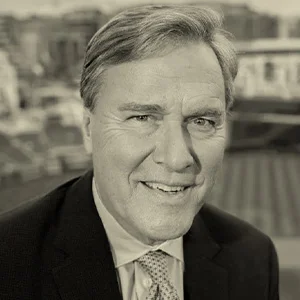
Sportscaster, Washington Nationals Play-by-play Announcer
Listen to sportscaster Bob Carpenter reflect on his 42-year MLB career, iconic “See! You! Later!” call, and broadcasting roots with the Tulsa Roughnecks.
Bob Carpenter was the television play-by-play announcer for the Washington Nationals for 20 seasons from 2006 through 2025. His professional broadcast career began in 1976, when he was hired as the play-by-play announcer for the Tulsa Oilers baseball team.
When the Oilers moved to New Orleans, Carpenter remained in Tulsa and became a broadcaster and public relations director for the Tulsa Roughnecks soccer team. He also became sports director at KTUL Channel 8 and KRAV-FM.
In 1984, he began broadcasting St. Louis Cardinals games and later called games for the Texas Rangers, New York Mets, and Minnesota Twins. Beginning in 1988, Bob spent 17 years as a regular ESPN broadcaster, covering college football, college basketball, and Major League Baseball.
He has received many honors, including induction into the Oklahoma Broadcasters Hall of Fame. Washington Nationals fans came to know Carpenter for his distinctive home run call: “See! You! Later!”
Full Interview Transcript
Chapter 1 - Introduction
Bob Carpenter was the television play-by-play announcer for the Washington Nationals for 20 seasons from 2006 through 2025. His professional broadcast career began in 1976, when he was hired as the play-by-play announcer for the Tulsa Oilers baseball team.
When the Oilers moved to New Orleans, Carpenter remained in Tulsa and became a broadcaster and public relations director for the Tulsa Roughnecks soccer team. He also became sports director at KTUL Channel 8 and KRAV-FM.
In 1984, he began broadcasting St. Louis Cardinals games and later called games for the Texas Rangers, New York Mets, and Minnesota Twins. Beginning in 1988, Bob spent 17 years as a regular ESPN broadcaster, covering college football, college basketball, and Major League Baseball.
He has received many honors, including induction into the Oklahoma Broadcasters Hall of Fame. Washington Nationals fans came to know Carpenter for his distinctive home run call: “See! You! Later!”
Listen to Bob talk about his first radio play-by-play, the Tulsa Roughnecks, and Scorebook Bob on the podcast and website: VoicesOfOklahoma.com.
Chapter 2 - The Carpenter Name
John Erling (JE): Well, my name is John Erling, and today's date is July 8th, 2026. So Bob, would you state your full name, please?
Bob Carpenter (BC): Bob Carpenter.
JE: You have a middle name.
BC: Well, I'm actually Robert Franklin, named after my dad.
JE: OK.
BC: So, Robert Franklin Carpenter, March 4th, 1953. That's a long time ago.
JE: That was your birthday and your present age is?
BC: 73.
JE: And we are recording these in the facilities of Voices of Oklahoma here in Tulsa. Is there a significance to the name Carpenter? Is there a story behind that?
BC: Yeah, my family is actually, I'm half Italian. And that side of the family, the original name was Carpentari, T-A-R-I. They were from Northern Italy. They came over to Chicago in the early 1900s and evidently back at that time, there was a lot of prejudice and maybe some racism, if you would call it that, toward some of the Italian immigrant families. I know I've got friends in St Louis where I grew up, who have relayed these stories to me about their families. And a lot of the families, at least a number of them, Americanized the names. So they took Carpentari and made it into Carpenter, which is pretty generic, I would think.
And John, during the Depression years, some of those Italian families migrated down towards Southern Illinois because the steady work at that time was in the coal mines, and there are numerous coal mines right across the river from St Louis, East St Louis, Belleville, Collinsville, that area in what is Southern Illinois. The Italian families, a lot of them settled in a little town called Collinsville, which, as the crow flies, is about 10 miles east of the Gateway Arch, and that's where my mom and dad grew up.
And, when they were dating, my mom told my dad, "I'm not gonna marry you until you get out of the coal mine." My dad went over to St Louis, trained as a welder, became a welder on the river down there. He worked at a company called St Louis Shipbuilding and Steel. And became a welder. My mom married him. I have 2 older sisters who were born on the Illinois side. My younger sister and I were born on the St Louis side.
And fast forward about 18 years, my dad made me work in the shipyard. Two different summers while I was in college. And you talk about a life lesson. I never wanted to go back to school so bad in my life. I think it instilled a work ethic in me and it also instilled a value of the education I was getting because I was getting interested in broadcasting at that time. So I spent two miserable summers in the St Louis heat down on the Mississippi River in that shipyard, and those are two summers I will never forget. Guys my age that I was working with, that was their career. It was my summer job. So, that's a long elongated story about how Carpentari became Carpenter.
JE: So—you, where were you born?
BC: In St Louis.
JE: And let's talk about your mother's name—her maiden name—and where she was born and grew up.
BC: My mom's maiden name was Davies. That part of the family is from Wales, a little town evidently in Wales called Newtown. My younger sister Mary has always been interested in the genealogy of our family. And she has actually traveled to Wales and made contact with some relatives there. The interesting about it though, my mom's mom's maiden name was Perona. And so that's Italian. So I'm 1/4 Italian on each side of the family, making me half Italian, 1/4 Welsh, and 1/4 German.
And it's, this is so Tulsa, this story. Not long after I moved here, I was living down in Brookside and I went to the cleaners down there, old place called Dunwell Cleaners. And I went in there and there was an older lady with her name tag on. Her last name was Perona. And we got to talking and we found out that her husband was my dad's cousin. And in 1964, when I was 11 years old, we were visiting my sister and her husband down in Waco, Texas. He was in the Air Force down there. On our way back, we stopped through Tulsa. To spend one night with these relatives. And what was it? About 13 years later, I'm in Tulsa. Working for the Tulsa Oilers baseball team, my first job here, and I run into the wife of my dad's distant cousin. And so that's the Perona side of the family.
JE: Wow. How about that? That is a great story. So then she grew up in what area? Where did she grow up? In St Louis?
BC: Collinsville, Illinois. OK, yeah. And then to make the story even more bizarre: years later, we have two daughters; Deb and I had Katie and Allison. And a babysitter got referred to us.
And, in the meantime, I had gotten, kind of forgotten about the whole Perona connection. And so we meet this young lady and her name is Jennifer Suber, and she's engaged to marry a guy named John Perona. He is the grandson of my dad's distant cousin, and she babysat our kids. She and my wife are friends to this day, and this whole Carpentari-Perona thing kind of came full circle.
JE: Yes, yes. What was your mother's personality like? What kind of a person?
BC: She was very outgoing, and my dad was a really happy, not a happy go lucky guy, but a hardworking guy. I mean, when you work 40 years in the shipyard, you're kind of a hardworking guy, and he became one of the lead men down there, one of the foremen down there. And my mom was—we got to see her at kind of the latter stage because I had two sisters that were older. Judy, who later worked for the Cardinals, was 9 years older than me, and Kathy, 10 years older. So I have two sisters in their 80s. They're both doing great. And I have a younger sister, Mary, who's 1.5 years younger than me. So, we had a 9-year gap. So, the big joke in the family was by the time myself and then Mary came along, mom was kind of tired, she had raised two girls and evidently just did a wonderful job taking them to museums and different things around the St Louis area.
We lived real close to the St Louis Botanical Gardens on the edge of the hill, which is the Italian neighborhood in St Louis where Yogi Berra and Joe Garagiola are from. Their houses are about 8 blocks from where I grew up. And so I don't think I got to see my mom at her best because she was well into her forties when I was born and then Mary was born and as was my dad. And my mom passed away, I think it was in '91. She had a heart issue. She also had some cancer stuff going on. My dad passed away on my birthday in '96 from stomach cancer, and we later found out a lot of that was due to the asbestos that was flying around in that shipyard. So I think I was pretty grateful that I only spent two summers down there; but they were fun, loving people. I don't remember them being the toughest disciplinarians or the most loving parents in the world to wrap their arms around you and say, "Hey, Bobby, I love you." I really don't remember those times, but I had a great relationship with my dad.
And I was very happy that he got to see me work for the Cardinals in the major leagues because Stan Musial was his guy growing up. And he first took me to Busch Stadium for a baseball game in the late 50s. I was probably 6 or 7 years old. And I got to see Stan Musial play. He was, I was 10 years old when Stan retired. And I distinctly remember seeing him hit a couple of home runs up onto that pavilion roof at that old ballpark up in North St Louis.
So, John, I grew up in a strictly middle class neighborhood. We were raised in a three-story row house that my parents rented from the Catholic parish where we went because the convent was next door. The priests had lived in my house. They moved up the street. There was a new church built up there in 1957, a new rectory for the priests across the alley. So I grew up in that three-story row house next door to the nuns. My backyard was the playground of the school. The school was across the alley, and there was another playground on the other side of the school. So when I got to be of age where I was singing in the choir and serving mass, and if somebody didn't show up to serve mass at 7 o'clock in the morning, one of the nuns would come running over to the house, knocking on our back door and telling my mom to get Bobby out of bed because we needed a server boy down the street.
So that's -- and we played ball. There was a public park across the street called Tower Grove Park. We played ball, whether it was baseball, football, soccer, basketball on the playground. We played ball every day, every night until Mom called us home for dinner. And I didn't realize it at the time, but that was a pretty cool place to spend as a kid, loving the Cardinals. We had the football Cardinals, and then we got the Blues. They were an NHL expansion team when I was 13 years old in 1966. Suddenly we had hockey and the whole town went crazy about hockey. So I guess a lot of my love of sports go back to that neighborhood on the edge of the hill in South St Louis because all we did was play ball and ride our bikes.
JE: Your father's name?
BC: Franklin William. His first, his dad's name was William, and it was my understanding… he was kind of a community leader over in Collinsville.
And it's my understanding that during the Depression, when some of the Italian families were really struggling, my grandfather, who I never met—he was gone before I was born on both sides of the family, I never met my grandpas—but I heard stories about him that he went to the local banks and went to the mayor's office, and he did whatever he could to help those families keep their homes because a lot of people were facing that during that time. The men were working their rear ends off in those coal mines, 10 hours a day coming home covered with soot. And they were still -- some of those families were still in danger of losing their homes, and evidently my grandfather was a guy in the community who made a real difference in Collinsville helping out those families, and I think we're all pretty proud of that.
JE: Absolutely.
Chapter 3 - First Play-by-Play
John Erling (JE): Your education. Where did you first go to grade school?
Bob Carpenter (BC): It was called Holy Innocents, I-N-N-O-C-E-N-T-S. That parish was named after the babies that Herod killed looking for Jesus—when Jesus, remember that story in the Bible? Where Herod had all the boys in Bethlehem, that area, he had those babies killed because he was after the baby Jesus after everything that had happened, and those babies were called the Holy Innocents. And that was the parish I grew up in. Went to kindergarten through 8th grade there, walked 100 feet across the playground into the side door of the school, and that's where I grew up.
I later went to McBride High School, which was a Catholic all-boys high school in St Louis that was known for pretty good academics. You had to have good grades in 7th, 8th grade to get in there. I had 4 years there. I played basketball there. Went out for the baseball team, got cut, played basketball for a couple of years. My big claim to fame was I was a pretty good gym hockey player because we had all gone crazy about hockey. In a hockey game, intramurals, I scored 8 goals against the homeroom of my math teacher, and I failed math that semester. I think I probably deserved to fail, but it was a great old place up on North Kings Highway up in North St Louis, and the neighborhood was deteriorating. It was getting a little dangerous up there. For 4 years, I rode the city bus, about a 20-minute ride straight north from my house up to McBride High School.
And to this day, I'm still really close to about 4 or 5 of the guys I graduated with. Several of them are still in St Louis. One's up in Illinois. But we were in each other's weddings and great friends over the years. And in fact, 2 of them come down here every year to play in a charity golf tournament that Debbie and I help out Operation Hope with. And they stay an extra day and we play a little more golf. So that was a great high school experience. Going to an all-boys school, you can imagine how crazy at times that was.
And then I went to the University of Missouri, St Louis for 2.5 years, trying to decide what I was gonna do with my life and my career. I got interested in broadcasting. The University of Missouri in Columbia had a great journalism school and still does. The size of that J-school kind of scared me off a little bit. There were like over 500 kids in that school at that time, and I heard you couldn't even dream about getting on the air until you were a senior. So then I heard about UMKC, University of Missouri, Kansas City. And they had a smaller radio, TV, film department, had about 75 kids in it. Long story short, I transferred up there for the winter semester in 1974 after 2.5 years in St Louis in college. Had a great two years in Kansas City. I got to work on local radio stations almost immediately.
And here's a weird twist to the whole thing. UMKC was pretty much a commuter school. It's much more different now. It has big dorms. They had one dorm. Transferring up there over the Christmas holidays, I couldn't get into the dorm. They had no openings. There was a Jesuit school, Catholic school across the street called Rockhurst College, which is now called Rockhurst University. They took all the overflow from UMKC and I lived in their dorm. So I lived in a different dorm than the school I was going, but they were literally, the campuses were right across the street from each other. And it was at Rockhurst where I first got on the air as a disc jockey.
And then I saw they had a basketball team, they had a soccer team, they had a baseball team. They were an NAIA school. UMKC was like Division 3. They didn't have that many teams. So I went to the manager of the radio station. I said, "Hey, has anybody ever broadcast any of the teams that you have on campus?" And he's like, "No, what are you thinking?" And again, long story short, the radio station was in the basement of one of the dorms that was right next to the baseball field. The soccer field was right next to the baseball field. We would literally plug a cable into the board at the radio station, run hundreds of feet of that cable across the baseball field up the bleachers, and I would sit in the top row of the bleachers with a clipboard. I didn't even have an earpiece. I didn't know if you're on the air or not. I just assumed a handheld microphone, and that's how I announced my first sporting events was doing soccer at Rockhurst College.
JE: That's great.
BC: And then later, soccer would get me on ESPN. It got me the job with the Roughnecks. And I ultimately did two World Cups for ESPN, which is kind of appropriate because we're recording this at the time of the year when the World Cup's being played. But that's how I got started in play by play, was at Rockhurst College, a school I wasn't even attending.
JE: But you said you got interested in broadcasting. What was that? How was that sparked?
BC: I can answer that very directly. When I was 14 years old in 1967, my sister Judy got a job with the Cardinals in St Louis. She was the secretary of group sales. All of a sudden, we had two tickets for every home game. I wore that ballpark out. Whenever it was allowed by mom and dad, and a lot of times it was with my little sister Mary—we would take the public bus downtown from our neighborhood down to the ballpark, down to, they were in the downtown stadium by then. They had moved in in 1966. A year later, Judy gets that job.
And I'll tell you, John, I just went crazy over baseball. Judy always had some duties that she would have to wrap up when the game was over. I'd go stand out in the lobby by the elevator where the players came up from the clubhouses downstairs to exit the stadium. Every night I would see Kenny Boyer walk out of there, one of my heroes. He was the MVP of the World Series in 1964 when the Cardinals beat the Yankees. I got to meet Lou Brock. Bob Gibson was on that team, and the Cardinals won the pennant in '67, Judy's first year. They beat the Red Sox in the World Series.
The next year, they won the pennant again. Lost game seven at home to the Tigers in the 1968 World Series. I was in the stands that day with a girl from Xavier High School that I was trying to impress. I took her to a World Series game. It was one of our first dates, and we lost. I couldn't believe it. I was like, "There's no way—we got Bob Gibson pitching today." This big old portly left-hander of the Tigers, a guy named Mickey Lolich, he beat the Cardinals 3 games in that series. He beat Bob Gibson that day. It was a heartbreaker.
And then in 1969, when I was 16, I could get a job at the ballpark. You had to be 16 to work there. I got a job as an usher. I could sometimes see the game and sometimes I couldn't. But on my break, I would go up on the ramp in center field where I could see the whole field in front of me. And I'd probably be leaning up against one of those pillars, and there were no seats up there. They were all down below, but people would be walking by. And John, up on that ramp, I pretended I was Jack Buck announcing the Cardinal games, and that's when I first started doing play by play. I was 16, wearing my silly-looking Andy Frain—usher's outfit with the funny cap on, the white shirt, the black tie, the blue pants with the yellow and the red stripe on the side, and my clip-on tie. And that's where I first started doing play by play, was up on that ramp watching the Cardinals.
JE: Back then, in your mind, you were doing play by play?
BC: Yeah, some—now, if I would do it out loud a little bit, but if I saw people coming, then I would shut up and I'm just kind of doing it to myself. But I think our break lasted 20 minutes. I would make good use of that 20 minutes.
And it's funny the little things you remember. Up on the very top level of the stadium, it was called the Upper Terrace. There was a concession stand up there, and we made $11.80 a night for ushering the ballgame. So I think it came out to like $2.75 an hour, something like that. There was a lady up there who loved all the young people who worked at the ballpark. So if you're on your break and you got a soda and a hot dog, well, there goes like $3 out of your $11 that you're making that night. And so there was this wonderful lady up on the top level, and if you would go there in your usher's outfit and order a hot dog and a soda, she would give you the soda, and then she would put two hot dogs in the bun. So we got to eat 2 hot dogs for the price of 1, thanks to that wonderful old lady. I don't know what her name was. I just remember that.
It was interesting because one night your assignment might be the men's room. We were supposed to follow people in there, and then just kind of walk out. They had some vandalism in some of the rooms. So one night you might be working there and the next night you might be working down on the field, like in the bullpen where the players were.
I ushered at Busch Stadium all through high school, all through college, along with that summer job at the shipyard. So I ended up ushering in the ballpark for seven seasons—from 1969 up until 1975 or so. And by that time I was graduating from college and I was too old—you can't be ushering in the ballpark making that kind of money. So that's where the whole baseball thing kind of took root for me, and the rest of broadcasting really kind of along with it.
JE: Absolutely.
Chapter 4 - First Radio Play-by-Play
John Erling (JE): So then, what after you graduate? Your first job then, after you graduate?
Bob Carpenter (BC): Jonesboro, Arkansas. KASU radio on the campus of Arkansas State University. One of the high school buddies that I referenced, his name was Bill Clutho. We played baseball, softball, basketball together. But he and I were interested in music. He was a piano player. I was a guitar player. We were both self-taught. I was in a little—we called them Beatle bands. People would call it now a garage band. We called them Beatle bands because we had 2 guitarists, a bass, and a drummer. I started doing that when I was 13 years old and pretty much taught myself how to play guitar. I don't read music, except when I was in high school and college, I played French horn, and I could read music doing that. But Bill and I were interested in music, so we would play together. We actually wrote some songs together that are probably lost in the sands of time somewhere.
But we were also interested in broadcasting. He wanted to be, I think, more of a disc jockey. I wanted to do the sports thing. Well, he goes to Arkansas State out of high school on a baseball scholarship because he was a really good pitcher. So he gets a scholarship offer and goes to Jonesboro for 4 years. He's down there working on the radio station. And he called me when I was getting ready to graduate in December of '75 and said, "Hey, we got an opening for a news director at the radio station." It was an FM station, NPR, just like KWGS over at TU, an NPR local station. He said, "I told my GM about you, that you're just about to get out of school," and I think he probably made up a few things about how experienced I was. He said, "Why don't you come down here?"
I took a Greyhound bus from St Louis to Jonesboro, Arkansas, spent the night with him, interviewed for the job, took the bus back to St Louis the next day. About a week later, they called and offered me the job. So it was Christmas of 1975. I had just graduated from UMKC. Within 2 weeks, I had a job lined up. I needed a car. I didn't have a car. My dad found a 1974 Buick Skylark with no air conditioning. I think he paid like 700 bucks for that car. I drove it to Jonesboro, Arkansas and started my first job right after New Year's in 1976.
JE: All right, how did you think you could be a news director when you really didn't have any news background?
BC: It was a one-man news department. I had read some news on the campus station. We had taken production classes at UMKC. I had a wonderful production guy there. I had two great professors—an older gentleman, the quintessential professor with the full beard, the gray hair, smoking his pipe. His name was Gaylord Maher. He taught all of the history courses in terms of the history of broadcasting, how radio got started, all that stuff, which is really fascinating to me. The other guy who taught all the production classes was kind of a loose cannon, really fun, crazy guy named Bob Musburger, who's still with us. He was a cousin of Brent Musburger, the great broadcaster at CBS, later ESPN and ABC. So I had those two guys that kind of guided me through those last two years. I don't know what they saw in me, but it seemed to me that they gave me some opportunities that they didn't give other people there. I mean, I was 250 miles away from home, just glad to be pursuing what I was, and I was willing to do anything.
And there's a crazy example of that, John. There was one year, in my 2nd semester junior, 1st semester senior, when I worked at a radio station, KBEA in Mission, Kansas. That shift was from 1:00 till 8:00 a.m. on Saturday morning. And I'm in the dorm at 8 o'clock Friday night trying to sleep before I go over there. A buddy in college let me use his car to go over to KBEA every Friday night. I would do rip and read news, spin records, everything a disc jockey does on those, take a few phone calls. I got to know an older lady over in Kansas City named Francis, who became my biggest fan. She would call me, we'd be on the phone for half an hour talking. I'm like, "Francis, I got to put a record on. Hold on." And then I would drive back into Kansas City. It was about a 20-minute trip over to Mission. I'd go up through the drive-through at McDonald's, grab an Egg McMuffin, get back to campus, and then I was on the air from 9 to 12 at KCUR, which was the UMKC NPR station—which helped me later because I knew all about NPR when I got to Arkansas—but I would work that shift from 9 to 12. And if there was a soccer game that afternoon, I was up on the bleachers doing the soccer game, or in the spring, a baseball game. And then I would probably get to sleep about 4 o'clock on Saturday afternoon, and nobody saw hide nor hair of me until about noon on Sunday. So I did that for the better part of a year.
You know, John, those are the things you do when you're kind of crazy about what you're doing. The job in Mission paid $2.50 an hour. KCUR—$2.50 an hour. And, you know, so I had a little pocket change here and there, but I didn't really have time for a social life because I was chasing this broadcast thing.
JE: You are passionate for sure, and it's that passion that drives you on and you'll do anything. You weren't working for money. You were working because it was fun.
BC: I know—eventually, when I met my wife Debbie, she was making more money than I was, so I don't know how good I looked on paper, but it was probably not real strong.
JE: When did you meet Debbie?
BC: I met her here in January of '77 after I got to Tulsa. So I was in Jonesboro, and after about five months there, I got a call from A. Ray Smith, the owner of the Tulsa Oilers. Now, this is not the previous ballpark that was right on the corner of 15th and Yale. This was the ballpark before that. That's over by where the Tulsa County Health Department is. It's a parking lot now, and where the batter's box was is painted on the parking lot there of Old Oiler Park.
I got a call from A. Ray, over in Jonesboro. He said, "Bing Divine from the Cardinals called me." I had received 35 rejection letters from minor league teams all over the country. I had sent out resume tapes my senior year in college—before I got the job in Jonesboro—and I sent, I think, 35 to 40 resumes, the old little 5-inch reels, with about 15, 20 minutes of play by play on them. I had edited those myself back in the days when we had the razor blade and you would cut the tape and tape it together. Got some really nice rejection letters, very kind. And I still have those. I pull them out every once in a while to look at them.
JE: So, you sent to 35 minor league teams?
BC: And the one response I got was from the Tulsa Oilers. But Bing Divine, the great Cardinals GM in St Louis, was my sister's boss by then, and he placed a call to A. Ray. He said, "Hey, I don't know if you have anything." I've heard this guy—when I used to go to St Louis on weekends and do my, record my resume tapes, Bing Divine came in the booth one day and listened to me. I guess he liked what he heard, and he told A. Ray, "I don't know if you have any jobs open, but I think this kid's got a chance to be pretty good." So I was only 5 months, 6 months out of school.
A. Ray called me, said, "Hey, can you come over to Tulsa this weekend?" Well, I got off the air at 4 o'clock in the afternoon on Friday. This is Memorial weekend, and this is the middle of May in '76. I drove—it's like 6 hours from Jonesboro over here because Jonesboro is over by Memphis, way over in Northeast Arkansas. I drove over here, spent the night at the Saratoga Motor Hotel on 11th Street right by 169, which I think under a different name still stands to this day. A. Ray owned that hotel, and that's where all the visiting teams stayed when they came in to play the Oilers.
I went to his trailer outside the 3rd base line of Oiler Park the next morning and met with him, and he said, "I've heard your tape." He said, "But I want to hear you live on the air." He said, "Can you go on the air tonight for a couple of innings?" I said, "Sure." The Oilers were home. Their number one radio announcer was a guy about 3 or 4 years older than me. His name was Terry Greene. Terry's from Springfield, Missouri. I don't know if you ever noticed this, when you drive through Springfield, you're in Greene County. His dad was a judge, his grandfather was a judge, and his great-grandfather was a judge, and that county was named after his great-grandfather, Greene County of Missouri.
So anyway, Terry was the guy. A. Ray put me on the air with him for about 3 innings that night. Terry and I had a great rapport. We were both Missouri boys, and all that. I said, "Hey, man, I'm not here to get your job. I'm just trying to get a job." I hope I'm just trying to have fun with this. I hope you don't think I'm pulling anything here, and he said, "No, no, we're good." Well, he took me out after the game, we hung out for a while.
So, the plan was I was gonna go back in and see A. Ray Sunday morning and then drive back to Jonesboro. A. Ray says, "You know, I heard you last night, but I'd really like to hear you again. Can you go on the air today?" I'm here, sure, it's fine. Well, what I didn't know was, at that time of the year, the Oilers had started playing their games on Sunday night, not because it was getting hot. So I had to wait till 7 o'clock. He put me on the air for about 3 innings. He called me down to his little private suite and said, "Hey, I know you have to get back to Arkansas. I really like what I hear. I'll give you a call sometime this week."
I got into Jonesboro at 3:30 in the morning. I was on the air at 7. Did that week. A. Ray asked me to come back the following week and do the same thing again, go on the air Saturday night and Sunday night. I did it again, and then finally, after that, he offered me a job. My first weekend here was Memorial weekend 1976.
JE: How old were you?
BC: 23.
JE: Wow.
BC: I thought I was hot stuff, John. I'm 6 months out of college. I got a AAA baseball job, but A. Ray didn't have it in the budget to pay me. You may remember this name. There was a wonderful guy—his name was Pat DeLozier. Pat was one of the top sales guys at KVOO back then, who was competing—KVOO, KRMG, man, those AM radio stations, with all your great years there at 740 on the dial. Pat got hired by a company to be the general manager at KKUL, 103.3 here in Tulsa. It was a soul station. Well, it got bought by a group, and they were gonna make it a rock station. So Pat took over. He became the GM. A. Ray called Pat, said, "Hey, I got this kid who needs a job. Can you hire him as a salesman?" I knew nothing about radio advertising. So anyway, I sold ads during the day, went to the ballpark at night for a hot dog and a Coke, and that's how I got started in baseball in 1976.
And then I met Debbie about six months after that. But the interesting thing was, John, the stadium was falling apart and I didn't know it. You might remember that stadium had to be condemned. The Oilers—A. Ray tried and tried to get a new stadium deal, and he couldn't get one. The Oilers left town, went to New Orleans. I was making $800 a month selling radio advertising. A. Ray offered me $600 to go to New Orleans. I didn't think I could afford to live in New Orleans on $600 a month, and I didn't go. Three months after I made that decision, I met my wife in Tulsa. So, you know, the House of the Rising Sun is always playing in the back of my mind. I'm wondering what would have happened to the poor boy had he gone to New Orleans, but I stayed in Tulsa, and for me, the rest has kind of been history around here.
Chapter 5 - Tulsa Roughnecks
John Erling (JE): So 1976 and 1977, you were with the Oilers?
Bob Carpenter (BC): And then they left town after the 1976 season. In 1977, I got a better sales job. I know you know this station because it was your sister station for a while, Queen '95, KWEN. A guy named Ron Curtis came in from Arkansas and bought the station. I was in sales for a year with them. I was doing Sapulpa High School basketball and football whenever I could. My old friend, the late Wayne McCombs, who passed away a couple of years ago—probably my closest friend I've ever had in Tulsa—I met him in the press box at Oiler Park, and he got me hooked up with KXOJ in Sapulpa. I did that in '77 and '78.
And then in March of '78, here come the Tulsa Roughnecks. And I walked into Noel Lemon and Tom Keeter's office, the GM and the owner. They didn't know me. I didn't know them. I walked in and just asked the receptionist if I could get a few minutes with the GM. I had heard the games are going to be on Channel 8 and on KRMG. And I didn't know if they had an announcer or not. I walked in, I walked out an hour later with a job as the Nationals—director of public relations, play by play. I had my tapes with me, play by play guy on TV or on radio on KRMG, and I was going to be the expert analyst on the games on Channel 8, who had Chris Lincoln at that time. Chris knew nothing about soccer. He leaned on me a lot before he kind of picked up the game, and we went on from there. And Chris and I did those games on TV together for five or six years, and I did the Roughnecks from '78 until about '83, '84.
And that's how I got started in professional soccer. But you know what, I don't get that job unless I had those soccer tapes from Rockhurst College sitting on top of those bleachers. And they hired me on the spot, and I got hired one month before we played our first game. The Roughnecks started in April of '84, and off we went. Or '78—I mean, '84 is my first Cardinals job.
JE: Was that Noel Lemon?
BC: Noel Lemon was the GM.
JE: And he hired you.
BC: He hired me. Tom Keeter of Rainbow Bread fame was the local owner. The team was actually owned by the Lay's family down in Texas—Lay's potato chips and all that. H. Ward Lay, a really nice gentleman, owned the company. They owned the soccer team, and that team was in Hawaii before they came to Tulsa. It was called Team Hawaii. The one player among others that they brought with them from Team Hawaii was a crazy guy from Scotland who would become one of my best friends, named Charlie Mitchell. I know you remember Charlie. Charlie was the heart and soul of that team. He later coached the Roughnecks, and he was a hard-nosed defender on that team.
I went all over Northeast Oklahoma with Charlie and a couple of the other guys, we did clinics. We went to all the grade schools, the community centers. We were doing clinics from here to Muskogee and every point in between. And that's how we really took soccer to the people here in Tulsa in '78.
JE: Tulsa really embraced the soccer team for sure. 1983 championship, they defeated Toronto Blizzard?
BC: In Vancouver, in front of about 40,000 people. That was the Soccer Bowl championship. I actually got to do the game on national TV. Anheuser-Busch, which was always big into soccer, and I was already doing some other work for them—they had a national network, and I did a lot of games for them. Debbie went with me. We turned it into kind of a traveling vacation up to the Vancouver, Seattle area. The Roughnecks beat the Toronto Blizzard.
Terry Hennessey was the coach who had taken out—he was Charlie's assistant when Charlie got fired by Noel, which was really not—Noel was not nice to Charlie on that deal, and it really upset me. Terry Hennessey coached that team; Billy Caskey and Victor Moreland, the Northern Ireland connection, they were on that team. They won the Soccer Bowl, and it was wonderful—we had a big reception downtown on the green, right by the BOK Tower. And John, within a year or two after that, the NASL folded. They just couldn't make it financially. So the Roughnecks were one of the last champions of that league.
JE: But in 1980—we had, they played the New York Cosmos.
BC: It was in the 1979 playoffs. The Roughnecks had beaten the Minnesota Kicks, who were our nemesis. They knocked us out in 1978 up in Minneapolis, Saint Paul. In '79, we faced the Minnesota Kicks again. And the game went overtime at Metropolitan Stadium, that old stadium up there where the Vikings and the Twins used to play. And a Roughnecks defender by the name of David Nish scored on a free kick in overtime, and the Roughnecks knocked the Minnesota Kicks out of the playoffs. We had beaten them in Tulsa and then beat them up there.
So next, here come the Cosmos. Game 1 was in Tulsa. Games 2 and 3 were going to be in New York. The Roughnecks—in what I think is the—I know they won the championship four years later. But that August night in '79, we beat the Cosmos 3-0. There were probably over 30,000 people at Skelly Stadium. The place went absolutely crazy. Alan Woodward assisted on the greatest Roughnecks goal I had ever seen. I'm trying to remember who finished it off. It'll come to me in a minute.
Woody, who later went on to work for American Airlines here in the maintenance department—and I told Woody, "You work in maintenance at American Airlines? I'm never flying American again out of Tulsa"—but that was just a little aside. Woody went flying down the right wing, made a beautiful cross, and at the top of the penalty area, our center—it'll come to me—he nodded it to the far post. It was the most beautiful, wonderful goal I had ever seen the Roughnecks score. They would score 2 more goals and beat the Cosmos.
Well, then we went up to New York. We got their attention, and in front of 70,000 people, they beat the Roughnecks. And then the NASL had this ridiculous thing called the mini game after that same night, which would decide it, and the Cosmos beat us in that. We got knocked out. But that August evening in 1979, to me, was the zenith of soccer in Tulsa, because we finally beat the mighty Cosmos, with Giorgio Chinaglia, Franz Beckenbauer, Carlos Alberto—all those international stars. They had 30,000 people at Skelly Stadium for a soccer game, of all things, and it was just unbelievable.
JE: And I was there. I was there. I'm sure you were. I consider that—when—Nolan Richardson and TU won the NIT—that's two of the zenith moments in the history of Tulsa. I don't know that the city has earned that kind of status before.
BC: Because TU made it. I think they won the NIT one other time, but TU basketball arrived on the national scene because that year—I was doing their games on TV for Tulsa Cable after I got fired by Channel 8, which is a whole other story. Nolan came in. He brought 5 of his guys from Texas Western Junior College with him. Paul Pressy was one of those guys, an amazing defensive player who later played in the NBA. They beat Louisville in overtime on a buzzer beater at the Assembly Center, because they were playing their games downtown that year. And then they had the magical run and went up to Syracuse, or went up to New York—I think Syracuse is one of the teams they beat—and they won the thing at Madison Square Garden. And you're right, that whole thing—that's when Tulsa basketball reached some unbelievable heights from where it had been before that.
JE: I remember the—we had that rally downtown on Bartlett Square, and I was there doing a live noontime show, 41 Live, KGCT TV Channel 41, and storefront studio in the main mall. And so that was a very, very memorable time. And Nolan Richardson was such a great guy.
BC: I remember interviewing Nolan as they were making that stretch. They were winning those games and getting ready to go to New York. Channel 8 sent me into his office to do a one-on-one interview with him. I remember he was at his desk. We had microphones set up on the desk. I was on the other side, and our cameraman framed it beautifully. Nolan sitting there, and right behind him on the wall was a sign that said, "One way, my way." And that's the kind of strong personality Nolan was.
And I asked him, during that interview, "Tell me more about this—one way, my way—thing." And he talked about—you're winning, you're trying to win, but you're also trying to teach young men how to be men and how to be winners. And he looked at me and he said, "There's one rule around here, Bob. I am the judge, and I am the jury." And that, in a nutshell, is Nolan Richardson.
JE: Why did the Roughnecks disappear and dissolve? What happened?
BC: It was a league-wide thing. The Roughnecks—during the summer, we still had, we had the Drillers. The Oilers were gone by then. As I said, they moved on to New Orleans, and that's a team that ended up in Louisville, Kentucky, setting all the minor league attendance records. But then the Drillers came a couple of years later. They played in a makeshift ballpark until they built Sutton Stadium right there at 15th and Yale.
Noel used to pound into our heads constantly, "We're the only major league sport in Oklahoma. We're the only major league sport in Oklahoma," which was kind of true if you consider the NASL major league. I mean, there was no other soccer league at that time. To a certain extent, we were the only game in town. The Green Country Soccer Association had thousands of kids playing soccer. Broken Arrow was the big hotbed. I think Bixby followed, Muskogee—hundreds of kids playing soccer down there.
So I think the Roughnecks, John, on a local level, really appealed to the kids, because they could look up to Billy and Victor and Charlie Mitchell and Alex Skotarek and all the other guys the Roughnecks had. Even though we didn't really have any local players on the Roughnecks, some of them made Tulsa their home eventually—most notably Victor, who's still here. Woody passed away a few years ago. But Alex has been around here forever.
But I think the Roughnecks, John, connected on a local level with this community—not only the kids, but the parents, because somebody's got to bring the kids to the game, and that's what happened. So because of that, the Roughnecks were drawing better crowds. We'd go to New York, and the Cosmos were the Cosmos, they were on another level, but we'd go to Philadelphia—the Philadelphia Fury, they're playing in the Eagles' Phillies stadium, and they're drawing 8,000 people. We'd go to Fort Lauderdale, the Strikers were popular, but they were playing in a glorified high school stadium in front of 10,000 people. Tampa Bay Rowdies were the other really good franchise. They were drawing 20,000 or so a game down in Tampa.
But really, from a crowd standpoint, it was kind of like the Cosmos, the Rowdies, and the Roughnecks. And the rest of the league—I mean, we went to LA, the LA Aztecs were playing in the Rose Bowl, and there were 7,000 people there. It was just so incongruous—it just wasn't, it just was weird. They had to play in these big stadiums. So some of the smaller towns did better in soccer than the big markets did. And I think those big markets—the Cosmos couldn't finance the league all on their own. So eventually, I think that's what led to the demise of the NASL.
JE: Well, the Roughnecks players became huge celebrities, and of course Charlie Mitchell had his restaurant.
BC: Charlie had 5 or 6 restaurants.
JE: And I remember his mother there, and she was so sweet and spoke with an accent, an Irish brogue, and—
BC: Well, don't be—that was Scottish.
JE: I mean, I'm gonna say that, and she spoke with a Scottish brogue.
BC: There you go. There you go, yeah.
Charlie was from a little town called Paisley, Scotland, and I just fell in love with that guy, and we had a Roughnecks reunion over at Chapman Stadium, formerly Skelly Stadium. It must have been a 30-year reunion. So, oh my gosh, John, that's been 13 years ago already. But we had a reunion in 2013 in the big reception area up there at the stadium.
Billy and Victor—Billy came back from Ireland. Alex was there. Don Draghi and Paul Turin from St Louis. Paulie was one of our goalkeepers. A whole bunch of the guys came back. And a bunch of them—Charlie was there kind of headlining the whole thing. I kind of co-MCed it with Victor. We had to shut down Victor for a while because the stories were taking way too long and all that. And there was some colorful language, as there always was with the Roughnecks, because off the field, these guys were crazy, fun, and a little bit out of control, but—yeah, it's hard to believe it's been 13 years since we had that 30-year reunion.
JE: It seems like I remember KRMG started raising money to try to save the Roughnecks.
BC: I think so. I think you're right, right.
Chapter 6 - Fired by KTUL
John Erling (JE): And Noel Lemon was such a big name, and he was back and forth, and I kind of enjoyed a relationship with Noel. It was fun. I'd have him on the air a lot.
Bob Carpenter (BC): You know why? You weren't working for Noel Lemon. He could be—and God rest his soul—he could be the biggest charmer. Five minutes later, he could be tearing your head off. Working for Noel for the two years I did in '78 and '79. I went to Channel 8 in 1980. Chris Lincoln got Tom Goodgame to hire me over there as the 3rd or 4th member of their sports staff over there. We had Becky Dixon, Chris was there, and Carl Lakey. But Noel was totally schizo. I don't think he was mentally ill or anything like that. That was just his personality. He worked tirelessly to promote soccer in Tulsa. I give him that, but I'm telling you, John, it was the biggest nightmare of anybody I've ever worked for, but he taught me a lot about putting together games, events, tickets. I mean, I did everything. He had me doing clinics. I was the broadcaster. I did public relations. I had to write and publish the media guide. I was handling group tickets, you name it, Noel had me doing it because we had a really small staff over there. I mean, in 1978, there were probably 5 or 6 of us in the entire front office. We were all expected to do many different things.
But if you're in the local media, or you're an advertiser, he flipped the switch. Here comes the charm. I used to sit back in awe and watch him charm the people that were important to that soccer team. And then 10 minutes later, he and I would be up in the booth and he'd be screaming at me about something. And sometimes it was my fault and sometimes it wasn't.
You remember Les Boyle over at Getty Oil. They were a big sponsor of the Roughnecks. Well, the first time I met Les was on the phone. The receptionist says, "Hey, Bob, Les Boyle from Getty is on line one and he's not happy." And I had heard about this guy. Les was from New York, strong personality, and he just started screaming at me on the phone about all the things that Noel had promised him that the Roughnecks were going to do for them as part of their sponsorship. Guess what? That's the first time I had ever heard about any of those things. And so I said, "Yes, Mr. Boyle, let me look into all of this." I wrote down a list. I marched into Noel's office. I said, "Noel, Les Boyle just ripped my head off. I didn't know about any of this stuff." And Noel just looked at me and says, "Carpenter, get it done." That's kind of the way, you know, I was Carpenter for two years. And so he and I had kind of a love-hate relationship.
And then Tom Keeter was the owner. I know Tom and Noel got into it a couple of times, but Noel could be hard to get along with. And I—quick story—I think it was maybe 1980, the first game. Yeah, because I was still working there. And we were playing our opener in Seattle. We had a new coach. His name was Alan Hinton, who had been a soccer hero over in England. He was on the Manchester United team and was one of the guys that survived the big plane crash over there that killed part of that team. And Alan Hinton was our new head coach.
And it's the morning we're leaving for Seattle for the first game. The game is the next night. And I'm in the office waiting for Alan, because he and I are going to the airport to meet the team. Raised voices through the wall next to me. He and Noel are just going at it like crazy. And I'm like, "This guy hasn't even coached a game yet, and he and the GM hate each other." Oh, you should have heard it, John. All of a sudden the door flies open, he slams the door. "Come on, Bob, let's go." Off to the airport we went. And then, that was Noel. And then we go up to Seattle and we win the game in overtime. And Noel and Alan are hugging after the game. They're on the field hugging each other and everything, and I'm like, "This is the craziest thing I've ever gotten myself to be a part of."
JE: Right? And we should bring in the name Ron Blue of KRMG, because he was right in the middle of all that and had interaction with all the people. Ron was very perceptive of sports and all, and I enjoyed him. He hired me, of course. So that was a good time. It was really a lot of fun.
BC: You were doing—you guys were carrying ORU basketball at that time, and ORU was really a big deal, and Jerry Vaughn was the play-by-play guy.
JE: Right. And Getty Oil about ran our radio station too, and Les Boyle, as a matter of fact. All right, so you're at KTUL for '80, '81, ‘82?
BC: '80 to 1982, roughly—
JE: —a sports director there, were you?
BC: No, they hired me. Chris was still there, Chris Lincoln, and so Tom Goodgame, who I think was the greatest GM of any TV station in the history of this market, he worked for Jimmy Lake, who could be crazy himself. Jimmy Lake was a more subdued version of Noel Lemon, running KTUL and KATV over in Little Rock from his office down in Muskogee. Tom Goodgame brought me aboard. Tom saw my work with the Roughnecks, saw that Chris and I really worked well together. Carl Arkey, another St Louis guy who I'd never met until Carl got to Tulsa. He was the #2 guy, and he was the weekend sports anchor. They basically brought me in as the #3 guy to be a reporter, and they said, you know, you get a chance to anchor some newscasts eventually, which I did.
And then they brought in Becky Dixon to do some features on women's sports and some high school stuff. That was unheard of for any station in this part of the country to have more than 2 sports people, and we had 4. Plus, we had a full-time photographer, Glenn McReynolds, really talented guy who was kind of Chris's right-hand guy, and Glenn went everywhere with us. He might be with Chris over at TU, then he'd get a call on the highway patrol little thing we had in the car, checking in. And he might meet me at Skelly Stadium to do a Roughnecks story. Then he might go meet Carl to do a game, to do a report over at OSU in Stillwater. So Tom Goodgame really put together a powerhouse sports department there at Channel 8.
JE: OK, so then why did you get fired by Channel 8?
BC: Well, a year after I got there, Chris left Channel 8, with Jim Wilburn and Keith Bretts, two of the sales guys at Channel 8, and they formed a company called Winner Communications, which eventually became Winnercom. They had done a lot of horse racing. Channel 8 was carrying quarter horse races and all that stuff. They left, and I think by that time, Todd—Tom Goodgame had left and ended up at KDKA in Pittsburgh, a huge, huge station. Carl had left by then to go to KPRC in Houston, got a good job down there. So he and his wife—another Debbie—Chris, Carl, and I were all married to Debbies, and we were all from Missouri. So, how does that happen?
Chris leaves. Channel 8 promoted me to news director. I lasted less than a year, because as soon as Chris wasn't around anymore to kind of smooth things over for everybody with Mr. Lake down in Muskogee -- Jimmy Lake, I got called on the carpet down there a couple of times. His idea of sports was fishing, hunting, camping, boating, recreational. That was his idea of sports in Northeast Oklahoma. And I tried my damnedest, John, to cover all those things, give them their due, but you still have OU football, you have OSU, TU, ORU, and, to make a long story short, he fired me because I wasn't doing enough fishing and outdoor activities. And I was running rings around -- Bill Tegan's over at Channel 6, and Al Jerkins and Jerry Weber over at Channel 2. Not that I was running rings around them as a sports guy, I was running rings around them as far as covering fishing and hunting and all that stuff. They didn't have to bother with that stuff, and I did. It was driving me crazy.
And to be honest, John, I was devastated. From the day I came to Tulsa, I wanted that sports director's job at Channel 8 whenever Chris decided he didn't want to be there anymore, and I got it. And I only lasted about 9 months in that job, maybe 10. And I got fired from that job.
Within two days of me losing that job, ESPN called me, flew me to Bristol, Connecticut, and put me in the studio with Bob Ley for the 1982 World Cup. The games were coming over from Spain, and Bob Ley and I did the games. He was play by play. I was the analyst. Within a couple of weeks after that, Carl Smith called me from KRAV, 96.5 FM. They put me on there with the morning and afternoon sports reports.
And then that fall, George Stewart, who had been my sports director at Channel 8, he ends up over at Tulsa Cable with Mark Savage, who is running that show over at 41st and, or 43rd and Sheridan. They called me and said, "Hey, we're gonna start doing TU basketball games, ORU. We're gonna get whatever we can get our hands on from OSU and OU. And we want you to be our play-by-play guy. We're going to pay you $250 a game. You can do as many games as you want, but this is what we're going to do. Nobody else in local cable in the country is doing this right now. What do you think?" I said, "Where do I sign?" And I did that for the next two or three years for Tulsa Cable before I started getting some other breaks and ended up with the Cardinals.
JE: OK, you've thrown me. You said ESPN called you. So I thought maybe that was a full-time job, but it wasn't?
BC: It wasn’t. I had done a few soccer games for them. ESPN was not on the air when I got out of college. I got out in '75. ESPN wasn't born until 1979. And again, Getty Oil—Getty and Anheuser-Busch, they put a lot of corporate money into the establishment of ESPN. So I had done some games for them here and there, and I got a call. My wife happened to be home, and this forceful lady from Bristol, Connecticut, named Ellen Beckwith called. She said, "I'm trying to get a hold of your husband. You tell him he better get an answering machine." I didn't have an answering machine. I never needed one. And Debbie said, "OK, give me your—" so I called Ellen Beckwith back. I got my answering machine. And she hired me for a couple of games here and there. And she asked me to come up for a week and a half to Bristol. And with Bob Ley in the studio, I did the World Cup.
And then that led to some other things with them later. And Ellen Beckwith—this weekend, Debbie and I are going back to DC for the first time since I retired from the Nationals. And the last time I was there, in October, I received an award from the National Press Club as a so-called broadcast legend, which I take tongue-in-cheek, but that's what it says on the coffee cup. Ellen Beckwith was at that dinner with me, and Mike Vetter, one of my producers at ESPN—a friendship that started in 1982. Turns out, later, she would live in Washington DC and became a huge national fan. And her boy Bob, who she hired 40-some years before that to do some soccer games, was the voice of the baseball team up there. So that's how that whole thing happened with ESPN.
JE: So you're sports director at KRAV and play by play for the sports on cable, like you said, but I have here: in 1984 and 1985, St Louis Cardinals TV play by play. So how does that work out when you're at KRAV?
BC: Soccer opened those doors for me. KRAV was willing to let me phone in my sports reports from around the country, wherever I was, because, when Carl Smith—one of the great broadcast executives in the history of Oklahoma, he's in the OAB Hall of Fame and all that, unbelievable guy—to work for him and Tom Goodgame and Sadie Adwan at Channel 8, just people who are legendary in Oklahoma. But, anyway, I told Carl, I said, "Carl, Tulsa Cable, they want me to do all these games. I'm gonna be traveling around." He said, "That's fine. We're gonna send a little audio unit with you that you can hook up to your hotel phone or whatever. Wherever you are around the country, we'll let you phone in your reports, as long as you get them in on time and get them on the air." So I was able to—I was running around like a madman, doing all those things.
Well, then, in 1983, I got contacted by Anheuser-Busch in St Louis to do some indoor soccer, for the St Louis Steamers. They were the major indoor soccer league team that was drawing 20,000 people a game to the old St Louis Arena up there. That got my foot in the door with Anheuser-Busch. And when they signed on a new cable network called Sports Time in 1984, they offered me the Cardinals job, and that's how the Cardinals thing came about. And soccer opened up all those doors for me with ESPN, Anheuser-Busch, and then a couple of years later also with USA Network.
JE: I suppose you were unique. Maybe not that many announcers, sports announcers did soccer, understood soccer, and because you did, they all heard about you. Was that true?
BC: That's got something to do with it, because I grew up in St Louis. South St Louis is a very—it's a series of ethnic neighborhoods. I grew up in the Italian section. Just to the north of us, there was another neighborhood. I don't know why they called it—it was called Dogtown. I don't know why they called it that. That was the Irish part of town. That's where their Catholic church was. All these Catholic parishes were, many of them, different nationalities in different parts of South St Louis. So we were raised on soccer. I started playing soccer in 2nd grade, 3rd grade, and understood the game. That got me the job with the Roughnecks because I had done those games in college. The Roughnecks job helped me to get on with ESPN and USA Network.
And you're right, there were very few soccer announcers around. And I kid Chris Lincoln about it to this day, because I said, "You didn't know crap about soccer until I got a hold of you." He goes, "Hey, you were right." But after about 6 or 8 games, Chris started figuring out—Chris is a smart guy, experienced broadcaster—and he figured out what was going on out there. And we became a pretty good, fun broadcast team for the Roughnecks here.
Chapter 7 - St. Louis Cardinals
John Erling (JE): All right, so was it in 1984 then, Saint Louis Cardinals TV play by play TV.
Bob Carpenter (BC): TV. It was a new cable network. It was called Sports Time. They were gonna do about 50-some games. I was already doing soccer for them, so they kind of rolled that into a new contract. I had never had an agent before. They said, "Do you have somebody that can do a contract for you and we'll look at it?" Well, a great friend of mine was John O'Connor, who later would serve as Oklahoma Attorney General several years ago. John and I and his wife Lucia and Debbie, we've been great friends for a number of years. John drew up my first ever broadcast contract in the spring of 1984. I would end up getting an agent about a year or two after that, and I've had one ever since. I've had two agents in, I don't know, 40 years. That's how I got started with the Cardinals.
And John, opening day in 1984, I'll never forget it. It was at Dodger Stadium. Beautiful, sunny, Southern California afternoon. And the Cardinals were playing the Dodgers. About a half-hour before the game, I'm sitting in the booth contemplating what I'm about to do—my first Major League Baseball game. It suddenly struck me that 2 booths over to the left, about 20 feet away, sat Jack Buck. Next to me in the booth, over there, the Dodgers radio booth—some legendary guys -- Ross Porter, who was an Oklahoma guy, was in that booth. And then maybe 6 feet away from me, on the other side of the wall, sits Vin Scully. I'm 31 years old, a kid from the streets of South Saint Louis, and I'm sitting there looking out over Dodger Stadium, which will have 56,000 people in it by opening pitch. And I'm saying, "Oh my God, what are you doing here?" And I said a little prayer: "Please, please, Lord, don't let me screw this up."
And I guess it went OK. Willie McGee hit a homer. My best friend on the Cardinals at that time, Darryl Porter, their catcher, he hit a home run. Ozzie Smith was on that team. They beat the Dodgers 11 to 7. Beat Fernando Valenzuela on that day, and that was my first day in the big leagues, and it's an afternoon I'll never forget.
JE: Who was with you in the booth?
BC: Mike Shannon, who worked with Jack. When Mike was on TV with me, it was the first 3 innings. For the middle 3 innings, he would go over to radio and work with a guy the Cardinals hired that year named Red Rush, who is an older, established Major League radio announcer. Jack Buck would come over for the middle 3 innings and work with me. So here I am, sitting with my teenage hero broadcaster—because I used to pretend I was Jack up on those ramps at Busch Stadium. Jack's with me for 3 innings. He, of course, takes over and does the play by play, and I'm supposed to be Jack Buck's analyst. What am I going to add to the game when Jack Buck is doing play by play?
But he was good to me. He'd engage me in conversation about things here and there. And I remember one night, the Cardinals were playing the Astros and Nolan Ryan was pitching. And we didn't have radar guns back then. People were estimating how hard a guy's throwing. We were in St Louis, and Jack said—we're talking about how hard this guy throws, and Nolan Ryan, if you dug in too far, he'd throw one right at your left ear and get you out of there like Bob Gibson used to. And Jack said, "Well, Bob, how hard do you think this guy's throwing?" He's kind of testing me a little bit to see what I might say. And I said, "Jack, I don't know for sure because we don't have a radar gun. I'm going to say he's throwing the ball 95 miles an hour." Jack Buck looked at me like I had two heads. Because we had no record of any—Bob Feller, in previous decades with the Cleveland Indians, there were rumors that he could throw high 90s, maybe 100, but nobody knew. Years later, Nolan Ryan was throwing harder than 95. So he probably was throwing 95 in 1984.
Jack, he would ask me certain questions here and there and converse with me on the air, put me to the test a little bit. But that's what I did that first year. I was on the air with Mike Shannon for 6 innings and Jack Buck for 3.
JE: Let me just interject an experience I had, because after I was here at KRMG for about 6 months, I went to KMOX, and I was—
BC: You had only been here that long?
JE: Right. And I went to KMOX, and then I was on in the afternoon. Bob Costas was—
BC: —he was out of Syracuse.
JE: Just out of Syracuse, right. And I'll never forget, Jack Buck was in another studio, and he came all the way over to where I was, extended his hand, and he says, "Welcome. Nice to have you here."
BC: That's Jack.
JE: And I have never forgotten that. How sweet that was.
BC: That was actually the sports director of KMOX, along with his duties with the Cardinals.
JE: Yeah
BC: That's pretty cool.
JE: Yeah, yeah, it is.
BC: I thought you had been here longer before you got that KMOX opportunity, because I remember you telling me you got up there and it just—it just wasn't what—
JE: After two weeks of saying "This is KMOX Saint Louis," it was all gone. I didn't need it anymore.
BC: Well, we were really glad you came back to Tulsa. And John, I don't want to make you uncomfortable, but I moved here in 1976. What year was your last year?
JE: ‘76.
BC: You were my voice of Tulsa for all those years, because I always wanted to be the sports director at KRMG really bad. And one year Jim Beck called me and offered me that job, but I was already doing all this other stuff, and I just couldn't let go of all that TV I was doing. But I just want you to know, from my standpoint—because I'm sure you do this as an announcer, you listen to other voices you hear on the radio or on TV. Certain ones don't grab you, but certain ones just grab you and take you along for the ride, and you were that guy for me. And I just wanna salute you for that, because you were my soundtrack of Tulsa for the first, you know, 30-some years I was here.
JE: Thank you. That's nice of you to say.
Chapter 8 - See You Later
John Erling (JE): OK, "You're handled. See you later," after a home run hit—did that come from Jack?
Bob Carpenter (BC): No, no, it didn't. Actually, that cable network with the Cardinals—I thought I had a job for 3 years. That cable network was supposed to be on the air for 3 years before it turned a profit, and Anheuser-Busch was prepared to lose $20 million in those 3 years to get that thing turned around. Well, guess what? They lost almost all of it in the first year. And right before the baseball season in 1985, they took that cable network off the air. So suddenly, I don't have my Major League Baseball job. The Cardinals let me do a few radio games here and there that year.
And then in 1986, I managed to land a TV job with the Texas Rangers. So I worked for them 1986 to 1989, for those four seasons. That's where "see you later" got started. That team had a lot of home run hitters on it. Pete Incaviglia, who played at OSU—never a day in the minor leagues, went right to the major leagues. We had Larry Parish, a big strong third baseman, hit a lot of homers. Pete O'Brien, a former Tulsa Driller, sweet swing, a lot of home runs. We had 5 or 6 guys on that team who could hit the ball out of the ballpark. And I don't really consciously remember how it got started, but one of those guys would hit a homer and I'd go, "See you later." And the fans seemed to like it. No, nobody else was really saying that. And so I used it for a number of years.
But then in 1988, along with my Rangers job, I went to work for ESPN, and then they got baseball in 1990. Well, I thought it wasn't a good call for network TV, so I never used "see you later" for network TV, but I continued to do it on the Ranger games. And then I did it when I went back to the Cardinals in 1995. Well, at the trading deadline in 1997, Mark McGwire gets traded to the Cardinals from the Oakland Athletics. Mark's hitting home runs that are in the air longer than anything I've ever seen before. He hits some low-line drives out of the ballpark, but his home runs were so high and so majestic—if I said "see you later," that ball would still be halfway to center field or halfway to left field. So the ball was in the air for so long, I was like, "See you later." And by then, the ball was coming down.
And that's how the whole thing evolved, because I had a guy from Anheuser-Busch come up to me, Steve Ule, who I was working for—he was our executive producer—and he said, "Hey, I really like that. Keep doing that. I think that'll catch on with the fans." And I said, "OK, man, whatever I can do to ingratiate myself to the fans—I'm a local boy, I grew up here." And so that's how the whole drawn-out "see you later" thing—and over my 20 years in DC, the fans seemed to really respond to it. And in fact, on that Saturday afternoon last September, when they gave me my retirement ceremony, they called it "See You Later Day" at Nationals Park, and they put out t-shirts. They gave me a crystal microphone on the base that said "See you later." They gave me a big framed jersey. Everything they gave me had "See you later" on it.
[Audio Clip from Bill Carpenter’s Baseball Commentary]
"And look at the contact on this one, deep left center, See! You! Later! RBIs 53, 54. Nothing like it—back-side James Wood homer at 110. And we got a topper."
BC: And so it kind of took on a life of its own.
JE: Didn't they name the booth the Bob Carpenter booth?
BC: I don't think they're actually calling it that, but my name is under the booth. It just says "Bob Carpenter" with a microphone, and I've only seen it for one day. The next day was the end of the season. And then on that Monday, Debbie and I flew home. I went back to the ballpark in October for that ceremony I told you about at the National Press Club.
And I never—it's weird, sometimes I amaze myself how scatterbrained I am—I didn't even walk into the ballpark and go out on the field and look up to the booth to see my name. I didn't. I thought about it on the flight home. I'm like, "You knucklehead, your name's up on the stadium and you didn't even go in there to see it." So I guess maybe I'll take a glance or two at it this weekend.
JE: Absolutely.
Chapter 9 - Scorebook Bob
John Erling (JE): We should mention too, I think in 1984, you developed your own baseball scorebook. And you started marketing it. So talk to us about that.
Bob Carpenter (BC): Well, when I did that first Cardinals game I told you about, I scored that game in a softball scorebook that I bought at Buck's Sporting Goods at 51st and Sheridan. I didn't have a baseball scorecard—but, you know, when I did it in college, I just scribbled it on a piece of paper. I just really kind of did my own thing. Well, after a couple of months, I'm like, "Hey, you're in the big leagues. There's got to be something better than a softball scorebook." Well, there was no internet. There was nowhere I could go find one. I asked around a little bit, and I saw some different scorebooks that some of the announcers had, and I just didn't like them.
So anyway, we were on the road somewhere—for some reason I'm thinking it was in San Diego. The Cardinals manager was Whitey Herzog. And before the game that afternoon, I said, "Hey, Whitey, if you don't mind, can I have a couple of blank lineup cards? To take back to the hotel with me. I'm trying to design a scorebook that I can use during the games." And Whitey said, "Sure," reached in his desk drawer, pulled out a couple. Well, they have the lineup, but then the thing that really caught my attention is it gave room for the substitutions. It had a box at the bottom about who the extra guys were—the left-handed hitters, the right-handed hitters, the switch hitters. Then they had another box for the other team's relief pitchers so you could match up. So those lineup cards I got from Whitey were the inspiration. I got some blank sheets of paper from our traveling secretary, went back to the hotel that night, sat down on my desk with a ruler and a pencil and laid out the grid, and that was the grid. It's undergone several changes over the years.
So that's when I developed the book, and I only put, I think, about 60 games in that first scorebook because I was only doing 50 games. I took it to a Jiffy Print place down on South Peoria, and they printed up a book and put a hard cardboard cover on it and some pretty lame binding. And that's how the scorebook got started.
And I used that thing, made a few tweaks here and there, for the better part of 10 or 11 years. And John, I would always have it under my arm when I went down to the field for batting practice. And guys would come up to me and say, "Hey man, where'd you get that scorebook? I like the looks of that thing." I'd go to the back of the book, I'd tear a page out. I said, "Copy it front and back, take it down to your local Jiffy Print, and you'll have a scorebook." Well, that started happening enough that I started thinking, “I wonder if there's a market out there for this thing.”
So in 1995—this is 11 years later—we designed a little brochure. I'll never forget this. Debbie and my daughter Katie and I sat in the living room one night and put these brochures together, taped them together, and then I put mailing labels on them and sent them out to every minor league team in the country. Baseball America put out a minor league and major league directory every year, so I had all the addresses. I sent them out—broadcaster, Tulsa Oilers, 1500 or 4500 East Yale or East 15th Street, whatever—and sent those out. That first year, we sold 40 books. The next year, we sold 80. The year after that, we sold over 100.
And then in 1997, I met a person who designed a website for the book. This was 2 years after we started, because it was mail order only. I still have that mail-order box down at 81st and Yale to this day—the same place still handles my mail orders down there. There's a printer here in Tulsa who does the books for me. I think I'm one of his favorite clients 'cause I really pay on time. After I get my bill, I'm constantly calling them—"I need 100 more books, I need this, I need that." John, the whole thing was pretty organic. It just kind of grew like that. The person who designed my Twitter page back in '17, she named me @scorebook_Bob. So to a lot of people, I became Scorebook Bob. I didn't come up with that name myself. She did. So that's been my Twitter handle for the last 9 years.
But that's how it got started, John. And right now, every year, I probably have 40 or 50 minor league and college guys who use the book. Women too. I've got probably about 15 people in the major leagues, maybe 20 analysts and play-by-play guys who use it. I have general managers who use it. I have scouts who use it. And now we sell—we had a record year last year, I think we sold about 2,200 books. We're on another record pace this year. It's my daughter's side hustle. Katie gets paid by dad to be the packer and the shipper, and it's become a little side hustle for her too, along with her other stay-at-home job.
JE: That's great. Most widely used scorebook in the nation, as a matter of fact.
BC: I don't know how that happened, but I guess a lot of it has to do with longevity, because the book's over 40 years old now. We've been marketing it for over 30 years.
JE: Let's talk about no-hitters, because obviously that's quite a feat. Seven no-hitters, first in '84 with the Cardinals.
BC: I remember the day—I think it was Memorial Day—the Cardinals were playing the Montreal Expos, who had a young pitcher named David Palmer. He no-hit the Cardinals for 5 innings, and then the game got rained out. So it went into the record books as a bit of a no-hitter with an asterisk, but that was my first sort of no-hitter, and that was my first year in the big leagues. So that was kind of crazy, the way that happened.
JE: OK, a no-hitter—do you start talking about it? Are you afraid of jinxing it, or how do you control that? How do you handle that?
BC: It's a great question that I get asked a lot. There's a way to handle it. Now, one guy who will say "no-hitter" when a guy's got it going—and he'll say it 20 times—was Vin Scully, because who's going to challenge Vin Scully? Vinny would say, about the 7th inning, "Yeah, Fernando's got a no-hitter going, 8 more outs to the no-hitter." He gets to the 8th inning: "4 more outs for a no-hitter." He's saying it again in the 9th inning. I've heard him do it, and Vinny got away with it, but I don't think any other announcer has the guts to do it. Because if somebody gets a hit, you're the jinx. You said it—it's your fault, not the pitcher's, for giving up that hit.
So there are different ways you can work around it. You can say "6 hitless innings for Max Scherzer," or "through 7, he's walked 2, but still—the Pirates haven't been able to hit safely against Max Scherzer." There's ways to say it, but you don't say "no-hitter." I'm not a superstitious person. I think a lot of baseball superstitions are absolute nonsense. But that is one that I'm not willing to mess with, because we're talking history if a guy throws a no-hitter.
JE: Okay. But when you know it's coming down to the final pitch, are you saying something then? “This is the final pitch…?”
BC: Well, here's the beauty of TV, John, as opposed to being on radio, because this has happened to me 6 other times—I've had 7 no-hitters total, and those 6 other times, it came down right to the end. The beauty of it is on TV you can set up the situation. I think by then the fans know what's going on. And then you rely on your producer—this is the big difference between radio and TV. Radio, you kind of have to keep on going, keep setting it up. TV, I always wanted to let—if you're watching me on TV, I want John to feel like he's in the ballpark with us. The announcer's not saying a whole lot. If anything, the crowd's going crazy, everybody's on their feet. And then when it happens, that's when you pick out what you want to say—"no-hitter," however you want to say it—and that's pretty cool.
We had a game in DC where Max Scherzer had a perfect game with 2 outs in the 9th inning. He had a 2-strike count on the hitter, this reserve infielder named Jose Tabata. Max throws a changeup, which is an off-speed pitch that kind of bores in on the right-handed batter. Jose Tabata leans into the pitch, lets it hit his elbow. The umpire can call no-pitch, to say he didn't try to get out of the way. The umpire that day didn't have the guts to do that, and he let him go down to first base, and that ruins the perfect game. And on the air, we're like, "He was one pitch from a perfect game"—this is after the fact, you don't say "perfect game" while it's going on. Well, the very next batter flies out to left field. And then I said something like, "He was almost perfect, but Max Scherzer gets his no-hitter." So the beauty of TV is you can lay out, and you can let the crew set up that whole situation and make you, the viewer, feel like you're in the ballpark. And at those times, the announcer doesn't have to say a whole lot. And to me, that's a good thing.
JE: We should just jump around here, because '92, '93, you were the New York Mets—TV play by play.
BC: I was between local jobs because I wouldn't go back to the Cardinals until '95—I was at the Rangers until '89. So in '90, '91, I just did baseball for ESPN. In '92, the Mets called me. Somebody recommended me to them. Tim McCarver, one of my boyhood heroes, who was the Cardinals' catcher back in the 1960s—he would take off on the weekends to go to the CBS games, and they brought me in on weekends to work with Ralph Kiner, work with Tim McCarver. So I did that for two years, and that's how I ended up with the Mets.
And then in 1994, I was going to go back to New York, but then their broadcasting kind of changed and that job wasn't open. In '94, I got a chance to go to Minnesota and work for the Twins. I knew their executive producer, and one of their announcers, Ted Robinson, left to go to the Giants, and he and a guy—a local guy up there named Dick Bremer—would kind of split the local games. I was not expecting this call, and Tim Scanlon called me and said, "We want to—if you can, because you're an experienced network guy now—we don't want one guy to do all the games, we want to split it up." He said, "Would you be amenable to coming up here and doing 50 games for the Twins, some on the road, some at home?" I said, "Sure, that'd be great."
You talk about a summer. I went up to Minnesota. Some nights, on weekends, I was doing games for them. On Tuesday and Wednesday nights, I was doing ESPN baseball games. And then in July, the World Cup started—that was the '94 World Cup in the United States, and I did 10 different games at five different venues around the country. So Debbie took the girls to Las Vegas to see her mom for like 2 to 3 weeks, because Dad was gonna be gone the whole time. That was a crazy summer. But that's how I ended up with the Twins in '94, and I was gonna go back there in '95, but then the Cardinals called me and said, "Hey, Jack Buck's not gonna travel anymore. We need a TV guy for the road games. What do you think, hometown Cardinals?" So I went back to the Cardinals in '95. So the '90s were just crazy for me, with all those different teams.
JE: A bit about the Twins, because I lived up there and worked in Minneapolis for a while and so forth. And you probably heard the names of Herb Carneal?
BC: Great radio guy, Hall of Famer. I met Herb. He was still there when I was doing the Texas Rangers in the late 80s, and we played the Twins all the time.
JE: And Ray Scott?
BC: One of the great NFL voices in history—it seems like he did more Green Bay Packer and Minnesota Viking games, but he was a classic TV and radio guy. Loved Ray Scott.
JE: But he also did—he did the Twins.
BC: You're right, he did.
JE: And they were huge personalities in Minneapolis.
BC: And Herb Carneal -- he was one of the most down-to-earth—he was like meeting the guy next door. He had no airs about him, nothing superior-acting about Herb Carneal. One of the nicest men I ever met. He and Ernie Harwell in Detroit with the Tigers might have been the two most genuinely nice guys I've ever met in baseball.
Chapter 10 - Washington Nationals
John Erling (JE): Let's bring you to 2006 to 2025, the Washington Nationals TV play by play. 42 years complete of Major League Baseball play by play. So the Washington Nationals and your career there. Should we talk about the World Series in 2019?
Bob Carpenter (BC): Sure.
JE: Let's do that.
BC: Let me tell you how I got that job real quick, because I was not looking for that job. The Expos left Montreal after the 2004 season. It was already known they were leaving to go to Washington the first year. I was still working for the Cardinals. I was in the second year of a three-year deal with the Cardinals, but I wasn't doing that many games. Everything was going to cable, and I was down to about 45 or 50 games a year with the Cardinals. So I did that in 2004 and 2005.
Well, I think it was February of '06. I'm having dinner with my ESPN crew in Stillwater. We're doing an OSU basketball game the next night. My phone lights up, and it's my agent Alan Sanders, who's from New York, calling me, and he said, "Hey, how would you feel about doing baseball in Washington, DC?" And I'm like, "Well, I don't know, I've never thought about it." I had been there for soccer, been there for some college basketball games, and I had been there the previous year for a weekend with the Cardinals—they played the Nationals in 2005, their first year, but I wasn't there. He said, "Well, they want to fly you up to Baltimore, where the network is headquartered, for an interview next week. Are you open?" I gave him a couple of days when I could go. He said, "OK, I'll call them and I'll call you back."
Long story short, the next week they flew me up to Baltimore, to the Mid-Atlantic Sports Network, which was headquartered in the warehouse at the Baltimore Orioles ballpark, Camden Yards up there. I met with their guy. The car that picked me up from the airport drove me 1 hour down to DC to go to their ballpark to meet with Tony Tavares, the president of the team, and his assistant, Kevin Ulich. I think I met with them for about 2 hours, and Tony Tavares raked me over the coals for like an hour and a half in this job interview. He was a tough guy. He's like, "Now Bob, tell me when you really think you nailed it—on a call of a game, a home run call, whatever." So I gave him a couple of things I'm pretty proud of, and then he looked at me and said, "Now, when did you really just totally screw it up? Tell me about those."
I was not prepared for that. I did recall a play that I had done years ago on NBC. I did one game for NBC, and there was a play at third base. I thought it was a double play. The umpire called the runner safe. Then they got the guy at 1st. So I called it a double play, and then it wasn't, and then they appealed, and the umpires changed their mind and called him out—so I eventually was right. I said, "Tony, I got caught in no man's land, and I didn't do a very good job." He goes, "You know what? That's a really good, honest answer from you. I like that. I think we're gonna work well together."
So then the car takes me back up to Baltimore, and I had dinner that night with the main guy from the network who had just flown in from being out of town, had dinner with him, spent the night, flew home the next day. And on March 1st, I was in St Louis. I had just done a promotional video for the Cardinals. And I got on the plane—I was flying to Vegas to give a motivational talk to a company that had hired me to go out there and speak for a couple of hours. While we were waiting to taxi away from the gate, my phone lights up, and my agent Alan says, "Hey, the Nationals want to hire you. I'm working out the details. You're gonna have to be at spring training in 2 weeks, and you're gonna have to be in DC in 4 weeks." This is March 1st. So I said, "OK, my gosh, OK." I didn't even have time to call Deb until I got to Vegas, because they were closing the door.
So the plane takes off. I strike up a conversation with the lady next to me. She lives in Washington, DC. I'm like, "OK, God, can we have any more symmetry here than what's going on?" And so that's how I got the job in DC. Two weeks later, I was down in Viera, Florida for spring training, and a month later, we were opening the season in New York against the Mets. Opening day was a week after that, at home. I met Vice President Cheney—he came out to throw out the first pitch—off and running. I went with the Washington Nationals, probably the last place I ever expected to do a baseball game, and I ended up doing 20 years of games there.
JE: Who were some of the players in that first year you were with the Nationals?
BC: Well, we had a young Ryan Zimmerman, who played his entire sixteen-year career with us. I'm trying to think of—fans in our area, that was not a real well-known team. A bunch of them were Montreal guys. The catcher, the team captain, was Brian Schneider. Second baseman was José Vidro. One of the pitchers was Livan Hernández, who had won a World Series with the Florida Marlins, I think back in '03. So that was three years before that. Not a real team. Vinny Castilla was on that team—no, he was the year before. But those were the main guys on that team. And it was a young team trying to sort of build early in their career.
And John, I had 6 really bad years with the team in DC. We had a losing record every year, but our record was so bad in 2 of those years, we got the number 1 draft pick. And with the first one, we took Stephen Strasburg, who would be on his way to the Hall of Fame had he not gotten hurt. And the second one was Bryce Harper, who will go to the Hall of Fame—even though he's a member of the hated Philadelphia Phillies right now, he was with us for 7 years.
Then we had 8 good years. We didn't have a losing record in 2011, but we were 81 and—we were 81-81. The next seven years, we were one of the winningest teams in baseball, culminating in the World Series win in 2019. And then my last six years—guess what? Pretty bad. So I had six bad years, eight really good years, six bad years. And I got to tell you, as an announcer, when you're there every day, the losing wears on you. I think I did some of my—I probably did better work in those 12 bad years to keep our fans engaged than maybe I did during those 8 good years, but that's the job of a play-by-play announcer. You have to find a way to keep the fans engaged, to keep them involved, and to keep them, most importantly, tuned in when everything's hitting the fans.
JE: And the attendance went way down, I would imagine.
BC: Yeah, it did. And then, during those really good years, we made the playoffs in '12, got our hearts broken by the Cardinals in the playoffs. '14, beaten by the Giants. '15, I think it was the Dodgers. '17, it was the Cubs. Finally, in '19, we won our division—those first 4 times, and every time we got knocked out in the first round. In '19, we go in as the wild card. Our team was 19-31 to start the season. They played unbelievable baseball for the next four months, got in the playoffs, beat Milwaukee. We were the underdog. Let's see, who do we beat now? We beat the Dodgers, won game 5 in LA, extra innings—we were the underdog. We swept the Cardinals in 4—we were the underdog. We beat the Astros in the World Series in 7 games, winning in Houston, and we were the underdog in that. So we beat the Dodgers on the road and the Astros on the road in winner-take-all games to win that thing. And I can't believe I didn't remember to bring you my big old ring to show you that I got for that season. It's about the size of the wind sock you have on this microphone here.
JE: Right. You never wear it, do you?
BC: I'm kind of afraid to. If I ever got in a fistfight, I'd really like to have it on my right hand, but I'm kind of afraid to wear it in public.
JE: When you were doing play by play, did you have a feel of freedom to be critical of the team? How did you handle that?
BC: Great question. I think as long as you don't make it personal—hey, so-and-so's having a rough day at shortstop. You listen to talk radio, I'm sure, a lot, because you did it for so long. Some of these guys on sports talk radio, they think they should be managing the team. They think they should be batting cleanup, and they think they should be starting every 5th day or be the closer coming out of the bullpen getting 50 saves. It doesn't work that way. And people on talk radio can get real personal about players—"Oh, this guy, he just stinks over the last couple of weeks. This guy's lost. He's having a nightmare." I worked for the network, not technically for the team, but I can say one thing: in 20 years with the Nationals, nobody ever told me what to say or what not to say. And that's big, because that makes you feel like you have the trust of the people you're working for.
Only one time, in St Louis, did we get admonished for something we said, and it really wasn't something we said. Cardinals were having a rough stretch, and whoever we were playing that night got like 4 or 5 runs in the 8th inning, and it was a one-sided game, and our director cut to the crowd, and people were leaving the ballpark. And I don't even remember what I said—I must have said something like, "We got some unhappy fans, and evidently they've seen enough." Not terrible, not mean. The team president called our producer the next day and said, "Don't ever show people leaving the ballpark again." I kind of get it. Now in New York, they would say, "Hey, screw you, I'm going to show what I want." But St Louis is a different kind of place. St Louis is a real feel-good baseball place. That's the only time I think I've ever been on a crew where we were told, "Don't show something," or "Don't say something."
Other than—you know, it used to get a little outrageous during summer games, guys used to show the women in the bleachers and their halter tops and their skimpy outfits and all that. That kind of thing went away probably 20 years ago, because it's just not the prudent thing to do anymore. It's not a boys' locker room frat house thing you're doing on the air. There were days when it was kind of like that, but those days are way, way gone.
But I think, John, back to your point, there's a way to point out that a player's having a rough game. And then it's up to the analyst to say why he's having a tough game. Maybe he's just not seeing the ball, he's not seeing the rotation on the slider or the curveball or whatever. His bat's a little slow. He's played 20 days in a row. He's just not catching up with the fastball. There are ways to do that without personally criticizing the player.
And I got to tell you this story, because when I heard this from Ozzie Smith in 1997, it became the mantra for the rest of my career. Ozzie had just retired. The Cardinals hired him to work the home games with me on TV in St Louis, about 50 games a year. And I love Ozzie. He was a great guy. I knew him as a player, we became good friends. And all of a sudden I'm working with this guy—he's a Hall of Famer, but he's never broadcast a game before, so he's really leaning on me and everything. So it's opening night, we're playing the Montreal Expos, and his best friend, Willie McGee, hits a home run in the bottom of the ninth to win the game, and we walk off the Expos. The stadium's going crazy, and we do our wrap-up: "Hey, great game tonight, fans. Thanks for being with us and we'll see you tomorrow night," whatever we said when we signed off.
And broadcasters have little things between us that the people don't see at home, because when that ball—Ozzie was kind of going crazy when Willie hit that homer, it was his best friend. Ozzie knew it was a homer before I did, but then I put my call on it, and Ozzie and I looked at each other and kind of went—we did kind of a "wow" without seeing it—and so the whole thing's over. Everything's kind of died down. We take our headsets off, and I said, "Well, Ozzie, what do you think of this broadcasting stuff?" And he said something, John, that I will never forget. He said, "Partner, the game sure looks easy from up here." And this is from a guy who won 13 Gold Gloves and made playing shortstop look as easy as anybody who ever stepped on a baseball field. And for Ozzie Smith to say that…
We've had meetings with the players. We used to have a meeting at spring training every year, before a game, and the ball club would let us talk to the players, and all the minor league guys were there. There might be 70 players in that clubhouse. And I would get up every year and tell the Nationals guys that story and say, "I just want you all to know that I appreciate the fact that you've made it to the highest level of your sport. Just to get here, you have to be amazing. To be a star here, you have to be unbelievably talented and amazing and hardworking. And I just want you guys to know we got your back when things aren't going well." I see the players, they're nodding at me, because I said, "I know that your mom's listening. I know your dad's watching, your girlfriend, your wife, your sisters, your brothers, your aunts, your uncles, your grandparents. We will never do anything on the air to embarrass you because we respect you making it to this level."
So about 3 or 4 years into this thing, we had this pitcher, Drew Storen, who was a real wise guy. His dad was a radio guy who kind of did what you did, and Drew thought he was kind of a broadcaster himself, or would be someday. And he used to imitate me and make fun of me and stuff—it was all in fun. So one year I got up there and I said, "Hey guys, it's really great to see you. And there's just one thing I want to tell you about the coming season." And Drew Storen announces to the clubhouse, "Here comes the Ozzie Smith story again." And we had a great laugh about it.
But John, I think you have to have respect for those players. If you respect those players, I think you'll get it in return, because they know you will never hang them out to dry and you'll have their back. And I've had numerous guys and their families come up to me and say—a couple of weeks ago, when my guy was really struggling, a dad will come up and put his arm around me, he'll say, "Hey, we really appreciate the way you handled that thing. And now he's out of it, he's doing his thing. We just want you to know how much that means to the family." And my heart just skips a beat when I hear something like that.
JE: You know, you humanize them, and often we look upon them as robots, but you made them human beings, and we need to hear more of that, as a matter of fact, I think.
BC: When Mark McGwire got traded to the Cardinals in '97, we traded three young players to the Oakland A's to get him. We were on the road when that happened. Mark actually joined the team in Philadelphia, and then I think the next night we flew back to St Louis to open up a home stand, and I knew one of those young pitchers really well that we traded. His name was T.J. Mathews. His dad, Nelson Mathews, pitched in the major leagues, pitched for the Cardinals decades before that. He was from the other side of the river, over in Illinois, not far from where my family was from.
And I told our Cardinal fans, I said, on the air, I said this: "You know, we're all excited about Mark McGwire. We can't wait for him to be here. But there's 3 other young men we need to be thinking about tonight. I know at least 1 of them had a dream as a little boy to pitch for the St Louis Cardinals, and now he's being sent to the Oakland A's." I didn't think a whole lot of it, but I thought I should say something, especially for T.J., who was just a great young guy, and I really got to know his family.
We get to the ballpark the next night, we do the game. I'm in the lobby after the game, right where I used to stand as a 14-year-old watching those players come out. This beautiful young woman comes running up to me and throws her arms around my neck and says, "Bob, I'm T.J.'s girlfriend. You have no idea what that meant to me and to our family and our families when you said that the other night." She was bawling her eyes out, and I'm trying to keep control, but that taught me, John, that you respect them, and you remember they have families behind them who are living and dying with everything they do on that field too.
Chapter 11 - Yellow Hard Hats
John Erling (JE): But notable elected officials in Washington were baseball fans.
Bob Carpenter (BC): Well, elected officials, I would probably say the top one would be George W.—George W. Bush.
JE: That was in Texas?
BC: Well, he was the owner of the Texas Rangers. He was the owner there the last year I was with the Rangers, but he was still president when I joined the Nationals. George W didn't come to any opening days, but he and his entourage would frequently come to the ballpark. And here's what they did—when the president's coming and everybody knows it, metal detectors, security lines, it takes forever, traffic. George wouldn't do that to our fans. Unannounced—and we had people with the club, security people who knew about it, but nobody else knew. All of a sudden, we'd be doing a game, and about the 3rd inning my producer would get in my ear and say, "Hey, George W and Condoleezza Rice and some of their other buddies are in the owner's suite. We're going to take a shot of them, we're not going to show them real long, but I think we need to acknowledge that the President of the United States is here in the ballpark." So we would do that. And then they'd leave before the game is over, get out of there, get back to the White House. And that's kind of the way George W handled it.
I mentioned, in '06, my first game in DC, Vice President Cheney threw out the first pitch. I met him down the dugout, introduced myself, I'd say, "Hey, I'm the guy that's going to be introducing you, great to have you with us. Give President Bush our best," and all that. 2009, Barack Obama had just been inaugurated. He threw out the pitch on opening day, and then he came up and joined us in the booth for about 15 minutes. I would not call him a big baseball fan—he's a basketball, golf guy—but he was very cordial, treated us very well. So I'd say on the rank, those are the three elected officials on a big-time basis: George W definitely first as far as baseball, Cheney 2nd, Obama 3rd.
But, you know, we had Markwayne Mullen. He came up to the booth. I got to know Markwayne a little bit. He brought his boys up at my invite one time, and he hung out with us. But there were other guys there, John—names you will recognize who are huge baseball fans in DC. When we clinched the division one year, Wolf Blitzer came into the clubhouse. He was a close friend of Mark Lerner and his father, Ted, our owners. Actually, that night I was up in the booth, I was not covering the celebration downstairs, but I saw Wolf Blitzer and I said on the air, "Evidently tonight, the Nationals clubhouse is the Situation Room." Well, I saw him a couple of days after that, he loved it, he said, "That was so great, what you said about my show."
Charles Krauthammer—wheelchair-bound, huge baseball fan, huge Nats fan. I only saw Charles during the playoffs because I wasn't doing the games, but I'd be around, and Charles is another one who would come after the game started and leave before the game was over because he didn't want to inconvenience people and get in the way. He was a huge baseball fan. Probably my most favorite of all, the great columnist and author George Will.
George grew up in central Illinois. He grew up a big Cub fan. You know, I'm from St Louis, so George and I had the Cub-Cardinal thing kind of going with each other, we'd rag on each other a little bit. But George told me, growing up in central Illinois, his dad would take him to Chicago on the train to go see the Cubs. He grew up a diehard Cub fan, always was. George was a frequent visitor to our ballpark, at least twice on every home stand. Often he and I would sit down in the media dining room and have dinner together and just chat. We love baseball, and he'd ask me—he knew I knew the history of the Cardinals and the Nationals—and he kind of adopted the Nats, but the Cubs are always his number one team.
He eventually wrote a book about Wrigley Field called A Nice Little Place on the North Side. You don't have to be a Cub fan to enjoy it, but if you're a baseball fan, it's a really fun read. And one thing that he pulled out of that book from the research he did—he said the Cubs were such lovable losers for so many years, their attendance didn't always mirror the win-loss record of the team. He said, but their attendance totally mirrored the price of beer. During summers when the beer was cheap, they were showing up, and when the beer was more expensive, they weren't filling the ballpark. And I'm like, "How did you find that out?" It's unbelievable.
So, between Wolf Blitzer and Charles Krauthammer and George Will—
JE: Tell him who Krauthammer was.
BC: Charles Krauthammer was a conservative pundit. He was on different networks at different times. I think widely respected by many, because he was a reach-across-the-aisle kind of guy—not like some of the total sellouts to the left or to the right like there are now. Charles was more of a in-the-middle guy, and people had a lot of admiration and respect for him.
JE: Other sports play-by-play people or color analysts that you have met—like Bob Costas, or John Sterling of the Yankees, Al Michaels
BC: I knew John well.
JE: You knew John?
BC: I have a picture on my phone of John coming to our booth in Yankee Stadium about 3 years ago. And he came and we sat for a while. I knew John way back when, when he was in Atlanta. It was really sad that we lost him last year. Old-time radio character guy. He wore $800 suits to the ballpark every night, impeccably dressed to the nines to do radio on TV. He would have been a hit—a true character, true character.
JE: I must confess to—
BC: But I never met Al Michaels. We—our paths never crossed.
JE: I must confess to you that I'm a big Yankee fan.
BC: “Theeee Yankees WIN!”
JE: Yes. Right, right, right.
BC: And I saw a video one time on Twitter. Somebody knew the game was about to end and the Yankees are going to win, so they got out their camera and they zoomed in as much as they could on the booth, because I always wondered what was John doing at the end of the game while he was doing that crazy thing. And he would stand up and his arms were waving around like he was having some kind of spasm attack. And that's how he did “Thheeeeeeeee Yankees!” And that was one—it was kind of weird at first. But again, John, if you're around long enough, and you come up with something that's kind of clever, kind of different, I think eventually people take to it. I think that's what happened with my home run call, and with John's call whenever the Yankees got that last out.
JE: At ESPN, you were paired with many former major leaguers—Joe Morgan, Jim Palmer, Ray Knight, Frank Viola, many others.
BC: Orel Hershiser, Rick Sutcliffe—guys who became really good analysts. Tony, I got to work with Tony Gwynn, just a prince of a guy. One time—this happened in Baltimore, and I think he did a couple of games and then he decided he didn't like it. So I'm in Baltimore, and it's an American League game. Why they did this to him, I don't know, because he never played in the American League. All he did was beat them in the World Series. I got paired with Bob Gibson to do a game in Baltimore.
JE: Wow.
BC: So I never saw Bob until we got to the ballpark. I was trying to get a hold of him to see if he wanted to have lunch or meet at the hotel. I never saw him until we got to the game. And then we spent some time together, and I kind of told him my role at ESPN. I was the new guy. I was the guy they gave all the new analysts to. I never achieved what I would call stardom at ESPN. I was more of a utility guy, because they knew I could do football, I could do basketball, soccer, baseball. They even put me on some things as a reporter, and I did some studio anchoring. I did College GameDay in 1989. So they knew they could depend on me to break in the new guys, help them out, set them up.
So we had done a rehearsal, and Bob and I are standing up in the booth. We're probably about 2 minutes away from going on the air, and Gibby, he's a little uneasy—this isn't really his purview, is that what they would call it? And I looked at him and I said, "You know, I grew up watching you"—he knew I was a St Louis guy and all that. And I said, "I am totally amazed that you are standing next to me right now." He said, "Why?" I said, "You hate the media." He was known as being real gruff and real short with the media. He was one of the first guys, along with Steve Carlton and a couple of others, who were kind of grumpy. And if you asked him a dumb question, he would just give you that glare, like he's ready to put a fastball right in your chin. And he laughed, and it kind of broke the ice. And I said, "You're one of us now, at least for the next 3 hours, so let's have fun and enjoy this."
And I always found out, John, that working with ex-players—not only the respect thing I talked about earlier—they were depending on me to kind of get them through those first couple of games. First game for a new broadcaster as an ex-player, they've never done this. You can do practice games in the studio, but it's not like it. I think if they know they can depend on me, that really kind of broke the ice. And that night with Gibson, it worked, and with others it did as well—or I'd tell a stupid dad joke or something like that, just to kind of get things going.
JE: The sports pages of newspapers are really critical to a baseball team, particularly, we're talking about. So the Washington Post—was their coverage, were they supportive of the Nationals, or were they antagonistic? How did they support it?
BC: I think they were—I think it would fall not as far as supporting and not as far as antagonizing. I think it was kind of in the middle. But the print media, man, they will point out, like, if a guy's 3 for his last 33 and batting .100 over the last 20 games, you're gonna know about it. Now, they're not going to write, "This guy really stinks," but they'll take the same approach we do: why is this happening, what's happening with this guy? And it's for the comments section, for the fans—"Oh, send him out, send him back to Triple-A, he doesn't belong in the big leagues," blah, blah, blah, blah, blah. You see a lot of that on Twitter now. You lose one game, and everybody should be shipped out, the manager should be fired. That's the way of social media.
I think the Post has been fair. I've gotten to know all their writers who've covered the team over the years. One of them was the senior guy, Tom Boswell—great, great writer, Hall of Fame, all the way, whatever sport. He was more of a columnist than a beat writer. Barry Svrluga, who's now a columnist, was our beat writer for a while, and there's been a whole procession of young people after him. I think they've been fair. The Washington Times has been more of an online thing, I really haven't had much interaction with them. There's a paper in Baltimore now called the Baltimore Banner—it's not like the big Baltimore Sun or anything like that—they're covering the Nationals on a pretty regular basis.
So I think the media has held them accountable—maybe not antagonizing, but holding them accountable. And they've been pretty rough on the Nats over the last 6 years for constantly losing, but I think some of it is deserved. And now, now that they got this good young team that's surprising a lot of people this year—they've been playing at or near .500 for about the last month and a half or so—now the media and the fans are waiting to see: are the owners going to do something at the trading deadline to try to get this young team, which is at least a year and maybe 2 ahead of schedule, into the playoffs? And if they don't, it could get a little antagonistic over the next month or two.
JE: Right. But didn't in Washington you really connect maybe with the town? When you go around the city—I mean, we only hear about the elected officials and the Capitol and the White House, and there's a town there. We forget about that.
BC: Well, here's the thing about Washington. If you're the water boy for the football team, you're probably better known than the play by play guy for the baseball team. I mean, it is really an NFL town. I would say second in line—maybe other than 2019—is the hockey team, the Capitals. They've got Alex Ovechkin—looks like he's going to play another year—broke Wayne Gretzky's scoring record last year, the all-time leading scorer in the NHL. Probably nobody will ever score that many goals again. The Nationals, I think, are right there with the Caps, and then come the Wizards, the NBA team, and on down the line from there with the WNBA team, or whatever, the soccer team, whatever.
For about a couple—I'd say for almost 2 seasons—I felt like a fish out of water there. And I was criticized: "Oh, he's a Midwest guy, what does he know about the East Coast?" Some fans were calling me Sunshine Bobby, because he never gets mad at the team, he never criticizes like he should, being on the East Coast. There's an East Coast mentality, and there's a Midwest mentality, and there's a West Coast mentality. And in the Midwest, we tend to be a little more polite, and we don't jump to conclusions and throw guys off the cliff because they went 0 for 15 in a big four-game series. So I got a lot of that criticism.
And I don't know when it was, John—I don't know at what, maybe it was 2012, and that was my seventh year there. That's the first time we made the playoffs. That's when I kind of felt like, OK, they don't want to shoot the messenger anymore, they kind of like what I'm doing. And I kind of went on from there. And as I mentioned, from '12 to '19, we had some really good years. But even over these last six seasons, the fans have been very kind. They've shown me a lot of grace, and they've said really great things about me—when they say, "Oh, Bob was a legend," and all that—to me, the legends are the ones hitting the ball out of the ballpark and throwing the no-hitters.
And to be that kind, in a place that can be pretty critical like DC—some people believe me and some people don't, and whatever. But I spent more time—I spent twice the time with the Nationals than I did with the Cardinals. So the Cardinals will always be my boyhood team, it's where I grew up. But the Nationals—Washington is my baseball home. St Louis is in 2nd place to that. But I don't see why you can't have two teams, and I have a World Series ring from the Cardinals, and I have one from the Nationals. And I remember thinking, as a Cardinal broadcaster, if I could ever just get a World Series ring from the Cardinals, that'd be so great. And now I have one from them, and I have one from the Nats. That's kind of the way it's going to be.
JE: The fans paid tribute to you. They wore yellow hard hats in honor of your last name. They wore tool belts, inflatable hammers, and "Bob's Carpenters" was a big sign.
BC: I had no idea that was going on. I'm thinking that was maybe about 8, 10 years ago, I can't remember the year. There was a ball hit into the outfield seats one night, and one of our camera guys spotted these guys. And it wasn't like 50 people—I think it was like 10 or 12 guys—but they were dressed up like carpenters, as you said, with the inflatable hammers, because I suppose you wouldn't be allowed in the ballpark with a real one. And I'm like—I was laughing about it, because somebody asked me, "Did you know anything about this?" I said, "Absolutely not." And I had totally forgotten about that until you brought it up. I don't—I think it lasted most of that season, whatever year that was, but it was kind of fun, it was kind of amusing, and we had fun with it. I just wished I could have gone out there during a game to meet with them, or get them to stick around after a game, but I don't know that I ever met with any of those guys face to face.
JE: You were a 3-time Tulsa Sportscaster of the Year, 2-time Emmy Award winner in St Louis for the Cardinals baseball, 2014. In 2015, Washington DC Sportscaster of the Year. 2017, inductee into the Oklahoma Association of Broadcasters Hall of Fame. And then, in '25, as we mentioned, name attached to the TV booth at Nationals Park. In 2025, Legend of Broadcasting—the National Press Club in DC gave you that honor.
BC: That was pretty cool. My only disappointment on the night—they asked who I wanted to introduce me, and I was so hoping George Will could be there. George had another thing going. So my old producer from ESPN, Michael Vetter, introduced me. As I mentioned, my other great friend from ESPN, Ellen Beckwith, was there. We all sat together and had a nice dinner, and then we did about an hour and a half. I didn't really get up and give a speech, except to thank them for the award, but we basically sat around a huge table with about 40 people, National Press Club members. Their knowledge of baseball blew me away, and some of the attention to detail they threw my way—that was a really cool thing. So that was the 3rd week of October, right after the season had ended, and I haven't been back in DC since.
JE: Do you miss the game now?
BC: I do. I don't miss buses, Ubers, hotels—and even though we're on charter planes, on American or Delta, I don't miss midnight flights to the next city after a horrific loss on getaway night. I don't miss that.
I'll tell you when I miss baseball, John—it's about 7 o'clock every night, when I was holding that mic, a little adrenaline going, waiting to get on the air, and then, boom, you're off doing a ballgame. I don't know how many baseball games I did—5,000 or 6,000, I'm not sure—but who gets paid to do that?
And somebody asked me about that. I was at a broadcaster summit in North Carolina last week to accept that DC Sportscaster of the Year award. The National Sports Media Association is based in Carolina. They have a big banquet and a seminar every year, and I was doing a seminar for some young broadcasters, and they're like, "How do you keep your edge when you're down 8 to 0 in the 4th inning and the whole thing is falling apart for you?" And I tell them, it happens for me before that. Every day I went to the ballpark—we're human, we have families, we have stuff going on. Maybe I didn't have a great day. But I get out of my car, and I look up at that ballpark, and I say, "You know what? Right now, hundreds of young people are getting out of their car at minor league ballparks, college ballparks, high schools where there might be 6 rows of bleachers or whatever, and they're excited because they're getting paid to do a game tonight. Maybe they're the PA announcer." I said, if I don't kick myself in the butt every day and tell myself how lucky I am, when all those other people have a dream and they're out there doing that—that's what I should be doing. And that's the way I approach it.
JE: As you look back, what are you most proud of?
BC: Well, this time of the year, two World Cups—I have so gotten back into soccer for the last couple of weeks, and I haven't done soccer, I haven't done any soccer since 1994. 32 years ago was the World Cup I did. But I think, maybe, John, from kind of an overview—I got to do 7 NCAA basketball tournaments, 7 or 8 college football bowl games—but I think doing 42 years of baseball. Baseball is not easy to do, day after day after day. And before I ever became a baseball announcer, I always wondered, can I keep it fresh? Can I keep it interesting? And can I keep our fans engaged, win or lose, every night for six months? And I think the ability to do that is something that any baseball announcer who can pull that off should be rather proud of.
JE: How would you like to be remembered?
BC: I would like to be remembered as somebody who the fans felt, when they listened to me, they were listening to a friend who they invited into their home, and we had a great evening together. Nothing terribly complicated. Hey, a lot of guys out there have done thousands of games and done this and done that. But I think I connected with our fans because I always went the extra mile for them—to take, when there was a trade made and we lost a big player. Last year, our manager got fired right as we embarked on a road trip before the All-Star break. I always tried, in my broadcasting, to think of the fans first and speak to them, before I tried to sound like the smartest guy in the room with all the stats and all the other stuff with which we have to work.
JE: Well, I want to thank you, Bob, for this. I always think about how people begin their journey, and for you, standing there as a 14-year-old boy—that'll always be in my head—and to watch your great career. I admire you a lot and what you've done. You've been put in very high-profile positions. Nerves, perhaps, got to you at times and all, but you did it, and here you stand as a very professional baseball man. So thank you, Bob, for adding your story to Voices of Oklahoma.
BC: Well, thank you, John. I've been here 50 years now, so I'm an Okie. I got here Memorial weekend of 1976, and I guess it's apropos that you would ask me to do this after I've been here for 5 decades—which, this was gonna be a whistle stop, and now it's my life. And Debbie said, "We're never leaving here. We're gonna die in that house, and we're gonna be Okies." But, for your legacy, and that voice of yours—that meant so much to me for many years—to be able to share this last couple of hours with you has been a real treat for me. And all that respect flies right back across the table, right at you. So thank you.
JE: That's mutual. Super. This was fun. Thank you, Bob.
BC: Loved it. Hey, John, I forgot one thing: See. You. Later.
JE: That's perfect. That's perfect. Great way to end it.
Gallery
Production Notes
Bob Carpenter
Program Credits: Bob Carpenter — Interviewee John Erling — Interviewer Mel Myers — Announcer
Bob Carpenter. "Bob Carpenter: Sportscaster, Washington Nationals Play-by-play Announcer" Voices of Oklahoma, August 28, 2026, https://www.voicesofoklahoma.com/interviews/carpenter-bob/, Accessed October 11, 2026