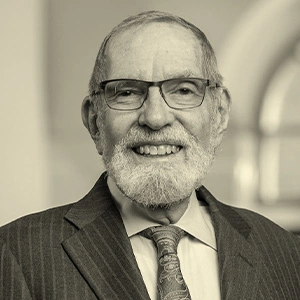
Frederic Dorwart, a legend in the Tulsa legal community, shares the story of his life, the formations of his legal career, and stories throughout his many years of philanthropy.
Fred Dorwart was the United States National High School Extemporaneous Speaking Champion in 1954, the year he graduated from Muskogee Central High School. He earned a Bachelor of Science degree in engineering with distinction from the U.S. Naval Academy in 1959 and served in the Navy until 1965. Fred was awarded an LLB cum laude from Harvard Law School in 1966. From 1967 until 1994, he served as president and of counsel with Holliman, Langholz, Runnels & Dorwart, before founding his current practice, Frederic Dorwart, Lawyers.
He has contributed to our community through his service as general counsel for the Bank of Oklahoma, an organizing trustee of the Tulsa Community Foundation, and, currently, as president and trustee of the George Kaiser Family Foundation.
Fred has played a significant role in supporting various major initiatives in Tulsa, often contributing in less visible capacities.
He negotiated the terms for the Woody Guthrie Museum and the Bob Dylan Museum and was a member of the original committee deciding the concept of Gathering Place.
Fred was a member of the University of Tulsa Board of Trustees for a decade, serving two years as chair, and now holds the title of trustee emeritus.
Full Interview Transcript
Chapter 1 - Introduction
Announcer: Fred Dorwart was the United States National High School Extemporaneous Speaking Champion in 1954, the year he graduated from Muskogee Central High School. He earned a Bachelor of Science degree in engineering with distinction from the U.S. Naval Academy in 1959 and served in the Navy until 1965. Fred was awarded an LLB cum laude from Harvard Law School in 1966. From 1967 until 1994, he served as president and of counsel with Holarud, Langholz, Runnels & Dorwart, before founding his current practice, Frederic Dorwart, Lawyers.
He has contributed to our community through his service as general counsel for the Bank of Oklahoma, an organizing trustee of the Tulsa Community Foundation, and, currently, as president and trustee of the George Kaiser Family Foundation.
Fred was a member of the University of Tulsa Board of Trustees for a decade, serving two years as chair, and now holds the title of trustee emeritus.
In his oral history, Fred talks about the Woody Guthrie Museum, negotiating the terms for the Bob Dylan Museum, and the early discussions surrounding Gathering Place, on the podcast and website VoicesOfOklahoma.com.
Chapter 2 - Teacher’s Influence
John Erling (JE): Well, my name is John Erling, and today's date is February 18, 2026. So Fred, would you state your full name, please?
Fred Dorwart. (FD): Frederic Griffin Dorwart, Jr.
JE: Your last name Dorwart. What's the significance of that, your ancestral story?
FD: Well, there are now a number of Dorwarts in the country, even though it's a fairly rare name. The family all started with two brothers named Dorwart who came over very early in the history of the country and settled in the Pennsylvania Dutch country.
JE: And they came from where?
FD: And they came from—they were Huguenots—they came from France.
JE: And where are we recording this interview?
FD: In Old City Hall in Tulsa, Oklahoma.
JE: And why are we in Old City Hall?
FD: Old City Hall is my law offices.
JE: And you own the City Hall, do you not?
FD: I do. I do.
JE: Old City Hall, when was it constructed?
FD: In 1917.
JE: And they used this till what year?
FD: 1959, I believe. It remained a derelict building for six to eight years, I believe. And then a prominent Tulsa architect by the name of Coleman, who you may know, and lawyer rehabbed the building and for an early downtown building rehab, they did a really nice job.
JE: So you've owned the building since when?
FD: 2004.
JE: And we should point out we're at the corner of 4th and Cincinnati. It's been named Frederic Dorwart Way.
FD: Yes. (Laughing)
JE: And you're embarrassingly laughing at that. How did that come about?
FD: Well, I’m not sure who originated it, but it was one of my law partners, and I think I know which one. (Laughing)
JE: Who was it? (Laughing)
FD: Paul DeMuro. Yeah.
JE: Your birth date?
FD: January 31, 1937.
JE: Making your present age...
FD: 89.
JE: We should talk a little bit about 89. Your ancestors, parents, or whatever, do they live that long?
FD: Yes, my mother and father both lived into their 89th year. My two sisters into their 92nd year. My maternal grandfather lived to be, I think, 98 or something like that. I don't know about my paternal grandfather.
JE: So you have that going for you, and then I suppose that people ask you, "What is it you've done to live this long?" and what do you say?
FD: Well, I don't know. I mean, I just take a day at a time.
JE: You've taken care of yourself, obviously.
FD: Yeah, I have. As a young person, I played a lot of athletics and have always been active, stayed away from stuff that you're supposed to stay away from. So I mean maybe that's it, or maybe it's just the good Lord decided this is what it was supposed to be.
JE: And you have genes going for you too, so that's important. But you're working every day. You're putting in a full day, aren't you?
FD: No, I normally work eight hours a day. I don't work on weekends anymore, though. I used to work on weekends. I don't do that anymore.
JE: Where were you born?
FD: In Muskogee. I'm the original Okie from Muskogee.
JE: Your mother's name?
FD: Mildred Gibson.
JE: And where was she born? Where did she grow up?
FD: She grew up in Culpeper, Virginia. My mother's family were early Virginians.
JE: Describe her personality. What was she like?
FD: Well, she was highly educated, which is kind of unusual for women at that age. She had a Bachelor of Science degree. She was a chief nursing officer at the UVA medical school.
JE: So this would have been back in approximately what years?
FD: 1925, something like that.
JE: Yeah, few women would have attended college back then.
FD: Yeah.
JE: Your father's name?
FD: My father's—well, I'm a junior. His name was Frederic Griffin.
JE: And where was he born and grew up?
FD: He grew up in Pennsylvania. His father was an Episcopalian minister there in a small town.
JE: And what was his personality like?
FD: He was very even keeled. He was a doctor. People loved him. He practiced medicine when the doctors made night calls. He was one of those kind of doctors that said, "Why don't you go home, take an aspirin," or he was even known to give people a placebo from time to time, which I don't think doctors are allowed to do anymore, but it seemed to work really well for him, so he was an interesting guy. He was an Army Air Corps instructor in aviation at Kelly Air Force Base in San Antonio. Then he went to med school and came here because the Fite brothers—do you know the Fite family from Muskogee? The Fite family is an old family in Muskogee, and there were three Fite brothers, and two of them were doctors and they were in his med class in Virginia and they talked him into coming to Muskogee and practicing with them.
JE: OK, so that brings your mother and father to Muskogee and the reason you were born there. Wasn't he a veteran of which war?
FD: World War I and World War II.
JE: Is that right?
FD: Yes, yeah.
JE: Now that's amazing, isn't it? It must have been near the end of World War I maybe, for him to be in both wars.
FD: You know, I don't know what the years were. But yeah, he used to fly up here and land in the country in the old biplanes that the army had at that point in time.
JE: He flew. Was he a pilot?
FD: He was, yeah. He was a flight instructor for the army in World War I. I still have these goggles—the goggles that go around there—I still have these goggles.
JE: Well, you had parents that were wonderful role models for you, weren't they?
FD: They really were. I mean, they really were.
JE: Did you have brothers and sisters?
FD: I had two sisters. They were both nurses. The older one married a Canadian in 1954 and lived in Canada and ultimately became a Canadian citizen. My younger sister was a nurse that trained at Saint John's Hospital when Saint John had its own nursing program here in Tulsa—
JE: Here?
FD: Yeah, and was a nurse at Saint John's for her life.
JE: Let's give their names. Your oldest sister first and the youngest...
FD: Carter. Carter was my older sister and Cynthia was my younger sister. Cynthia just died several months ago.
JE: And how old was she?
FD: She was 92.
JE: And then your older sister?
FD: She was 92 when she died, but that was—she died during the pandemic, which was not what you would hope it would be.
JE: OK, your education. Beginning of grade school there in Muskogee.
FD: Yes, Longfellow Grade School.
JE: And to junior high?
FD: Junior high school. And then Tulsa Central High School.
JE: You jumped on me now. How did you come from Muskogee to Tulsa? Why did that happen?
FD: I left -- when I graduated from high school… Immediately that summer I went to summer school at the University of Michigan because my debate coach, who was just a super fellow—he was getting his PhD there and he asked me just to go up with him to Michigan and I did. Then I went down to OU and then the fall of 1954, I was going back and forth on weekends to OU and I really didn't like OU. I was a prude and they chewed and they smoked and they went with women, and anyway, I didn't get along down at OU. So my mother one weekend said, "Well, here's what you can do." And I said, "What's that?" And she said, "Well, the representative"—oh gosh, I'm having a blank moment here. You would know him. His brother was governor—was giving tests for appointments to the service academies. At that point in time, the congressmen had all figured out that having the power to appoint someone was more a liability than it was an asset, so they started giving tests. So I took this little test and a couple of weeks later I got a letter from him saying that I had the appointment. So then the question was what was I going to do? And I said, "Well, I guess I'll go to the Naval Academy." My mother had gone to Sunday afternoon tea dances in Annapolis, and that's why she thought the Naval Academy would be the right thing to do.
JE: OK, let me come in. What year did you graduate from high school?
FD: '54.
JE: And with honors too, as a matter of fact, magna cum laude?
FD: Right.
JE: But that's when you got involved in speaking?
FD: Yeah, my high school days were all spent in competitive debate and extemporaneous speaking with a school teacher by the name of J.W. Patterson, who was a terrific guy. I probably learned more from him than I have anybody else. So that's how I spent my high school days.
JE: So that just came so naturally to you, apparently, even maybe as a freshman, sophomore—I mean, it was just an obvious thing that you would partake in?
FD: Well, he sought me out. He actually called my parents and said he wanted to talk to me because he wanted me to do it. I don't know why he picked me. I, frankly, I never knew that. So yeah, I guess it's kind of natural.
JE: Because you hadn't thought about it. If that teacher hadn't reached out to you...
FD: Oh no, no, no. If he hadn't reached out to me, I don't know what the course of my life would have been like.
JE: Proving the importance of teachers, right?
FD: That's exactly right.
JE: How they can change a course of a person's life.
FD: Yeah.
JE: And I have several instances of my many interviews of a teacher who did exactly what yours did.
FD: Yeah, no, there's no question. There's no question about it. I learned more from that one person than any other person in my life, really, other than my parents—the influence of my parents.
Chapter 3 - Naval Academy
John Erling (JE): So US Naval Academy, what did you graduate with from the Naval Academy? What degree?
Fred Dorwart. (FD): What do they call it? Excellence. It's not, they don't, they don't treat it like everybody else, but it was with excellence, which was in the top 10% of the class.
JE: So isn't that where you had a BS in engineering?
FD: Yes.
JE: And you graduated there in what year?
FD: 1959.
JE: All right. Why engineering?
FD: Well, at the time, that was the only degree that the Naval Academy offered. It was interesting. We had a totally prescribed program. Every man or boy—because there were no girls—took the same classes, and there were 1000 of us, and we got an engineering degree. That was the only degree that the service academy offered at that point in time.
JE: So you're going from Oklahoma to Annapolis. Was that a big jump, your first days at Annapolis? Was it difficult for you to adjust?
FD: Well, the summer was terrific because it was basically like basic training where you gained your physical strength and learned teamwork and learned how to fire weapons and all that sort of business. I really enjoyed that. Then the first year was really rough because that's when they had both physical and mental hazing in the academies, so it was really, really rough. At one point in time, around Christmas time, I told my father, I said, "You know, I think I really want to come home," and he said, "You know, you're not coming home until the end of the 1st year. You stay the year and then if you want to come home, we'll talk about it." Well, when I got through that first year, then I really enjoyed it and I really realized what a value that plebe year was.
JE: One example of hazing, what would they do?
FD: Well, for example, we all went to a dining hall and we all sat together in companies with and at the table, you'd have upperclassmen and then you'd have several plebs, and you would have to sit straight. You couldn't talk, you couldn't look down at your plate. You had to take it up, bring the fork into your mouth, and then they'd say, "shove out." Well, that meant you just pushed the chair out from under you, but you stayed sitting. And then you had to eat with nothing underneath you. That was one of the things that I remember, very difficult. Built a lot of strength in your legs and back.
JE: I guess.
FD: But that's the sort of thing they would do. They'd make you run, they'd make you do push-ups. They'd do all sorts of crazy things.
JE: Did you have people dropping out?
FD: Oh, yes, yeah. Yeah, after the first year, I think 10% probably dropped out.
JE: It certainly influenced you in your life.
FD: The Naval Academy?
JE: Yes.
FD: Oh yeah, I tell people that, "I learned the law at law school, but I learned how to practice the law at the Naval Academy."
JE: So wasn't this during wartime?
FD: It was during the Cuban Missile Crisis. The equipment, our ships and our equipment were essentially World War II vintage, brought to date, very rudimentary. And I can remember rolling around on a ship at sea with these classic old bulbs crashing against the board while we were trying to repair the radar. And if we had the radar working 70% of the time, we thought we were heroes.
JE: Isn't that amazing that we weren't better equipped than that?
FD: Yeah, yeah. It was rather, you know, at that point, it was that early. This was just right after World War II.
JE: But you were athletic too, weren't you? Did you play in high school sports?
FD: No, I didn't play sports, not on a high school team because I was totally occupied with the debate program. We spent two or three hours five days a week doing it, but I did, I always played sports and I loved tennis and I was pretty decent at a 1950 vintage basketball player.
JE: Well, you're tall. How tall are you?
FD: I was 6 ft. Yeah.
JE: But you debated in the Naval Academy.
FD: I did, yeah, yeah. They didn't have a debate program when I got there. And a friend of mine from Tennessee, we instigated the commencement of a collegiate competitive debate for the Naval Academy. Debaters were at the time kind of not thought of well by the senior officers. So I thought we were all like lawyers, we needed to be quiet and do what they told us to do. But anyway, we went through this whole process of addressing an application up to the superintendent of the Naval Academy, and we finally got approval for it. So then it became like a sports program. We were actually funded the same way and traveled the same way and did all the competitive debates. All the service academies are now very active and competitive debate.
JE: And you and a friend started it.
FD: Yeah.
JE: Well, that was a learning experience, wasn't it?
FD: It was, yeah, yeah, I was learning that process about how you go through dealing correctly with a formal organization institution.
JE: And some of that you drew on later on in life, I’m quite certain.
FD: I did, sure, yeah; you learn leadership, you see it done correctly, you see it done incorrectly, but you study it. And you study, even though it was an engineering degree, we studied the psychology that went along with leadership and it has been very meaningful in my life.
JE: I believe you were selected as commander of the 4th Company, midshipmen.
FD: Yeah, that’s right.
JE: And how did that come about that you were selected as commander?
FD: Each company would have a commissioned officer that was in charge of the company, and they just selected who they thought they wanted to have those positions.
JE: Well, somewhere along the line you stood out apparently. What responsibilities came with that as commander?
FD: Well, you were just in charge. You were the midshipman in charge of the members of that company, getting them where they're supposed to go on time, leading the marching, doing those sort of things.
JE: What rank are you at this point?
FD: I'm a full lieutenant or I was a full lieutenant before I retired.
JE: And then didn't you serve as Chief Engines Officer in the USS Newport?
FD: Yes.
JE: As Chief Operating Officer in USS Turner, and as an instructor in naval tactics at the USS Navy Officer Candidate School in Newport, Rhode Island.
FD: Correct. Right, yeah.
JE: Now that encompasses a number of years, doesn't it?
FD: It does, including the 4 years that the Naval Academy. I was in the Navy for 11 years. Well, 4 of them were at the Naval Academy, 4 of them were on active duty, 3 of them on reserve duty while I was going to law school.
JE: Oh, going to law school at the same time? So that's why you stayed in?
FD: Yes.
JE: Because you could have left sooner.
FD: I could have left.
JE: But you had law school going for you. Were there major difficult leadership decisions that you probably had to make? I don't know if you can think of any one or two, but there must have been.
FD: What comes to mind is that when I was operations officer of the USS Turner, we were transiting from the United States to the Mediterranean and we stopped in Lisbon, Portugal. And the commander of our ship dropped anchor and caught some of the underground cables that run intercontinentally, which was a kind of a gross error. And from that point on during our whole tour in the Mediterranean, I was the con of the ship. I conned the ship. I was a ship driver taking the ships in and out of port, not the commander, which normally they would do. I don't know, one of the funniest thing experience I had was when I first left to go on the Turner. We were in Charleston where I boarded the ship. We went out to refuel. I had never driven that ship. And we were going to go alongside underway refueling and the commander had the con of the ship. He was driving the ship and then suddenly he said, "you take the con," and then I was supposed to go alongside the tanker, and had never done anything like that. So I didn't say, "well, I can't do it." I just stupidly did it. So it was that was kind of fun.
JE: And it didn't ram into it?
FD: Didn't ram into it. We got refueled and off we went. Yeah, yeah.
JE: Wow. But if you'd said no, that would be not good.
FD: Well, I could have said, "I've never really done it and I don't feel comfortable," or I don't think he ever had either. So I just did it. I've not been bothered making decisions and doing things.
JE: So this is in the 60s about we're talking.
FD: Mm-hmm (in agreement).
JE: Yeah, yeah.
Chapter 4 - Nanu
John Erling (JE): Somewhere in here you were married.
Fred Dorwart (FD): Yeah, in 1962.
JE: And your wife's name...
FD: Was Reine-Anne. I called her—everybody called her Nanu—but her name was really Reine-Anne Weymouth.
JE: Why “Nanu?”
FD: Nanu. Well, Reine-Anne, “Anne,” became Nan became Nanu. Essentially was the path that it went down.
JE: Tell us a little bit about her personality. What was she like?
FD: Oh, well, I met her when she was 16. It was one of those things where we just fell in love. First time I ever saw her.
JE: Where did you meet her?
FD: I met her in Menton, France. Menton, a little town near the Italian border. Her father was ultimately what became a vice admiral in the navy. He was a Naval Academy graduate. He was at the Naval Academy when I was there, but I did not—and I knew him. And I knew my mother-in-law at the time, but I did not know my wife, and they were in Menton while Nanu's father was in the Middle East on a flagship. He was the commander of a flagship. It's really interesting. At that point in time, he was the senior United States person in the Middle East—you can imagine. The Newport News, we were anchored at Cannes. And the skipper of the ship called me one day and asked me if I had the duty because when you go into port, half the people have duty, half the people have to stay on the ship. I was on the ship. He said, "Well, do you have any duty assignment?" I said, "No, I don't, but it is my day." And he said, "Well, join me on the deck at 1800. We're going to go to dinner." And so I said, OK, so I joined him on the deck and we went to dinner with Nanu's mother and aunt and all the siblings, and that's when I met her.
JE: How old were you?
FD: Well, let's see, I would have been 21, 22. I would have been 22. And she was 16.
JE: So instantly, did you...
FD: Just instantly, no kidding. And she told—I didn't know this, but she told her mother after I left that she was going to marry me.
JE: And her mother said, "You're crazy."
FD: Her mother said it's crazy. Yeah. And she was half French. My mother-in-law was French.
JE: Well then, how could you keep in touch with her, a relationship with her?
FD: Well, the next home port we were going to—you'd go to sea for a couple of months and then you'd go into port. The next port we went into was Barcelona, and it turns out that Nanu's great aunt lived in Barcelona. So she went to Barcelona and I was in port there and I always claimed, of course, that she came to Barcelona because I was coming there. She claims, of course, that she was always planning to go to Barcelona. So we did it by mail, the old-fashioned way—no telephone, no email, just regular mail.
JE: So how old were you when you got married?
FD: We got married in 1962, so I was 25 years old.
JE: And she was how old?
FD: 19 years old. She was 19.
JE: And where did you get married?
FD: In Maryland, Prince George's County, Maryland. Her father was stationed in Washington, DC at the time, and they had a home up on the hills in the Potomac at the time. It was kind of out in the country. Now, of course, that's all a totally urban area.
JE: Yeah, but then unfortunately, she passed away.
FD: Yeah, six years ago.
JE: 2019.
FD: Yeah.
JE: What took her life?
FD: She had a stroke. She had fallen and had broken her hip and was having trouble with it and now that I look back at it, I think she must have started having some cognitive problems, but then one night she just had this massive stroke and passed.
JE: How old was she?
FD: 73.
JE: But she was 73 when she died?
FD: Yeah.
JE: Children from your marriage? You have how many children?
FD: I have three.
JE: And they are…?
FD: I have two daughters and a son. The two daughters live in Tulsa. And one of them is a nurse practitioner. Laura's the older one, and she's a nurse practitioner at Saint Francis. The younger one is a lawyer, Erica. She's a lawyer. She worked for a long time in this firm, and then she left a year and a half ago to go out on her own. So she has her own practice now here in Tulsa.
JE: And then your third child?
FD: My son lives in Winchendon, Massachusetts, which is a small town up in the hills northwest of Boston. His wife is a retired army officer. And he's an artist-type.
JE: Artist? Musician?
FD: No, he does metalwork and he did (gesturing) — He did that.
JE: He did that? Oh, the menorah.
FD: He did that,
JE: It’s beautiful.
JE: And he really has a lot of talent that way.
JE: His name?
FD: His name is Marc, M-A-R-C.
Chapter 5 - Harvard Law School
John Erling (JE): So what sparked your interest in law?
Fred Dorwart (FD): I don't know. I think—I mean, I always thought of lawyers as being speakers, right? I mean, nothing was sophisticated back at that point in time. And I suppose that was it. And then my mother's brothers—three of my mother's brothers were lawyers.
JE: And where did you go to law school?
FD: At Harvard.
JE: Harvard Law School?
FD: Uh-huh (in agreement).
JE: And you graduated there in what year?
FD: 1966.
JE: And that was cum laude as well. And then you had competition while in law school, Best brief award. What is that?
FD: Well, each class, each year, it's appellate work—if you think about the appellate work—court appeals from trial courts to appellate. In each class you have to write a brief. And then you have to give an oral argument. I got the best brief award and the best oral argument award, and so…
JE: So you're in. Annapolis Naval Academy work and you come to Harvard, was either one more difficult than the other?
FD: No, I don't think so, but in a different way, because the study of the laws are intensely academic undertaking—or at least it should be. I worry about how they view law schools these days, but it's intensely academic. A lot of the law developed historically, so there's a lot of history associated with all of it. The engineering program is just that engineering—learning engineering—so it's difficult, but it's a different kind of exercise. At the Naval Academy, I always felt I was one of the peers. I mean we were all peers. I was at the same level with everybody. They were on the same level with me. When I went to Harvard Law School, I started out with wondering whether I was really as good as these guys who had gotten bachelor degrees at Harvard and Princeton and Columbia and Michigan and all the great schools, and they were much younger than I was and they were just out of college, and I had had these four years of interruption at sea where I was away from everything. So it was different and it was hard. It was hard.
JE: But soon you figured out you deserved to be there and you could compete with them.
FD: Well, I guess so, but I don't—it's funny there, I think there were a couple of guys in the class that would never come to class, this Harvard Law School. Never come to class, but then when they would come, the professor would ask them to recite. And they just knew it, so it just seemed like—to me, it just seemed like this is easier for them than it is for me. I just had to work.
JE: And apparently it was … easier for them.
FD: It was—I mean it was easier. It was easier for them. I had to work at it harder, yeah.
JE: Any professors there or classroom moments that maybe left an impression on you? Any professor there at Harvard?
FD: No, not—the only one I really remember is kind of a negative experience that I've talked about a lot. It was a—he was a professor of constitutional law. But he was a fan of the Interstate Commerce Clause, so for a whole year we spent talking about the Interstate Commerce Clause. And in my lifetime, if there's ever been an area of weakness, it's been the US Constitution because the only part I ever studied was the Interstate Commerce Clause, and there's slightly more to the US Constitution than there is the Interstate Commerce Clause. (Laughing) It's kind of funny.
JE: You graduate in 1966 from Harvard Law School, then what happens?
FD: Well, my wife and I—we were thinking about what are we going to do next. We thought about staying in Boston. We thought about going down to Jacksonville, Florida because my second tour was homeported in Mayport, Florida, right near Jacksonville, and we liked Florida. We thought we'd—we would give the Wild West a try, and so we went out and interviewed in Los Angeles. We thought about doing that. Ultimately just decided we'd—we decided to come home. And then Muskogee—it was a great place for a young person to grow up, but there's not a lot of opportunity there. And so I decided we would come to Tulsa. So that's how we got to Tulsa.
JE: What year would that have been?
FD: It would have been 1966.
JE: Do you go to work for a law firm then here?
FD: I went to work for a law firm by the name of Lupardus, Holarud, and Huffman. It was one of the largest law firms in the city at the time—like 16 lawyers or something like that. And I'd been there six months, seven months, and the law firm—the partners in the law firm split up. And they both asked me to go with them. I decided—the senior partner at that time of Lupardus, Holarud, and Huffman was Joe Holarud. And then Robert Huffman, who you may know, who was a counsel to ONG at that point in time. So they split. And so Joe asked me to go with them. And so Joe Holarud, Bob Langholz, and I went off. I was to be their litigator. They were businessmen, tax and businessmen, not litigation types. And so I went with them to be a litigator.
JE: So what type of cases would you handle then as a litigator?
FD: Well, at that time, the law firm was not specialized the way it is now. Whatever case you had, that's the case that you handled. I never did any criminal work. I did all civil law things, most of it oil and gas litigation and commercial business litigation.
JE: Were you a director and officer of various manufacturing concerns?
FD: Yes, Joe, Bob, Gail, and I had, during this period of time, bought these companies. As the time went by, the law firm was growing. I was managing the law firm. They were spending most of their time with the business entities. I was managing the law firm. We grew that law firm to 32 lawyers, which for Tulsa was still pretty big, when I was not happy with the situation and I asked them to buy me out and I was going to go off and just be my own lawyer, which is what happened.
Chapter 6 - Bank of Oklahoma
John Erling (JE): You said you bought companies?
Fred Dorwart (FD): Well, one of them was Geophysical Research Company. Geophysical Research Company designed and built these called "bombs" which were dropped down the core hole, borehole of an oil and gas well and took measurements of heat and all the elements that geologists want to know. We had a company that was essentially a data recording company -- analog, not digital. We had Bryan’s Infant Wear that at that time manufactured infants' wear, which was quite successful until everything opened up in international trade and the company closed because it couldn't compete with the international products. And then we had an oil field supply company that applied just the ordinary things that you need when you drill an oil and gas well.
JE: So here you're practicing law and then you're invested in these companies.
FD: Well, I was mostly practicing law. They were running the business.
JE: But you were in on the buy.
FD: But I was in on the buy.
JE: OK, right. So others were doing day to day operations and you didn't have to.
FD: Yeah, I learned a lot about owning those businesses
JE: I’m sure.
FD: But I was not principally responsible for them.
JE: And then they were all sold off.
FD: Well, my interest was sold off and then I went out and then for a while I just practiced by myself in the same building, which is called the Holarud Building—Holliman, Langholz, Runnels & Dorwart—over on 3rd Street. We had offices there and I stayed in the building with them. But I had withdrawn from the law firm and wasn't managing it. That was a period of time when George Kaiser bought Bank of Oklahoma. I handled all that transaction when we bought the bank from the FDIC.
JE: So that was your first interaction with George.
FD: No, no, no, my first interaction with George was in 1967.
JE: Really? What was that?
FD: Playing football.
JE: Football?
FD: Flag football. Yeah (Laughing).
JE: I didn't know this. Where are you playing flag football? How did that come? Was there a league or...
FD: No, just a bunch of guys that were playing flag football and I was with them, and that's when I met George in 1967. And he was young. He came back in '66 from business school—Harvard Business School—when I came back from law school. I didn't know him in Cambridge. But that's how I met him playing flag football. And then he had this idea of something he wanted to do and he asked me if I'd help him and I said, "Sure." He had decided he was going to make a hostile tender offer for the stock of a company called Pancake Place Food Systems Inc., which had sold $250,000 worth of shares to residents of Oklahoma and had built the place—had built a pancake place out on Memorial—and then it had this place it had built and had $125,000 of money. It was going broke running the pancake place. Stock wasn't selling for anything. It was selling for less than $125,000. So George wanted to make a hostile tender offer and get the $125,000 and we did it. So that's the first thing I ever did with George. And then I just started doing whatever else he had in terms of legal issues and that practice grew and yeah, that's how I first knew George.
JE: So that was through your own law firm? You had established a law firm then.
FD: No, at that point in time I was still with the other law firm.
JE: OK, and you did that work for him.
FD: Yeah, when we did—when I did that—and the first big thing I did after I withdrew was the acquisition of Bank of Oklahoma Trust Company—I mean, Bank Oklahoma Corp, which owned the Bank of Oklahoma. But I did that when I was practicing by myself.
JE: OK, so help me here. George, how did he come to be the owner of BOK?
FD: Well, he had been on the board. He's actually been chair of the audit committee, but the bank, as you may remember, at that point in time all the banks were failing in oil country. The FDIC had taken over Bank of Oklahoma and what at that time was called "open bank assistance." What the FDIC would do would be to buy shares of the company, become a stockholder of the company, and let the bank run itself, but they would put capital into the bank, let the ownership run the bank, but they owned it. So we negotiated the acquisition of the interest of the FDIC, which was 99.9% of the bank, and George bought it and I handled that transaction. That would have been in 1988 starting the negotiations and then the bank was bought in 1991.
JE: But then he had his own company, Francis Kaiser...
FD: Kaiser-Francis Oil Company.
JE: Right. And he was doing that while he was making his acquisition.
FD: Right. And during that whole period of time also we were doing a lot of legal work for him. During the 1980s, you'll remember that there was a depression in the oil and gas industry. Many, many companies went bankrupt. I spent essentially seven or eight years in the 80s with George's organization doing nothing but buying defunct oil and gas companies out of bankruptcy—Chapter 11 reorganizations of the company. So that's what we were really engaged in doing during that period of time. And then George wanted to buy Bank of Oklahoma and that's when I negotiated that deal and we floated the stock of BOK Financial Corporation to the public, registered that stock, and then BOK Financial Corporation owned the bank, having bought it from the FDIC. And BOK Financial Corporation had—I can't remember how many—what percentage of shares he gave, he gave stock to the owners of the defunct bank, Bank of Oklahoma Corp, in order to create a public market. He just gave it to him. And he—but he owned the 97%...
JE: 97%?
FD: Something like that. I don't know, but nearly all of it. But he had given them these shares and we created a public market.
JE: Were there some major risks that were happening here that it was a no-brainer or there were risks you were taking?
FD: Well, I wasn't taking the risk…
JE: No, but he was.
FD: But George was certainly taking the risk—of course, a huge risk that he was taking—but the transaction—I could bore you with it—but it was really complex from a legal point of view. It was really complex. And one part of it will never happen again, I don't think. We actually put the old holding company in bankruptcy. Acquired it in Chapter 11 and then I took the new certificate down to Oklahoma City and I got them to stamp it as a bank, which it really never was. And then we merged that into the Bank of Oklahoma so that Bank of Oklahoma got the benefit of the net operating losses.
JE: You'd never done this kind of work before, had you?
FD: Well, I'd done a lot of banking work, mostly on the lending side. I've done a lot of commercial work. I did a huge amount of work in the early days in the securities area. There was a major statutory change in the regulation of securities by the Securities and Exchange Commission in 1966. I was vectored up to the University of Wisconsin to take a month's course in that new law, securities law. In a sense I came back knowing this new law a lot better than the people that have been doing it for a long time because they're trying to practice and I'm just going to school, so I did a lot of securities work early on, yeah.
JE: So you came to George with banking experience actually then.
FD: Yeah, yeah.
Chapter 7 - Philanthropy
John Erling (JE): Somewhere then you established your own law firm.
Fred Dorwart (FD): Yes.
JE: Was that 1994?
FD: That was in 1994. That's when I left the Holarud building and I invited three of the lawyers to come with me. Tom Murphy was Ruth Nelson's husband.
JE: And Ruth Nelson would have been the sister of…
FD: George.
JE: Right, yeah.
FD: I actually introduced the two of them for business purposes, I never thought I was being a matchmaker. It was an odd match, but it was a very successful match.
JE: Between?
FD: Between Ruth and Tom, yeah, as it turned out. So I brought those three guys with me. We came over here. We rented this first floor of the building—Old City Hall. This area you're sitting in was where Steve Largent had run his last unsuccessful political campaign, and the detritus of all that campaign was spread out across the floor and all that stuff. We started out just four of us, and that was the idea. The idea was we were to finish out our days, the four of us just practicing law by ourselves.
JE: But then you brought George's work with you into the firm.
FD: Yeah, all of George's work
JE: Right. That wasn't a bad way to start your firm, was it?
FD: It was a pretty good basis. (Laughing)
JE: But I believe you worked philanthropy into the mission of your law firm.
FD: We did. I did.
JE: Talk about that, and why were you donating thousands of hours of legal work to various cases?
FD: I don't know whether it's my faith or—it's a combination of things, I guess, probably my faith, probably the fact that George was philanthropic, a major source of the business of our firm, not entirely, but a strong source, and he was engaged in all this philanthropic work, so I was associated with all of that. When I formed the firm, I told the lawyers that we were going to do philanthropic work, pro bono work. The lawyers would get paid the same amount of money as if they were working on a business proposition. And at that point in time, I owned all of the firm. So the lawyers were interested in doing the philanthropic work, but for them, it was really not philanthropic because they were getting paid the same thing that they would be getting as if they worked on a business deal. But then as the law firm grew along and I brought all of the senior lawyers in together and we formed an organization where, you know, I continued to manage it, but my equity interest was the same as every other lawyer. Everybody had the same equity interest. So I just liked being able to help and I could afford to do it and so I did and that culture has continued in the firm. The American Bar Association has—I can't remember the numbers, but they have a recommended amount of pro bono work that these big law firms ought to do. We do about 10 times that amount—pure legal work for which the lawyers get paid, but the clients get the pro bono work.
JE: Yeah, but you're not taking an income from that, right?
FD: Right.
JE: So many of those that you helped, maybe their business or whatever would have floundered if you hadn't helped them.
FD: Well, yeah, they need the work. It's that a lot of them really needed it or they couldn't have really created their organizations, but it's also that we relieve them of a burden, so that they have—every organization has limited capital and if we can provide free services, they don't have to deplete their capital by the legal costs, and the legal costs can get to be quite high.
JE: And when you look at your life, that area of your life has got to give you some great feeling, pride, satisfaction.
FD: Well, I guess, yeah.
JE: If you were able to help all those people with thousands and thousands of free legal work.
FD: I'm blessed. And it feels good to be able to help others.
JE: Is there any example that you might want to cite that you helped?
FD: Tulsa Educare—they do all their legal work for free.
JE: And what is that -- Tulsa Educare?
FD: Tulsa Educare. There are four schools that George essentially financed. That's part of a national Educare network and it's essentially birth-to-three schools which are testing the principle that early birth growth is important, and they have better programs for young people and it's proved successful. The students—and they're basically underserved students from the underserved community—it moves them into a competitive position as they move along in their life after the early years. So that's the Tulsa Educare system. We do all of River Parks Authority work for free. There's just any number of them that we do.
JE: Do people reach out to you for help?
FD: Yeah, sure.
JE: And then you have to identify which ones that you're going to help.
FD: Yeah, yeah. Yeah, all the times I'll do that for you. I mean, that's how River Parks started. I was in a meeting of the River Parks Authority and the city was trying to charge them more for the legal work and cut their budget and I'd say, "Well, how much is your legal work?" And they said, "something like 35,000 or something a year." And I said, "Well, I'll do that." So we've done that for years and it's a lot more than $35,000 now.
JE: You still do it?
FD: Yeah, we still do it. Yeah, we do all of it.
JE: I'm proud to say that KRMG's Great Raft Race was the one who birthed River Parks Authority, yeah. But didn't you also sign on as counsel of the children's rights nonprofit, which led to a class action suit in 2008…
FD: Yes.
JE: … against the Department of Human Services on behalf of foster children who were abused and neglected while in state custody? That had to be an extremely interesting, probably adversarial in nature with them because the DHS did not want to be…
FD: Well, we—yeah, Children's Rights are a national, New York-based national litigation reform group. At the time, they had spent four years investigating the foster care system in Oklahoma and determined—essentially determined—that it was the worst in the United States. So they came to town and asked a number of law firms—four or five law firms—if they would help locally with bringing this class action against the department. And I said, "Yes, I'll be one of them." Well, as it turned out, we were the only one. Everybody else, when it got down to the lick log and you really started having to do work, kind of fell out of the group. So we filed that lawsuit. We were in litigation for four years. We finally were able to settle it by consent decree. A consent decree being an order of the court that's entered by agreement of the parties but has full effect of an order of the court to reform the system. We spent five years fighting the system because of the resistance. Then the governor appointed a guy by the name of Jeff Brown to take over the department, and he joined forces with us instead of fighting us.
JE: Was that Governor Stitt who appointed him?
FD: OK, yeah. And so then we were on our way and at the end, the foster care system in Oklahoma is now recognized as one of the best in the United States. We had a ceremony. It turned out to be a ceremony—it was supposed to be a judicial hearing in front of Judge Frizzell to formally terminate the court supervision of the foster care system. And all the people we'd sued and all the people from the department were there and all that. It actually really turned into a celebration. I've never been in a hearing where people were clapping and applauding and everything. Twelve years from start to finish, but real success. And actually, I am really proud of that, yeah.
JE: Wow. Yes. It's just hard to imagine that when children get into the foster system that they still are abused and neglected. And is that because fostering is a moneymaking deal? And so they'll take children in and not necessarily interested in the care and keeping. Maybe I'm way out of line here.
FD: Well, no, you're not totally out of line, but it's … to me it's a little more nuanced than that. There are really two ways of thinking about it. They're group homes, which are horrible, and one of our objectives was to get rid of group homes. Those are commercial enterprises operated solely as businesses, and the higher incident of abuse and neglect is in group homes. The second one has to do with individual families that agree to take in foster kids. I think the incident of people taking in kids simply to get the money is probably pretty rare. But being a foster parent—because most of these kids that are foster kids have come from broken up homes, there are all kinds of abnormalities associated with these kids, and raising a kid is tough. So that's where you can get abuse and neglect.
JE: And the children can be hard to deal with.
FD: Because the kids are hard to deal with, put a lot of stress, and that sort of thing.
Chapter 8 - Dylan-Guthrie
John Erling (JE): Well, you have through your work led you into some surprising situations that you never thought you'd be in, right? You were the lead negotiator in obtaining the Woody Guthrie and Bob Dylan archives.
Fred Dorwart (FD): That's true.
JE: And Bob Dylan, I think, would have been in… When he became famous, you would have been in the Navy.
FD: That's an interesting story there. One of the things about Bob Dylan and his fans, it has to do with when he shifted from strings into electronic guitars. It was at a concert in Newport, Rhode Island.
JE: I can tell you the date: July 25th, 1965.
FD: Yeah, yes, my wife and I were there at that concert. And so what I tell, when I was negotiating the Bob Dylan deal, and I would say, well, I was there at that concert. Well, it's almost like they would bow down to me because they worship Bob Dylan. At the time, we didn't know. Well, I had just been at sea, and then I so I didn't know anything about the culture and had no idea what was going on and they never really put it together until later years.
JE: Yeah, right. You just happened upon a fifteen-minute set of rock and roll…
FD: (Laughing) Yes…
JE: … that was initially—now you've no doubt seen the movie, the Bob Dylan movie, A Complete Unknown.
FD: Yes.
JE: So when they show that scene, you say… “I was there!”
FD: "I was there."
FD: I was there. And when I would tell these people that were working on the Bob Dylan Project and all this about this, I was like one of them, you know?
JE: All right, so I see you have two—the guitars here sitting against the wall. Certainly there isn't... is there a story related to any of this that we're talking about?
FD: Not Woody Guthrie or Bob Dylan, but you may remember that Phil Kaiser—Philip Kaiser…
JE: I know him.
FD: … sponsored these in the Arts District for three or four years, sponsored musical concerts, but I did that. I did all that legal work for him for free, and that's the reward I got: those two guitars.
JE: And then you led the effort to purchase Dylan's archives on behalf of the George Kaiser Family Foundations and the University of Tulsa. Was that a challenging … or was there some delicate aspects of that negotiation that stood out for you? And did Dylan—could you feel any Dylan influence at all from him?
FD: We dealt with a man named Cohen who spoke for him. I never met him during the negotiations. And those are really complex agreements, by the way. I mean, a lot goes on, but one of the things I was really striving to do was to get Bob Dylan to come to the opening of the Bob Dylan Center, and I never could get him to commit to do it. He just would not do it.
JE: Did you ever speak to him?
FD: No.
JE: No?
FD: Yeah, and in fact, it was astounding to me when we were negotiating this contract about a volume of artifacts and documents, and I had never seen the documents or seen the artifacts or seen the inventory of them. I just knew that there was this vast inventory of these things. So after we actually got the contract put together, I said, "Well, now you've got to send me the exhibit, right? To the contract, so I can look at it." I just nearly fainted. It was just a voluminous amount of things that Bob Dylan has kept. You've been to the Bob Dylan Center, I'm sure.
JE: Oh, yes.
FD: And have you ever been back in the archives?
JE: No.
FD: Yeah, well, it's just an enormous amount of material that over his lifetime he has kept, and the scholars still come in all the time and study those materials.
JE: Right. Well, they were processed and stored at the Helmerich Center for American Research at first, weren't they?
FD: Yes.
JE: And they've been relocated now to the system of the American Song Archives, which is now shown and managed at the Bob Dylan Center, so it's all there.
FD: Yes, right, yeah.
JE: Was that a long negotiation? Did it take you a long time?
FD: I can't remember. I mean, I'd probably say six months, something like that.
JE: You're negotiating too as a business person. Was there a dollar amount, was that a big issue?
FD: Yes, the dollar amount was agreed to before I ever got involved. It was not a big issue for me. I think George personally and Ken Levitt probably—I mean, I was just given a number, so I was not part of those discussions.
JE: There are many stories about Bob Dylan, but one of the—I think the last concert he was here, he actually went to a Drillers ball game. Did you hear that?
FD: Yes.
JE: And so there are those of us who wondered if he went to that by himself, walked there—if he would have walked past the Dylan Center at all.
FD: Well, he physically would not have had to.
JE: No, but we're hoping he did,. But then you were involved in Woody Guthrie's negotiation as well.
FD: Yes.
JE: Between the two of them, was any more difficult than the other?
FD: No, I think they're about the same. I mean, business contracts negotiations can get heated. Lots of argument. These were more pleasant kind of discussions. Everybody just trying to get a document that was workable for everybody.
JE: Because everybody wanted it to happen.
FD: Everybody wanted it to happen, yeah.
JE: Right. And the Woody Guthrie's papers are also held by the American Song Archives, and you can see them at the Woody Guthrie Center. That'll make you feel good to know that you helped in establishing these two museums in our town.
FD: Oh yeah, sure.
JE: And they are destinations for people from everywhere.
FD: From everywhere.
JE: They will come here specifically for those two and then see our other fine museums as well.
FD: Yeah. In fact, the lawyer that I negotiated the Bob Dylan Center with was a lawyer located in Los Angeles. Just—I don't know—maybe nine months ago, certainly within the last year, I've been trying to get him to come to Tulsa and he'd never come and finally he and his wife came out to tour the center and he was just blown away to actually see it. It's just amazing.
JE: So just those two museums, you wonder about the economic impact it had on our city. And I don't know if anybody can really trace that or not, but it has to be a high percentage.
FD: Oh yeah, I mean, and it's just—
Chapter 9 - Gathering Place
Fred Dorwart (FD): The other thing you haven't mentioned that I was involved in was the Gathering Place.
John Erling (JE): OK, so you're going to come to that, yes.
FD: And each of these—each of these things are separate. But the conglomeration of them is what has made Tulsa today what Tulsa is. It's why people today, like the Wall Street Journal that said we were one of the—Tulsa is one of the 10 places in the world to visit this year. But it's all of that. It's the church. I mean, it's Gilcrease, it's Philbrook, it's all those pieces put together: the River Parks, Turkey Mountain, Gathering Place. Certainly Gathering Place had the most recent significant impact on the city.
JE: Right. Maybe at one time Tulsa was known—I think the phrase was coined by some journalists as "America's most beautiful city." Maybe we're living up to that now. I don't know, but we could certainly be in the running for that title. But talk to me about the Gathering Place, how you first heard about it. Did George talk to you? He says, "I'm thinking about building a park," or how simple did this happen?
FD: Well, Phil Frohlich and George—I think Phil Lakin and Jeff Stava and I would be having conversations, so probably others, but those are the ones that come to mind about the Blair mansion. And this huge piece of property that's sitting right in the middle of the city of Tulsa and what the heck is going to ever happen? What's going to happen to it and how great it would be to see something happen. Well, Phil Frohlich got the idea of buying those two apartment complexes which you may remember were south of the Blair mansion in order someday to consolidate those with the Blair property. We bought the bonds of one of those apartment projects and were able to close on the bonds and get a hold of the project and then we bought this what it was called Sun—Sun-something apartment, I can't remember now. So we bought that property, so I always had the idea we were going to warehouse these funds to do something. Phil Frohlich was really kind of a leader of that, and we were always talking about it. And then when we successfully got the two apartment projects, we started saying, "Well, how are we going to go about figuring out what to do about this?" And that's when we conducted an international request for proposals to what to do with it.
JE: Oh, so the idea of a Gathering Place hadn't come into your scope of thinking at that point yet.
FD: Well, it depends upon what the idea of the Gathering Place is. Certainly a park—certainly a park idea was always there.
JE: Oh, OK, so that was all right. So the park idea was always the mission. Then you did a request for a proposal as to how, what kind of...
FD: How we were going to do it, yeah. And before we did that, we talked to—I wish I—I'm not good at remembering names anymore, but the architect that had done the significant project up in Canada came down and we visited with him for a long time. He had this wild idea about a cupola from the property up to Turkey Mountain, and we all now laugh about that idea. Yeah, so then we went out for requests for proposals, and there was a long period of time, of course, developing the concept and then starting to drill down to what we were really going to do and how much it was going to cost. Yeah, and Phil Frohlich and I were always the big spenders in the crowd. We wanted it built right. (Laughing) You know all those stones that line the whole park on the walkways in the park and all that? Well, George just wanted to do concrete. Put the stones in. And Phil and I said, "Well, let's just don't say anything about it. We're just going to put in the stones."
JE: Isn't it true though that—I mean, George gets credit here. Was it his idea to have a park? I mean, we're talking, they always ask George what you wanted to do with this, and he wanted a place for the whole community.
FD: Yes—the wealthy—yeah, no, that was very much a part of the project.
JE: I mean, that was his vision.
FD: The whole vision—the whole vision was to make it, quote, "a gathering place" where all kinds of people would mingle. And one of the most rewarding aspects of the park is that it's been that success. I mean, if you walk through Gathering Place, it's just like being in a park in New York City. I mean, it's amazing. And that was always—I mean, that was always the core concept, yeah, and George deserves the credit for it.
JE: Was he in on many discussions at the beginning of this?
FD: Oh yeah, yeah, lots of them.
Chapter 10 - Artificial Intelligence
John Erling (JE): We have to talk about artificial intelligence, AI, because that could affect the banking business and your law business, I think. Talk to us about how it's affecting you now and what you think about the future.
Fred Dorwart (FD): I worry about it because people jumped in to start using it early on. The AI programs were hallucinating—people using AI to write briefs, to write plans. We recently in one of our litigation with the Department of Mental Health, they used AI to write a plan and it was obviously just a hocus. And there were—we've seen briefing where cases were cited that didn't exist and where cases are cited that exist but that are cited for propositions that the case really doesn't stand for. But on the other hand, it's a tremendous tool which we actively use in this office every day. When you had a legal issue and you really wanted to drill down, you were trying to argue for a new proposition or something, we used to have these huge libraries that you could go to—hard copy accumulation of work that thousands of people have done over hundreds of years—and we don't have those books anymore, but we had those books electronically and we used to be able to search words and phrases and that sort of thing. And but now you can use AI to pull up all that data for you, which makes that end of the process significantly more cost effective. But if that's all you do, it's a real problem because lots of times what AI will tell you at the lead of the article, what it thereafter says in the article is different, and used properly it's tremendous. I don't think that I'm getting really philosophical now. If you think of us as human beings, I think human beings have to interface with human beings to get things done. And even though you have all this tremendous amount of knowledge and accumulation and there's no questioning that they're gonna be able to cut manpower and all that sort of stuff, I think in my profession if people don't act exactly like they acted 100 years ago or hopefully act, you'll have the same mishmash. It won't really be of much value.
JE: AI won't be much value?
FD: Not the end product.
JE: It'll help you get to the end product.
FD: It'll help you get to the end product.
Chapter 11 - University of Tulsa
John Erling (JE): For 10 years you served as a member of the University of Tulsa Board of Trustees and 2 years as chair, and now I believe you're trustee emeritus.
Fred Dorwart (FD): Yes, I am.
JE: Right. Now you didn't attend the school. Why and how did you begin to serve the school in so many ways?
FD: I think I was originally invited on the board because I was George Kaiser's general counsel and they wanted—they saw me as an avenue to money.
JE: OK. (Laughing)
FD: That's why I think I originally got on the board. I don't think my so-called brilliance or whatever had any damn thing to do with it. (Laughing) I think they saw me as a possible avenue to money, which is why TU got in such serious problems then and now. The failure of institutions always starts at the top.
JE: And so without pointing fingers...
FD: Right.
JE: ...because you served under several presidents...
FD: Yeah. Well, I was thinking of the board as being the top.
JE: OK, the board, yeah.
FD: Yeah, and so Bill Thomas really advocated for me to become chair of the board when it got in trouble in 2019, and it had serious financial problems at that time. It had serious academic problems with the oversight boards at that time. And principally because of the work of Janet Levitt and the reorganization of the board to put people on the board that were not the source of money but were the source of talent and were willing to use their talent. I mean everybody on the board's got talent. The question is whether they're gonna work on the board. We totally turned the university around in a three-year period of time and avoided serious issues.
JE: What could have happened?
FD: Well, they could have gotten sanctioned. They could have been put on notice, which then would have made it extremely difficult to recruit good students. I was asked to become chair to solve the problem.
JE: Yeah. So this is a board problem, not a president's problem.
FD: It can be a problem with the president, but the president can't create the problem for the university if the board is sufficiently active in supervising the conduct of business of the university.
JE: So we had a board that just let a president do whatever he wanted to do.
FD: Mm-hmm (in agreement).
JE: And that ended when you became chair.
FD: Yes. We put in the people who were willing to spend the time and effort on the committees to provide guidance and oversight so that you couldn't have one person not being responsible to another, maybe a little bit like national politics today. (Laughing)
JE: So the school today…?
FD: Still—well, of course, the school a year ago faced the same difficulties by not appropriately—by the president overspending money and just that's what happened. I mean, he spent an enormous, enormous, enormous amount of money that the university didn't have. I think they have a lot of headwind now, but I think that they're on top of it.
JE: But that's gotta make you feel good too that you helped right the ship when you were out there.
FD: Yeah, if I had to point to one thing—I don't like to talk about pride, but if there's one thing in my life I'm really proud of is being able to help TU out of that mess. I really do take a good deal of pride in that.
JE: But weren't you at the beginning of the Tulsa Community Foundation as well in setting that up?
FD: I set it up, yeah. For a while I was the only trustee of the foundation for a couple of years, but we weren't doing anything.
JE: OK, tell people what the Tulsa Community Foundation is.
FD: Well, it's a tax vehicle. It's a creature of the tax code, but it's a charitable organization that is supported by what are called supporting organizations, which are organizations that are actually engaged in charitable activities. It's a community-wide organization that consists of community leaders which rotate off and on as you would imagine one does. Phil Lakin is the chair of it, as you know. I was chair of the recruitment committee and for Phil. He had done a terrific job with it, I think, but the whole idea—George's—this was George's idea. The whole idea was to look at where we were in Tulsa, the philanthropic community, and the philanthropic community was old. It consists of people that had been in the philanthropic community for a long period of time and they were not young people in the community creating, giving back to the community. And his idea was to use the Tulsa Community Foundation as a vehicle to encourage a younger generation of people who had acquired wealth to think about their philanthropic activities and help them do it and show them how to do it and encourage them to do it. And that's been the purpose of it and it's been really successful.
JE: So the model then is—aren't there those foundations and all that will place their money in the Community Foundation and so needs come before the foundation and they vote on who they're going to help. How does that work?
FD: Well, yes, there is—that is part of it. That you couldn't have the organization unless it had sources of funds to operate and do its work. That money comes from the supporting organizations which themselves are carrying on activities, but they provide funds to the Tulsa Community Foundation. So if somebody has an idea and a need for funds, they can go to the Tulsa Community Foundation, and the Tulsa Community Foundation, drawing on all of these supporting organizations, can provide those funds.
Chapter 12 - Most Proud
John Erling (JE): There's a long, long list here of community involvement. It would take me a half hour to read the entire list that you've been involved in. Tulsa Regional Chamber; Volunteer of the Year, Oklahoma Bar Association; Commissioner of the Tulsa Housing Authority. I'm just jumping ahead here: President of Holy Family Cathedral Parish Council; Director of Community Service Council; President, Harvard Law School Association of Oklahoma; Master Counsel, Oak Tulsa Chapter Inns of Court. All of these that you've been involved in -- Inaugural Honoree Indian Nations Troops; Scouting America; Annual Frederic Dorwart Community Impact. You never set out at the beginning of your life to do all that, did you?
Fred Dorwart. (FD): No. No, no, I didn't. As I say, I've just been blessed in a way that's enabled me to help.
JE: But you had that philanthropic spirit. That's what got you into all of this. If you didn't have that, and a lot of people don't, who are wealthy in this town and they don't have that same attitude you have.
FD: Yeah, but I mean, don't ask me where it comes from. I mean, who knows?
JE: Let's give your parents credit for it, should we?
FD: Yeah, probably. My dad was a very caring person.
JE: So as you look back on 89 years, what matters more to you now, maybe, than it once did?
FD: Well, early on, I never really even thought about it. The generation I grew up -- at the time I grew up, we didn't think—I don't, we didn't really think about things the way now, and maybe the young people don't think about it now. Maybe they're like I was where they're really not—I mean they're really young people I'm about in high school and that sort of stuff. I don't know. I don't know when it develops that you really feel like you want to help.
JE: What advice do you give to young people who are beginning a career either in law or any field? What kind of advice would you give to them? They will listen to this story.
FD: I think they need to, whatever field of endeavor they pick, I think they need to spend years becoming competent in that field. And really understand it. Hopefully, once that happens, they'll be in a position to do for others. A lot of kids nowadays, they say, "Well, I want to get in a not-for-profit." You talk to law school class of 100, 80 of them want to get in a nonprofit world. It doesn't work that way. Somebody has to provide the capital. There's nothing wrong with creating capital if you use it right, right? And so, I get it in a way, but by establishing yourself, there's a lifetime left to do things that you might really want to do.
JE: This you could speak about your profession of law, and sometimes lawyers are—probably don't have the highest reputation of categories, maybe. I mean, everybody says—but then when you really need somebody, you need a lawyer.
FD: Yeah, but a good lawyer doesn't create problems. He solves them. There are just too many lawyers that want to create problems, and a lot of them let their own pride or whatever it is get involved rather than really affecting a solution to a problem.
JE: They certainly add value to society.
FD: They certainly do. There's no question about it. I mean, there is no question about it. I mean in all different kinds of ways. They improve business, they protect civil rights, they—I mean the whole schmear.
JE: Well, we pointed out -- the look back now, you're 89. And we've already pointed out points along the way here of what you can be proud of. There are several of them, so. I know what you're feeling about feeling pride, so I won't ask you that question, which you're the most proud of. Is there an answer to that?
FD: Most proud… ?
JE: Most proud of?
FD: I think it's the work I did at the University of Tulsa as chair of the board.
JE: Wow.
FD: Yeah. I think it had the most impact on the most people. I think that if I had to single out one thing, that's probably it.
JE: Well, that's pretty special. So how would you like to be remembered?
FD: Oh, God… I don’t know. (Laughing)
JE: It's your question. (Laughing)
FD: (Laughing)
JE: It's my question, your answer.
FD: I object! (Laughing)
JE: (Laughing) You'll take the fifth?
FD: Yeah. Yeah.
JE: Should I let it go with that?
FD: Yeah, let it go with that.
JE: All right.
FD: OK.
JE: Well, Fred, this was fun.
FD: Well, thank you. I enjoyed it too.
JE: And I appreciated your extreme honesty in many areas, and that was very nice of you. So thanks for giving this so students and others can listen and learn from your life and maybe become philanthropic.
FD: Well, thank you. I hope so too.
Gallery
Production Notes
Fred Dorwart
Program Credits: Fred Dorwart — Interviewee John Erling — Interviewer Mel Myers — Announcer
Notes: Recorded by John Erling in Tulsa, Oklahoma. Digital Audio Sound Recording, Non-Music.
Tags:Naval Academy, Harvard Law School, Bank of Oklahoma, Philanthropy, River Parks, Bob Dylan, Woody Guthrie, Artificial Intelligence, George Kaiser, Gathering Place, University of Tulsa
Fred Dorwart. "Fred Dorwart: Lawyer, Philanthropist" Voices of Oklahoma, April 14, 2026, https://www.voicesofoklahoma.com/interviews/dorwart-fred/, Accessed October 9, 2026