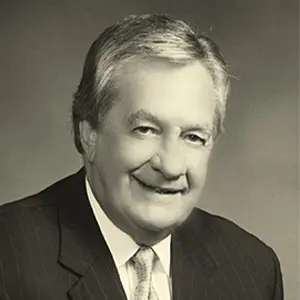
Ted Fisher reflects on 20 years in the Oklahoma Senate, passing House Bill 1017, creating the Quality Jobs Act, and championing early childhood education.
Ted Fisher was elected to the Oklahoma Senate as a member of the Democratic Party representing the 12th district in 1986 and served in office until term-limited in 2006.
Before entering elected office, Ted worked for Warren Petroleum in Tulsa and Montgomery Ward in Sapulpa, Oklahoma, the company best known for its mail-order catalog. He later joined a real estate and insurance firm before being recruited to run for office.
As a senator, he sponsored legislation that provided funding for the Training for Industry Programs, authored the Welfare Reform Act, and established regional centers of the Oklahoma School of Science and Mathematics. He also sponsored legislation for Early Childhood Education. After leaving the Senate, he became economic development director for his hometown of Sapulpa.
In 2007, Ted was inducted into the Oklahoma Career Tech Hall of Fame.
Full Interview Transcript
Chapter 1 - Introduction
Ted Fisher was elected to the Oklahoma Senate as a member of the Democratic Party representing the 12th district in 1986 and served in office until term-limited in 2006.
Before entering elected office, Ted worked for Warren Petroleum in Tulsa and Montgomery Ward in Sapulpa, Oklahoma, the company best known for its mail-order catalog. He later joined a real estate and insurance firm before being recruited to run for office.
As a senator, he sponsored legislation that provided funding for the Training for Industry Programs, authored the Welfare Reform Act, and established regional centers of the Oklahoma School of Science and Mathematics. He also sponsored legislation for Early Childhood Education. After leaving the Senate, he became economic development director for his hometown of Sapulpa.
In 2007, Ted was inducted into the Oklahoma Career Tech Hall of Fame. Listen to Ted talk about being a driver for W. K. Warren, the drama of House Bill 17, and his passion for Early Childhood Education on the podcast and website VoicesOfOklahoma.com.
Chapter 2 - W. K. Warren
John Erling (JE): Well, my name is John Erling, and today's date is July 14, 2026. So Ted, would you state your full name, please?
Ted Fisher (TF): Ted V. Fisher.
JE: What does the V stand for?
TF: Vern.
JE: And we are recording this interview in the facilities of Voices of Oklahoma. In Tulsa, your birth date?
TF: 12-6-41.
JE: December 6, 1941. The day before--
TF: Pearl Harbor.
JE: And maybe at the outset here, we can talk a little bit about something, a health issue you're dealing with, and that is Parkinson's.
TF: Yes.
JE: Have—has this come on for a long time and how is it affecting you?
TF: Well, 7 or 8 years I've been diagnosed, I guess, and it's affected my voice and my balance. I have to be very careful. I was an avid golfer and I can't play golf anymore, but I've—I live a full life. I'm—it's—it's—I've got good doctors and good medicine and I'm gonna be OK.
JE: Right, right. Well, I appreciate you doing this under these circumstances. Where were you born?
TF: Holton, Kansas.
JE: Did you grow up there?
TF: No, no, no. Came to Oklahoma at age 3. Came to Jenks.
JE: Let's talk about your mother. Your mother's name, maiden name, where she was born.
TF: Maude Jeffries was her maiden name and born in Lebanon, Missouri.
JE: Her personality, what was she like?
TF: She's the most loving person I've ever known. She had 7 children -- was unbelievable, loving person.
JE: Your father's name?
TF: James Ray Fisher, and he was a little more strict. He was a Baptist minister, so—
JE: Oh, really?
TF: Yes. I had to have a little more latitude. I'm a Presbyterian. (Laughing)
JE: (Laughing) Right. So, and what his personality then he was pretty strict?
TF: Very strict, harsh.
JE: And did he come from Kansas as well?
TF: No, no, he was born in Sallisaw, Oklahoma.
JE: So you were a preacher's kid?
TF: Yeah.
JE: And did people think you needed to be a preacher too?
TF: Well, I never did flow in those directions. I was not an unruly kid. I was very obedient, but I wasn't a preacher.
JE: Right, right. Your education, where did you first go to grade school?
TF: Well, I went 12 years of Jenks public schools.
JE: And you graduated from there.
TF: Yeah.
JE: What year?
TF: '59.
JE: What was high school like? Were you involved in organizations or sports?
TF: All sports. I played all sports. Wasn't great at any of them, but I played them. We were small, a mud puddle town, and everybody had to play everything.
JE: And Jenks football wasn't what it is today.
TF: No, no. No, it had been, but it wasn't during my time there. It really came on later.
JE: All right, so you played football, baseball—
TF: Baseball, basketball—
JE: And basketball.
TF: Got a scholarship in basketball, went to NEO and played in junior college, and then went to Northeastern and didn't play anymore after junior college. I'm—I burned out.
JE: But you said you golfed, so you took up that later in life. Or—
TF: Yeah, I caddied when I was 12 years old and learned the game of golf.
JE: Where did you caddy?
TF: Meadowbrook Country Club here in Tulsa. It was a Jewish country club at the time.
JE: Yes. Yes, yes.
TF: They're great people.
JE: So, you're somebody, your parents drove you to—
TF: The—well, yeah, we'd—I'd walk. It's only 3 miles from my home.
JE: And then you said after high school you went to what school?
TF: NEO, Northeastern Oklahoma A&M.
JE: And that's in Miami.
TF: Miami, right.
JE: Yes. And then you went to…?
TF: Northeastern.
JE: Northeastern in Tahlequah?
TF: Right.
JE: And you graduated when?
TF: I didn't graduate. I came back, went to TU.
JE: Went to TU.
TF: Yeah, 1 semester and then went in the army.
JE: So what year are we talking about then at TU and going in the army?
TF: Oh, I guess '63.
JE: All right, in '63 you went in the army?
TF: Well, no, I went in the army. I went to work. I quit TU and I went to work for Warren Petroleum. I was a mail boy at Warren Petroleum and in that I chauffeured Mr. Warren—W.K. Warren Senior. I was his chauffeur from time to time.
JE: Oh, really? How interesting to be around him.
TF: Oh ,yeah.
JE: What kind of a person was he?
TF: Well, it was interesting that I'd drive him and I never spoke to him. It was my old caddy days—caddies never speak to their carry, so I never spoke to the man. And he would always speak to me and tell me where he was going. I'd take him to Southern Hills or the bank or the airport.
One day—he's going to the airport to go to the board of directors meeting in Pittsburgh, Gulf Oil, and he's supposed to leave at 10 o'clock. Well, he doesn't come downstairs, and he doesn't come down. The pilots are calling. "Where is he?" "Well, I don't know, but when he comes down, I'll bring him." But it wears on for an hour, and they'd call back. Another hour, they'd call back. Finally he comes down and he says, "Airport." OK, I take off to the airport.
And we get to the airport, and on the way to the airport, he makes a statement to me—he starts talking to me. He says, "I don't think people ought to buy anything unless they can pay cash for it." And brash young college man—I'm not, trust me, I was not crude or rude—I said, "Well, Mr. Warren, if that's the case, my folks would never have had a home." "Oh, sonny, he didn't mean a home. I don't mean a home." And I said, "Mr. Warren, my folks wouldn't have had a car." Well, then the conversation started. I cannot tell you one sentence either of us uttered after that except the conversation was on. And I—as a matter of fact, I remember I was saying—as a matter of fact, "Mr. Warren, I don't know if we'd have had a refrigerator if we couldn't have paid it out."
At any rate, it was—an interesting time and he—we pulled up to the airport that day. I remember the pilot's been calling all this time, filing new flight plans and everything, and it was—I pulled up under the wing of the plane as I always did, and I got out of the station wagon to get his luggage out. I start up the stairs into the plane as I always did. The chief pilot was at the top of the stairs, saying, "You little SOB, what have you got that's so important to talk about?" Because we had been under the wing of the plane talking for about another 3 or 4 minutes. It must have been an hour to that pilot. And at any rate, he was—and I said, well, I said, "This is an important meeting this time at Gulf, and he really needed my input."
JE: (Laughing)
TF: (Laughing) At any rate, it was a fun time.
But I left. I worked for Warren Petroleum with the idea I was going to go to night school. After that airport trip, I got a call from my vice president, and he said, "How would you like to go to New Mexico, to one of our plants -- facilities?" I was making $270 a month, by the way, as a mail boy. And he said, "Well, I don't know." I said, "What does it pay?" He said, "$540 a month." I said, "I'm gone." And double my pay, you bet, huh. Those were the days.
JE: Do you think that call came about because of your conversation?
TF: I just always thought so. I don't have any proof that it.
JE: So WK respected you. You challenged him.
TF: I can't know that. I don't know that.
JE: Right. It's a possibility, though, and he ended up liking you. Did it -- did the conversation end OK?
TF: Oh yeah, it was great. I mean, it was great, and his secretary was a Sarah Jane Quinn. She was a beautiful, mature lady—but she ran the show, believe me, she was the king of the walk, queen of the walk I guess would be.
JE: So WK listened to her?
TF: Well, could be, could be. I don't know those things.
Chapter 3 - Insurance & Real Estate
John Erling (JE): But then what did you do when you went to New Mexico?
Ted Fisher (TF): Well, I was a productionist, they call it there, which was a flunky, I guess, but I did some important work. I was a productionist and we measured our intake into the plant. It was an LPG plant. I did my part of it. I don't—I'm a small part of that operation, but. And I got draft notice to go to the army. I went in the army.
JE: All right. And so this is around '64 or '5 in there.
TF: And so '64. I went in the army in—
JE: And this is because of Vietnam. You got your draft notice?
TF: Right.
JE: Where did you go then after you were drafted? Where did you do your basic training?
TF: Fort Polk, Louisiana.
JE: And then did you end up going to Vietnam?
TF: No, no, I stayed in the reserves.
JE: Oh, you were in the Army Reserves. Who were you attached to? What was it?
TF: 46th Civil Affairs Group here in Tulsa.
JE: And then you probably did 7 years and you did--
TF: Yeah, 6 years.
JE: Once a month weekend meeting and 2 months in the summertime. I'm well aware of that because I did the same things you did.
TF: That's what I did.
JE: Right. And then, but then you were still working in New Mexico. No, where were you working?
TF: Yeah, I was in New Mexico. I was working, but I left New Mexico and came back.
JE: And so that you could go in the reserves. But then you had to work here. What was your job here in Tulsa?
TF: Oh, OK. One of my reservist buddies. District manager for Montgomery Ward, and he hired me to go in their training program and become a district—a store manager for Montgomery Ward, and I did that. Went through the training program in Kansas City, and they offered me, “Here's a list of stores that are available to you,” which I said, “Which is the worst one?” And he said, "Sapulpa, Oklahoma."
JE: Why did you ask for the worst one?
TF: Well, that's where you can make the most bones. You don't want to go to the best one and fall short. I'd rather go to the worst one and bring it out of the dust. That's my thinking.
JE: So I hadn't heard that name Montgomery Ward for a long time, and Montgomery Ward—tell them, because a lot of people don't know what that was.
TF: It was a Sears Roebuck competitor and a catalog store, and catalog was a big thing back then. There was—and they were—we were a catalog store.
JE: When you say catalog store, they'd get the catalogs. I don't know, they came in the mail or something and then they could see what they want. They come into the store to purchase the product. We're talking…
TF: '66.
JE: '66.
TF: I'd been there a year and I really liked the town. We're in the foothills of the Tulsa mountains, you know. (Chuckling)
JE: Yes. (Chuckling)
TF: At any rate, we're a local insurance and real estate company there, very respected company, and called on me, wanted me to go to work for him. And I said, "What do you do?" And he said, "We're in the real estate and insurance business." I said, "I don't know anything about either one of them." "We'll train you. We want you to go to work for us." So I did, and wound up owning the company.
JE: And the name of the company was?
TF: Lon T. Jackson Agency.
JE: I want to compliment you here because you obviously had the personality that people saw. I'm going to call it maybe a salesman's personality. Would you agree with that?
TF: Well, I guess, yes, I guess so.
JE: Right, right. So you were a stand-up wherever you went. As to be a leader, and we'll certainly know that as we continue with our conversation. Then you got into the insurance business and real estate business. First of all, what kind of insurance?
TF: I was a general agent. We were homeowners, automobile, commercial. Everything.
JE: And then why is real estate under the same roof?
TF: Well, it's just what many did back in those days. You needed the additional income. I loved the real estate and hated the insurance.
JE: And why is that?
TF: I really can't tell you. I just never warmed up to the insurance. I hate—I loved the real estate. I was licensed. I was good at it, but I wasn't as good as I could have been.
JE: But it was also handy because if you were selling real estate and you sold house, it was—
TF: Homeowners—
JE: You had a homeowner's insurance, you did it right there. Well, we just—OK, well, you bought this house, well, we have insurance to—
TF: Cover it. Exactly, exactly, and did that every time.
JE: So homes back then were selling average, what kind of cost do you think?
TF: Oh, John, it's dirt cheap. I mean—my first house, $20,000 for it. I didn't thought the payment was $123 a month. I thought, "I'll never get this paid off."
JE: Well, how long did you work there before you became the owner?
TF: Oh well, I wasn't. I was just partially owner. I was just became a partner, and then as time went on and I never did own it by myself. I went into—when I went into the legislature—I diminished my interest in the business.
Chapter 4 - Elected Office
John Erling (JE): Was politics of interest to you at all as a young person or in college or whatever?
Ted Fisher (TF): As I got into deeper Sapulpa and politics, it became interesting to me. I didn't really realize that when you go into politics you live your life with an audience. That was interesting to me.
JE: Did you get involved in the city?
TF: Yes.
JE: Did you—
TF: School boards — anything to help the community. Deeply involved civically in the community and the attendant politics that goes with that—bond issues and city councilmen and school board members. I would run campaigns. I was kind of a local—yeah, but I never dreamed I would run for anything.
JE: Remember any issues back then in the '60s that Sapulpa faced?
TF: Oh yeah, well, mostly local. We needed a new sewer plant, and one I remember—we used, and I organized a campaign—"Vote yes for sewer, just for the smell of it." (Laughing)
JE: Well, that worked, didn't it? (Laughing)
TF: Yeah, it worked great.
JE: So you were enjoying all that, but then somewhere along the line—I mean, now we're going to jump up into—so you did that for a long time before you ran for the Senate.
TF: I ran for the Senate in 1986.
JE: So those years building up there, you were doing your insurance and real estate, city government in Sapulpa, not realizing you were laying the groundwork for what you were about to do.
TF: Exactly. I had no idea I would ever—
JE: I suppose somebody came to you and said you ought to run for Senate.
TF: Yes, they did. Two of my friends, two attorneys—
JE: Who were they?
TF: Streeter Speakman and Lester Henderson, both judges.
JE: OK, tell us about that.
TF: Well, I had thought that Lester Henderson would be a great senator, and I talked to him about running, and he considered it, and we ran some tests, and we determined that he didn't think he could win as a Republican. I was a Democrat. He dropped out, and so that was the end of that. And then one day—he, at least, and Judge Speakman came to see me, said, "We want you to run for Senate." And I said, "I don't—I don't think about that." I said, "I've got to—" I think my partner was Lon Jackson. I said, "I have to talk to Lon about that." And he said, "We already have." I said, "Well, I think I ought to talk to my wife about that. I don't—this caught me off guard. I can't give you an answer." Well, as it turns out, I agreed to do it.
JE: I guess we could point out that, as unbelievable as it is today, Oklahoma was a Democrat state.
TF: Yes, it was.
JE: It controlled the legislature, the governor, all. You were in control, and that's why he dropped out, because as a Republican, there is no chance. It's all flipped, of course, today. You said yes to them, and --
TF: Eventually, yeah.
JE: Oh, it took a while. It took a few days?
TF: Yeah.
JE: How did they help you then to begin with, because you'd never run a campaign? So in that area, what is that district? It's the 12th district.
TF: It's the 12th district, yes.
JE: And that covers what areas?
TF: Creek, Lincoln, and Okfuskee counties.
JE: And Bristow was in there.
TF: Bristow.
JE: All right, talk to us then about the campaign.
TF: Well, I took charge of my campaign, but my best friend was a banker, his name was Bob Basinger, and I talked him into being my campaign manager, and what a campaign manager he was. He was unbelievable. He took an envelope and put a card in it and wrote a number, and then he pinned it to the headquarters bulletin board and said, "There's the final tally," in that envelope, and going by 55.1—he had it at 55.2. Weeks out from the election, he was unbelievable.
JE: All right. Who are you running against?
TF: A 22-year incumbent Democrat, John Young. He was a wonderful man. He just couldn't quite bring—get what we needed. We needed roads badly. I ran for jobs and roads. It was my focus. But at any rate, I ran, and I went to see him, because he'd had some health problems and I'd heard he wasn't gonna run. And I said, "John, I heard you might not be running, and I'll have interest." And he said, "Well, my wife's praying about it with her prayer group." A couple of weeks later, I went back and, "John, I'm still interested." "Well," he said, "my wife's prayer group is praying about it." And I said, "Well, when does God normally get back to her on these matters? I think I need to tell you, I think I'm gonna—I'm determined I'm gonna run. But I'll promise you this, I will not—you won't hear a negative word from me." And he didn't, and we ran, and we remained friends till the day he died.
JE: He won that race. And you served for …?
TF: 20 years.
JE: 20 years. The only reason you didn't serve longer is because they had instituted term limits.
TF: Yeah, yeah. Well, I'd had 8 years in when term limits passed.
JE: All right.
TF: So I got another 12 years.
JE: Did you want to serve longer?
TF: I was pretty much ready to come home, I guess, but I'll tell you, it's pretty hard to leave.
JE: You became the Senate majority leader, chairman of the Senate Economic Development Committee, and then you had other committee assignments as well.
TF: Yeah, yeah, it was appropriations, education. Education—House Bill 1017 was a big deal. I was very much for 1017, and Henry Bellmon was a friend of mine.
JE: Let's talk a little bit, as long as you mentioned 1017, because that was so important. Some of the points of it, I believe—improved teacher pay, reduced class sizes, expanded early childhood education, established consistent academic standards, made school funding more equitable, and created a long-term framework for educational accountability.
TF: It was a very important bill.
JE: As a matter of fact, historians considered House Bill 1017 the most comprehensive education reform package in Oklahoma since statehood.
TF: Right.
JE: But there were critics of it, weren't there?
TF: Oh, yes.
JE: Talk to us about it—it wasn't easy to pass.
TF: No, it wasn't. Governor Bellmon couldn't get the Republican caucus—he couldn't get a vote, and we had 4 Democrats that were held out and we needed them. We're looking for Republicans to break over, and they never did. They were led by Tom Cole, who's now the congressman, Cole.
JE: And that caucus was led by Tom Cole.
TF: The Republican caucus was—he was very influential in their caucus. Yes, he's a smart guy.
JE: Yes. But for some reason, why were they against this?
TF: It had taxes in it. Because of taxes—and anything, it's hard to get a Republican to say the word "tax," no matter how much it's needed. That was the crux of the matter. Finally, Senator Bob Cullison, who's president of the Senate, called for a caucus, a Democrat caucus. And there were 10,000 people at the Capitol that day. And we went into caucus, and we're in it for 7 hours. And there was tempers flaring and papers flying, and it was quite a dramatic place, that caucus room. But everybody took a pass at a statement about their position. Finally, there was a proposal that broke the thing loose. I don't remember the detail of it, but it was a minor thing where we could give a little bit of help to the poor. If we do that, these 4 would come on board.
JE: OK, help to the poor in some—
TF: I'm trying to remember, John. It was a bit of assistance, minor. We agreed right there. Senator Cullison says, "We can do that. Get with staff that moment," and said, "draft this up, put it in a bill and get a bill distributed." The staff is amazing. They work so fast and so beautifully and competently, and they put it together, and we left that caucus room and went straight to the floor of the Senate and voted. And it was quite a—10,000 people at the Capitol demonstrating that day.
JE: Teachers and everybody?
TF: Oh yeah, parents.
JE: Had come across from the state, across the state to the Capitol to support—
TF: It was raining outside. And they were walking in the rain. It was quite a sight. But it was something to behold, really. But when we came out of that caucus room, we had to make our way through this crowd of people.
JE: And they're all yelling at you, shouting, probably?
TF: They knew by the looks on our faces we have a deal. Worked out good.
JE: Oh yes. So then you were able to pass it without the Republicans?
TF: Yes.
JE: And there were, I think… 3, 4, 5 of them from Tulsa.
TF: They all got beat—4 of them got beat.
JE: After that.
TF: Yeah.
JE: Senator Charlie Ford was one of them, as I recall.
TF: Well, he was against it, but he didn't get beat.
JE: He won, but the other 4 lost the races.
TF: There's 4 of them that lost.
JE: But then let's go back and remember now, here is Henry Bellmon, a Republican in a Democrat state, and he was very much for this from the beginning.
TF: Yes, yes, he was very strong, and at his urging—he told us what he wanted to do, really. And, "We're not gonna go anywhere in the state unless we get something done about education." Senator Bernice Shedrick was the chairman of education, and she was a firebrand. Worked like a dog.
JE: Of course, Henry Bellmon was so down to earth. I would say he's—would you agree—one of our greater governors?
TF: Oh, by far, yeah. He's a great, great man.
JE: Right? But he couldn't bring these Republicans across with him.
TF: Yeah, yeah, not—well, he got a lot of them, but he couldn't get all of them. Well, he couldn't get any of them. As a matter of fact, he got one.
JE: Who was that?
TF: Owen Branstetter. Senator Branstetter from Enid, I think.
Chapter 5 - Quality Jobs Act
John Erling (JE): You created the Oklahoma Quality Jobs Act in 1993. Tell us about that.
Ted Fisher (TF): The way we operated when I got there is a prospect comes to town and thinks they're thinking about moving their business, and we'd swing into action and get an incentive wrestled up for them, see. And if they wouldn't come, that incentive would go away with them.
United Airlines came to town, going to build a huge facility. So we put together and hustled up an incentive program for them. They took our proposal and went to Denver, shopped our proposal. Denver or Colorado put together a proposal, and they took it to Indianapolis and shopped it there, and we found out about it. And Governor Walters and I—I had my input and said, "I—we're through with this. We're not gonna play that game. We want to create a program that, regardless of who comes, here's our program. Not one built for you, but here's our program and we'll do for anybody."
Well, we wrote the Quality Jobs bill, and with the help of some bright staff—I wanna tell you, they were great—input from Governor Walters. We had very, very smart people working on this thing. And I get credit for it a lot that I don't deserve. Governor Walters was deeply involved in it. This bill—just to put an emphasis on it—won 4 national awards.
JE: OK. What incentives were built into this Quality Jobs Act to bring people to Oklahoma?
TF: Here was the program. It's so simple. If you will create a payroll of $2.5 million—80% of your employees must be full-time. You must provide health insurance for your employees and pay at least 50% of the premium. If you'll do those three things, we will refund to you, on a quarterly basis, up to 5% of your gross payroll for 10 years.
JE: Did you put those numbers together?
TF: Well, I don't wanna—I'm not gonna take that kind of credit off of it, but—
JE: You were in on a committee.
TF: Yeah. We worked—I remember just writing with Brian Maddie and a staffer, brilliant guy, Vic Thompson, Carolyn Dennis, Jan Young. I hate to bring names because you leave somebody out. But we would put these together, and then the economist at Commerce would have to run the model out and see if it's revenue positive for the state. If it wasn't revenue positive for the state, we couldn't do it. We'd have to adjust it and keep doing it till it was revenue positive, to fight the argument that it's welfare for the—corporate welfare. So we had to beat that rap and figured out a way to do it.
JE: All right then, what business came because of that?
TF: Several. It created 93,000 jobs in the first 18 months.
JE: 93,000?
TF: 93,000. And I can't tell you—one, the first one was Fred Jones Ford in Oklahoma City. They at one time were retail car dealers, but they were manufacturers. They were the first user of that.
JE: It took many, many companies to come in and produce 93,000 jobs.
TF: Yeah, yeah. Well, you do an incentive to cause people to do something they wouldn't do otherwise.
JE: Oklahoma City Thunder took advantage of that, didn't they?
TF: Yes, they did. That's what I understood. I wasn't there for that.
JE: I realize that, but I wanted to point that out. At one point, they took nearly $7 million in rebates from the program. However, the revenue they generate for the state is enormous, of course.
TF: It's revenue positive.
JE: I would say so, right. Then we can move on to other things, like career tech.
TF: Yes.
JE: And it became a system that was nationally recognized. So talk to us about your contributions in career tech.
TF: Well, I'm career tech's biggest supporter. As a matter of fact, I think one time I was the only legislator in their Hall of Fame.
JE: You became a member of the Hall of Fame in 2007. Talk to us—broaden that conversation.
TF: Well, I was just a big supporter of career tech. When you looked around—a delegation of us went to Europe to see the best training supposedly that they had. We went to Germany, Denmark. Those were the two countries that had the very best skill training. We went and looked at them and spent two weeks there, and they couldn't carry vo-tech’s briefcase, and we weren't telling the story. We started telling the story, and there was a period there when there wasn't a month that goes by, there wasn't some delegation from somewhere else, from other countries, come to look at our career tech system. And that was due to Dewey Bartlett and Henry Bellmon.
JE: OK, what made it special?
TF: The TIPS program, Training for Industry Program—I get credit for that too, but the company come to the state, we would pay for their training, in essence, pay their own people to train their new employees. And nobody else did that. At any rate, it became a deciding factor in our economic development, but career tech is amazing. They're just amazing.
JE: Well, it addresses people who wanted a career and they were not going to college, so it gave them a career path that they maybe would never have discovered.
TF: Yes, I mean, college isn't for everybody, but some awfully talented people involved and are needed in our workplace and in our society—the skills and brainpower to burn, and we found a way to utilize it.
JE: You established regional centers of the Oklahoma School of Science and Mathematics.
TF: Yes, higher math and science, chemistry. It is no problem in Tulsa and Oklahoma City, and larger cities, bigger schools, could hire them and provide that education. But those aptitudes are in the rural kids too, and they didn't have the opportunity. Those rural schools could not offer that range. And what I did is I employed the vo-tech, which ran a bus every day to every school to pick up vo-tech students and bring them back to the career tech center, and hire the best math teacher and best science teacher money could buy. And bring those kids there. So that's the program, and we kicked it off, and the first one was at Drumright, and immediately I had 2 kids full ride into MIT. The first year, from little ol' Creek County.
JE: Because you brought that to the rural areas—
TF: Because those kids—rural kids—have math aptitudes.
JE: The Juvenile Justice Reform Act. How did that come about, and how did it come to your attention?
TF: It was in the news a lot and needed attention, and I think Speaker Benson contacted me—would I be the Senate author—and I was happy to do that. He was an attorney and he understood more about the criminal—I mean, the justice part of it—than I did. I brought a layman's perspective to it. We spent a lot of time with juvenile judges and DAs and so forth. But we would meet every Tuesday, Wednesday, and Thursday morning at 7 o'clock, for weeks, and we had to do that at 7 o'clock because his speaker duties—they had lined up with him, stacked in his office all day long. We had to work 2 hours before the day started.
JE: What do you remember though that it stated? What reform was it bringing about?
TF: There was a simple premise that guided it—you're just as dead at the hands of a 15-year-old as you are an adult. I think that was to not overreact, but certainly deal with what we saw as troubles.
JE: When you were running for office—the ranking of issues, more state aid to education—I often wondered why that wasn't always a priority for everyone, because in this day of 2026, we rank near the bottom when it comes to money funded for education. Why do you think that is, that people didn't understand that?
TF: Well, it has to do with the priorities, and this is not free—you have to fund it. One of my meetings with Governor Keating was that if you want the best jobs in economic development, you need to have the best education system— that was my philosophy, and jobs were my priority.
JE: You mean Governor Keating didn't buy into this with you?
TF: No. Well, he didn't have the support of his caucus.
JE: So everybody had pet projects in there.
TF: Oh yeah, yeah, we all had 'em.
JE: And you want to put the money over here and the money over here when they should have put it in education. Here we sit near the bottom in the United States.
Chapter 6 - Importance of Golf
John Erling (JE): OK, let's just talk about how things have changed down through the years. The legislature is flipped. It's Republicans running it now, I suppose. Do you ever see the Democrats taking control again?
Ted Fisher (TF): No, not in my lifetime. When I first went to the legislature, we would fight and argue on the floor, and about 5 o'clock, the flag came down, we'd go to dinner together, and had some really good relationships. Over my 20 years, I saw it deteriorating, and I think the Rush Limbaugh phase took over so much that compromise—getting along—wasn't a good thing.
I traveled a good bit as chairman of economic development. I was deeply involved with commerce, and we'd have these recruiting trips, and I'd go on those trips to many different countries. Some funny stories. I went with Governor Bellmon. We were in Japan, in Tokyo, and we went to the embassy and announced our presence—Governor Bellmon, and Senator Jerry Smith from Tulsa. We went in to see the ambassador, Senator Mike Mansfield from Montana, former majority leader of the U.S. Senate, and we entered the room, and I remember him leaping out of his chair to warmly embrace Governor Bellmon, and he looked at me and said, "This may be one of the finest men that ever sat in the Senate in the United States." Really appreciated that, but he understood the need for education.
We were recruiting companies from Japan, or trying to. We'd had some success with that. On a recruiting trip to England—and we went to, we had a meeting with the ambassador to England, Admiral Crowe from Oklahoma, and he's the most engaging man. I still think—I've sat with the president's—one of the smartest people I've ever met in my life, Admiral Crowe. We were to meet with him for 30 minutes; we were there an hour and a half. And he was just mesmerizing. I enjoyed it so much, but toward the end he says, "Oh, I've got to get something." He got up—a large office—and went to his desk at the far end of the room and came back with a stack of faxes, and he says, "I get these every morning from the United States of what happened yesterday, this news, and the last page is always something humorous." Well, at that time, some political consultant in Washington, D.C. had been caught with a prostitute, and it was all over the news. And he said, "Last night on Jay Leno as follows: “Wouldn't it be terrible if—how awful it would be for your family and your friends and your colleagues to find out that you'd been consorting with a politician. That poor girl.”
JE: (Laughing)
TF: (Laughing) Yeah, at any rate, we had quite a time.
And at any rate, we were—the company that we were recruiting, SMC Electronics, was picking us up at the embassy, and they had to wait an extra hour because we stayed over, and one of their vice presidents or something picked us up and drove us out of the country, north, about 40 miles out of London. Strangely, the driver, the guy who picked us up, asked me, said, "You—anybody play golf?" And I said, "Yeah, I play golf." And that was all he said—he said he played golf.
So at any rate, we go, and we get to the company, and they take us to lunch at this nice place out in one of those little manors in the English countryside. Had a nice lunch, go back, and it's about 2 o'clock, and we're in this meeting in a small conference room. So the door opens, and this guy that drove us out there came and says, "Senator, we've got a tee time at 2:30.” “Tee time? To play golf." “Yeah.” I said, "Well, I don't have clothes or shoes, or, you know, I'm in a suit." He said, "No problem, I got your clubs, you can play in your street shoes." OK, so off we go, and I had a set of rental clubs, none of them matched—they were just hodgepodge clubs. He had everything, but I went and played golf, and I played golf in my street shoes better than I played in my cleats, and I shot a 39, I think—I broke 40. But at any rate, he—when we got in, "Senator can play OK, he can, he plays golf all right." It was like it was a test—were you telling me the truth that you played golf? And I don't know—I've still never figured it out. I just took my suit coat off, my tie off, and rolled up my sleeves and played.
JE: You landed in some business?
TF: Yeah, we got some business. It's kind of funny, golf came up a lot in our foreign travels.
We're in Taiwan, and there was a delegation of 20. We were hosting a lunch at a hotel, 2 round tables of 10. The Secretary-General of Taiwan was our host—his name was Roy Wu. He's an elegant man, very sharp. At lunch he says, "Does anybody here play golf?" And everybody looks at me and says, "Senator plays golf." He said, "Well, how would you like to play with me Saturday?" Considering all of the things I've got to do Saturday, and I've just done that—"I'd love to play golf with you Saturday, but I don't have clubs, shoes, I didn't bring this." "You can play in tennis shoes, and I've got clubs for you." I said, "Well, sure." He said, "Well, you'll get instructions from my office."
And I got a note in my room: "Be in your room at 9 o'clock Saturday. Bring a change of clothes—we will bathe after golf. At 9 o'clock the phone will ring, answer the phone." It's detailed instructions. So 9 o'clock Saturday morning, the phone rang and said, "Meet us at the fountain in the hotel lobby." So we did, change of clothes in hand and everything. We go down there, we go outside, out of the hotel, and he claps his hands, and up comes a car with flags on the front. Now, Creek County boy was impressed.
Went out and played. I played pretty good—we had his father's clubs, and his father was a short man, and his clubs didn't work for me too, too good, but I muscled it around and had a really good day that eventually wound up with further contacts in Taiwan that we managed to exploit to some degree.
JE: Isn't that something?
TF: Yeah, but at any rate, he said you'd like stories, so I got them.
JE: That is amazing. When you're spending several hours with somebody, you bond with them, you talk and you visit. Did you use golf in other countries?
TF: Oh yeah.
JE: And all these people wanted to play golf.
TF: It's a big deal, nationally, internationally. But Parkinson's shut down my golf.
JE: Yeah, that's been tough to take, hasn't it?
TF: Well, it's—I enjoyed the fellowship. I wasn't a great golfer.
JE: Oh, you were though.
TF: Well, I was adequate.
JE: Any other stories that you think about?
TF: I had a couple of Stipe stories that I thought—
JE: Oh, Eugene Stipe, Senator Eugene Stipe—did you have interaction with him?
TF: Interesting man. I think Charlie Ford also said, "If you don't like Gene Stipe, you never met Gene Stipe," because he was a charming, charming man.
JE: Didn't Senator Ford call him the Prince of Darkness?
TF: Yeah, probably did, but they were great friends. Helen Cole—Tom Cole's mother—national Republican committee woman and staunch Republican, and Gene Stipe, staunch Democrat, and they were best of friends. He was a pallbearer at her funeral.
I remember one day he was debating a bill, and he said, "I had this condition, and Senator Cole told me to eat 5 almonds a day." And she said, "Gene, Gene—4 almonds." He said, "Well, that's my problem, I'm overmedicated." (Laughing)
Another time—he was a great debater, great in debate—but he was debating against this bill, furious with this bill, and Senator Gilmer Camp says, "Gene, you're a co-author on the bill." He said, "Now that I've told you the bad parts of this bill, let me tell you why I think you ought to vote for it." *(Laughing)
JE: Were you able to work with him on anything?
TF: Oh yeah, yeah, and I worked with him and I worked against him.
JE: What would be the most enjoyable time of your life, you think?
TF: Probably in the Senate. Friends and colleagues that I made and worked with, been able to accomplish things that matter.
JE: So then, of all that in the Senate, what would you be most proud of? Any bill or anything that you worked on that you could say, "Well, that's number one"?
TF: No, I don't think there's—I had a lot of success. I had a very high success rate in passing legislation and was requested author of request bills and such.
JE: So a lot of people asked you to be an author of a bill because you had a good success rate?
TF: Well, I guess that's what it was. Every new bill was an education for me—subject matter that I sometimes knew nothing about, and I had to get into it.
Chapter 7 - Early Childhood
John Erling (JE): So is there anything else that you want to share?
Ted Fisher (TF): Well, early childhood—I was proud of my work on that.
JE: And what does that mean, early childhood? Explain that.
TF: Well, as George Kaiser put it, “early childhood can break the chain of poverty", and I believe that deeply. It goes like this—little Johnny, no early training at all. They throw him in the first grade, and teacher asks questions, and his hand doesn't go up. And more and more his hand didn't go up, but Susie's does, and there are other kids that know the answer to these things, and pretty soon he's not getting any positive attention, but he's getting attention—it's negative attention. Well, and he goes to 2nd grade and he's still behind the kids that didn't get that early start. He finds there are other little Johnnies just like him, and they start bonding and they start running together. He's headed for prison. So I think it's terribly important.
JE: So early childhood begins at what age?
TF: As early as we can make it, but 3 and 4 be my suggestion.
JE: And so you were instrumental in promoting that in the Senate.
TF: Well, I was one of many. Yeah, I was the author, I was a Senate author. But we were the leader with North Carolina after our work on that, but we had really good public support—Martin Fate of Tulsa, huge on early childhood, George Kaiser, Bob LaFortune. Representative Ron Peters was my House author.
JE: That was a beautiful example, how you said what happens to little Johnny when he gets left behind.
TF: Yeah, yeah. You know, he's sitting there and little Susie says, "I've got to go to the dentist," and he's thinking, "I'm glad I don't have to go to the dentist." And she says, "My daddy's favorite meal is pot roast," and he's thinking, "What's a pot roast? What's a daddy?"
JE: How would you like to be remembered?
TF: Never thought about it. Honest and hardworking, I guess.
JE: Well, you left a great mark on our state. There's no question about that. People spotted something special in you when you were a young person—the biggest argument you had was with W.K. Warren.
TF: Yeah, he's a good, great man.
JE: All right, well, thank you for this very much. We're well aware that you did this under—the fact that you are fighting Parkinson's, and I admire you for that, but I admire you for the work you did in our state. So thank you, Ted.
TF: Thank you, John, for the opportunity. You do important work.
JE: All right, very good.
TF: Thank you.
JE: Thank you.
Gallery
Production Notes
Ted Fisher
Program Credits: Ted Fisher — Interviewee John Erling — Interviewer Mel Myers — Announcer
Ted Fisher. "Ted Fisher: Oklahoma State Senator" Voices of Oklahoma, September 3, 2026, https://www.voicesofoklahoma.com/interviews/fisher-ted/, Accessed October 19, 2026