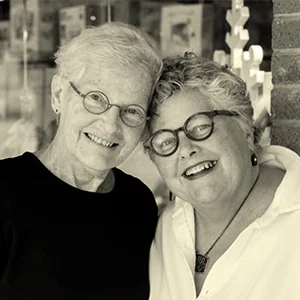
Jan Stevens, owner of The Snow Goose in Tulsa, shares the story of her life, her successes and failures, and the advice she has for others seeking to start a retail business.
From Troy to Tulsa is the story of Jan Stevens, owner of The Snow Goose, a gift shop in Tulsa’s Utica Square.
Jan grew up in Troy, New York, and after attending high school and college, did Master’s work in Fine Arts from the University of Wisconsin in Madison. It was there she began to work in a retail store which sold contemporary gifts, jewelry, dinnerware, and fabrics. Two professors from Tulsa who taught design at the University invited Jan to move to Tulsa to help them set up a store in Fontana Shopping Center.
In 1981, Jan and her sister Elin, opened their own store, The Snow Goose, in Utica Square. It moved to its present location in 1982, and the store observed its forty-fifth anniversary in 2026.
Full Interview Transcript
Chapter 1 - Introduction
Announcer: From Troy to Tulsa is the story of Jan Stevens, owner of The Snow Goose, a gift shop in Tulsa’s Utica Square.
Jan grew up in Troy, New York, and after attending high school and college, did Master’s work in Fine Arts from the University of Wisconsin in Madison. It was there she began to work in a retail store which sold contemporary gifts, jewelry, dinnerware, and fabrics. Two professors from Tulsa who taught design at the University invited Jan to move to Tulsa to help them set up a store in Fontana Shopping Center.
In 1981, Jan and her sister Elin, opened their own store, The Snow Goose, in Utica Square. It moved to its present location in 1982, and the store observed its forty-fifth anniversary in 2026.
Listen to Jan talk about why she moved to Tulsa and the influence of her father on the oral history podcast and website VoicesOfOklahoma.com.
Chapter 2 - Troy, New York
John Erling (JE): My name is John Erling, and today's date is April 1st, 2026. So Jan, would you state your full name, please?
Jan Stevens (JS): Janet Stevens.
JE: Do you have a middle name?
JS: I do not.
JE: And why don't you?
JS: Good question. I don't know. (Chuckling)
JE: And haven't—you've certainly been asked that hundreds of times in school and everywhere.
JS: I have been asked that. My brother -- my older brother -- has a middle name. I think that had to do with at the time he was born, my mother was still a practicing Catholic and Dennis John Stevens. So after that, we weren't practicing anymore. So the next three had no middle names.
JE: Really?
JS: Mm-hmm. (In agreement)
JE: We're recording this in the recording facilities of Voices of Oklahoma here in Tulsa. Your birthdate?
JS: May 14th, coming up, 1949.
JE: Your present age is?
JS: 76.
JE: Where were you born?
JS: I was born in the beautiful little town of Troy, New York.
JE: Where is that in New York?
JS: It is—well, if you refer to upstate, people think that's just outside of New York City, but upstate, it's halfway between New York City and Montreal, so it's near the Vermont border and it's in the tri-city area: Albany, Schenectady, Troy, 25 miles from the border of Vermont.
JE: Your mother's name.
JS: My mother's name is Margaret Allen Stevens.
JE: And where was she born and where did she grow up?
JS: She was born in Hoosick Falls, New York, and that's where she grew up through high school.
JE: What is her heritage?
JS: Irish.
JE: Did her parents come from Ireland?
JS: Her grandparents, yes.
JE: So what was her personality like? How would you describe her?
JS: She was a very opinionated, very strong, lovable woman.
JE: You take something from her?
JS: Oh yeah. You can't help it.
JE: Yeah. Right.
JS: It's not by choice.
JE: And your father's name?
JS: Elwyn Whittle Stevens.
JE: And where did he grow up?
JS: Hoosick Falls, New York.
JE: Okay. His personality?
JS: A bear—a very strong and loving man. He really was frightening to many and otherwise, he's a pussycat inside.
JE: So you saw both sides to his personality?
JS: We saw both sides. We sure did.
JE: Was that good?
JS: It was good. I think it gave us a lot of strength.
JE: And what's his heritage?
JS: English.
JE: And parents coming from or grandparents from…?
JS: Actually, I think, yeah, grandparents.
JE: And what did he do for a living?
JS: He was an architect, graduated as an architect, taught architecture at the school in Troy, New York, Rensselaer Polytechnic Institute, and after that he became the head of the construction fund for state university schools in the state of New York.
JE: I didn't ask your mother, did she have a career?
JS: She did not have a career, but she worked several places in nursery schools and she loved kids. We'd drive around Troy and they'd be in the sort of the lower parts of Troy and she would see some little baby playing out in the—"Oh, just stop," she said, "and pick that baby up." And she always just loved kids.
JE: So she did some volunteer work then through that.
JS: Yes, everything she did was volunteer.
JE: Right. Siblings?
JS: Oldest to youngest?
JE: Yeah.
JS: My brother, he'll be 80 this July; the next sister under me, Elin. And she is the closest to me, although she's 10.5 years younger than me. When she was born, I was just the right age, almost 12, to raise a child, and I did so. And then the next little one, as my parents say, they had her to keep Elin company. So that's Annie's cross to bear, and she is—she'll be, I have no idea. She's 3 years younger than Elin, so do the math.
JE: And I guess in the interest of full disclosure, I have talked to your sister Elin. So some of the material I bring up comes from her. It's all good stuff, but I want the audience to know that I've done that research through your sister. Let's talk about your education, your grade school. Where was that?
JS: In Troy, public grade school, very good school in the city of Troy, one of the top.
JE: Were you a good student?
JS: I was OK in some things and very good in others.
JE: You were quite athletic…
JS: Very.
JE: ...as a child. You grew up swimming in a river in Troy. Tell me about that.
JS: Well, the river isn't just a river, it is—it was our front yard. So my father and grandfather built the house in 1949. It was on—it's on pure slate rock, so about 40 feet off the front of the house, as we call the front that faces the stream, there's a drop off into a huge beautiful rock-lined stream, and there were rapids and falls. Water would go up and down for the season and lots of trout, which obviously attracted a lot of fishing people, but there were—we had 10.5 acres. So it was a wonderland. We were never in the house. We just explored constantly.
JE: But you swam upstream.
JS: Well, yeah, we—in front of our house, we had one of the largest falls. So then it came into a pool where we learned to swim. And the pool could be very mild and then it just gently went down, but you swam against current if you swam up to the falls. So that was that—I think everybody did that that came. They tried and you could go behind the falls, and that was very fun.
JE: But you had to be strong to do that. You also played goalie for your brother's hockey team.
JS: Well, again, my father built a tennis court and then he would flood it in the winter for the peewee hockey friends to practice because there wasn't always ice to practice and they had nobody that wanted to be goalie. So, "Hey, Jan, come on, play goalie." So things would happen. I got hit in it—then they didn't have a puck, so I got hit in the eye with a chunk of ice. That was all right. I think it ended my goalie experience.
JE: But the point is you did it.
JS: I did it. Of course I did it. Yeah, I wanted skating time as well. So I skated, I swam, and all the sports that school had to offer.
Chapter 3 - Only Boys
John Erling (JE): And even I don't know how you did this, when you were about 12 years old, you taught Ukrainian egg dyeing.
Jan Stevens (JS): I did. I did.
JE: Now, before you came, I looked that up. That's some very intricate design.
JS: It’s very intricate. We were looking at some pictures yesterday and I showed to friends. They all sort of knew the process but didn’t quite know how it worked and in the city of Troy was a very large Ukrainian population. I found out about that because I used to attend the Junior Museum of Troy and I taught origami and dyeing eggs and Ukrainian Easter eggs, but they also had a little store to buy all the products you needed to do this. And I loved intricate stuff like that. And I used to tie flies for my father to fish.
JE: Really?
JS: Yeah, his hands were so big and strong, he couldn't manage the little threads and the—so it was fun to me. I mean the colors and the designs and you didn't follow a pattern. You just made it look like some weird fly or something.
JE: But did you use beeswax? I noticed...
JS: And the egg dyeing, yeah, and there's a stylus and you heat it up over a candle and put a little amount of beeswax and it flows through the stylus onto the egg and the pattern. You can draw the pattern with a pencil if you wish, but a lot of it was more freehand. It was intricate. So every time you wanted to color, you covered it with beeswax so it would stay and then you go to your next color and cover it with beeswax, so it will be there at the end, the egg is black. So you take it over your gas flame, your stove, and you start melting the beeswax off. Well, then you possibly could drop it. It breaks on the stove, but the eggs are blown out, so they're hollow. So they're fragile.
JE: Did you have any eggs from those years preserved over the years?
JS: Yes, yes. In fact, just recently, because we still have our house in Troy, we found some that I did when I was young and made sure that Elin took them back to her house so that they wouldn't deteriorate. So it—yeah, they're there.
JE: Were you an artist of any sort in painting?
JS: At that age? No, not really. I did more things like I was creative. My bedroom was a sight. Not so much that I recognized. I knew of many things and I enjoyed them. But not—I didn't actively paint or draw at that point.
JE: Yeah, but you were also, and you still are a musician.
JS: I was, I loved music. When I forget how old I was and I begged my parents to get a piano. "No, no, no, no, no, we don't have a place for a piano. We don't." I said, "Well, really, get a—can I get a piano?" So they found one and it was like a little baby grand with a cracked soundboard. Well, who cares, right? I think it was $50. So I practiced and had lessons and found out that my father could sit down and play some chords and it really—and that shocked me. I had no idea he could do that. He had a great voice as well. And it was just—it was fun. I did that for a while. When I went to college, I left that and started playing the guitar, and I did that for a long time. So with friends and 2 or 3 people and it was great. Of course it was the folk days so that was exciting, right?
JE: Right. Did you take any lessons?
JS: No.
JE: You played by ear?
JS: I did.
JE: You probably can read notes too, even though you didn't take lessons.
JS: I can read notes, but it's just—it was just what you picked up what other people knew. Because you wanted to do that. So that's how I played the guitar and I got pretty good at it.
JE: But not everybody can do that.
JS: No, and they shouldn't. We don't want everybody to do that.
JE: No, I agree because everybody...
JS: That would not sound good.
JE: There wouldn't be an audience then, would there?
JS: Right, right, we'd be left up on the stage, everybody would be up there and nobody listening.
JE: So we're only into this by about 15 minutes and you realize all the talent and gifts that you already have.
JS: Well, no, of course I don't. I mean, it was innate. I mean, it just was there. I don't think of it as something that I had. I just...don't.
JE: It was just when it—when it comes natural.
JS: Yeah. That's probably the thing..
JE: Right. You don't sense that.
JS: No.
JE: Right. So junior high and high school, was that in Troy?
JS: There is no junior high. That was elementary was through 8th grade and then high school, Troy High.
JE: Well, tell us about your high school years. Were you active in events?
JS: Yes, played all the women's sports, was the president of every committee that I could possibly get elected to. I didn't want to be student council president. But Future Teachers of America and on and on and on. So that was pretty fun. It just came to me—one of the things I remember was wanting to take a course in drafting, and it was only for boys. So I remember that to this day and I was so disappointed and I did not understand that at all.
JE: Did they try to explain that to you?
JS: No, no, it was a flat…
JE: “No.” Right.
JS: They tried to tell me I wouldn't like it. I wanted to tell them I was probably better than the boys in the class.
JE: But you might have been on—become a great architect.
JS: Oh well, I doubt it, but that's—that's that.
JE: So high school, good grades, I would imagine. I mean, if you're that involved.
JS: Relatively good. The classes I did not like—like, I took 4 years of Latin and I'm sure it did something to me that was valuable, but I don't know what. So I didn't really like Latin, but you had to take a foreign language, and I also took French. Was I a good student? Like I said, in the things that I loved, I was good. I loved math and I had a great—if you have great teachers, I also loved science. I loved biology, and on and on.
JE: Yeah. What year did you graduate?
JS: '67.
JE: So then what?
JS: Well, then on to the State University of Brockport, New York, in Western New York.
JE: OK, and why there?
JS: It was one of the state schools which I think I was encouraged to go to. I applied to others out of state and I think maybe it was a matter of tuition. Because my father probably had a break at the university schools because that's what he did. So, also, when I looked into it, it was very strong in women's athletics. And that drew me to that, I believe.
JE: So you played what sports in high school?
JS: In high school, I played softball, basketball—and I was on the court when they announced that John F. Kennedy had passed away. And we all just stopped. Swimming, field hockey. That was a good one. And that was a tough one. My father came one day and watched. He had never seen me play and we were centering off. The girl that I was facing just took the hockey stick and just whacked me with it instead of the puck. So my father said, "Oh," he said, "I thought you were just going to kill her." I didn't.
JE: Right. So you excelled in those sports. So were you thinking then of maybe physical education?
JS: That's exactly what I went to school for in college.
JE: As your major?
JS: Yeah.
JE: OK. So how far did you go with that?
JS: Not far.
JE: Why?
JS: I figured out that the time spent on that—for instance, the swim team was 5 nights a week and the tennis team was at least another 2 or 3 times a week at some odd time. It just was on and on and I thought, "Well, when do you go to school? Or how tired do you have to be when you go?" And I switched because I discovered that they had an art department. They didn't have a degree in art, but they had an art department. So I looked into it again. My father knew the president of the university very well and my father encouraged me to go in that direction, so I did. And I was one of the first in the year that I graduated to graduate in fine arts with a fine arts degree. They finally implemented that. Yeah, it was, and it was good. It was so thorough and wonderful. I just enjoyed it so much.
JE: What did you learn the most from that, do you think?
JS: Well, my favorite was metalsmithing.
JE: Metalsmithing?
JE: Jewelry smithing, jewelry. I could work on the forge and the teacher was just amazing for college level. He is still alive and quite famous. I also had great teachers in painting. And I discovered that many of them were affiliated with the Rochester Institute of Art and Design. That was very close to Brockport. It was only 20 miles away, and it wasn't until later that I realized that they showed work in the museum and all kinds of things. They were well known. The sculptor was great, and I remember all of them clearly because they were such influences on what I did.
JE: Back to jewelry. So do you have pieces probably that you've made?
JS: I have a few, yeah.
JE: Did you make a lot of jewelry back then?
JS: Oh gosh, yes, I did.
JE: And you gave—you sold them or gave them away or…?
JS: I did sell some. There's a little sidebar to that. One of my mother's best friends was a professional jeweler. And she was a very good friend of my mother's. And so my father would always buy her something of this, and she was Danish trained. And the jewelry was stunning. So as I—when I grew up, I knew her and then when I got into it, we started talking about it and I knew she was all hand construction and I started doing casting work and she was flabbergasted and loved it. Asked me to teach her how to do it. So I was really excited and we built the whole casting machine out of an old washtub and a centrifuge. She got into it so much that a lot of her pieces were cast and it was really fun.
JE: Help me understand the casting machine—is that how you're beginning to form the jewelry in the cast?
JS: You make a wax model. You carve it out of wax and then you put it in Plaster of Paris in a crucible. And then you heat that crucible up, the wax comes out. And you let the silver flow into it centrifugally. Yeah, it was exciting.
JE: So you taught yourself that?
JS: No, I learned it in school.
JE: Oh, in school. And then you were teaching...
JS: And then I was teaching. Yeah, a real artist. Her—you can see her pieces on eBay and so forth.
Chapter 4 - University of Wisconsin
John Erling (JE): With all these interests in college and all, were you ever beginning to wonder, "What am I going to do when I grow up?"
Jan Stevens (JS): Hm, did I wonder then? You're taking me back. I don't know if I wondered. I just kept following a path that took me places. I ended up going to grad school in fine arts, so.
JE: OK, so you graduated from college in what year?
JS: Whatever 4 years is after '67—'71.
JE: OK. All right. And then did you go to grad school then?
JS: I did.
JE: And where was that?
JS: State University of Wisconsin in Madison.
JE: All right. And why?
JS: Quite a city.
JE: Yes.
JS: A really fabulous reputation. My metal teacher in college knew one of the professors there, Fred Fenster, and said, "Let me show him some of the things you did." Yada yada yada. Strangely enough, when I applied, I got a letter back from Wisconsin and said, "We're sorry. We are not allowing any students from New York in our college because of the bombing at the University of Wisconsin."
JE: Tell me about that.
JS: I don't—I don't have a good grasp on that because it was not—it was shocking to me that that occurred and it seemed to be some obviously New York students that did it. I think it was the math building. I don't remember those things. My teachers were appalled and so they sort of helped get me in and say, "This is not a bomber." (Laughing)
JE: “She hasn't shown any tendency.” (Laughing)
JS: No, not yet. Not yet.
JE: Did you land in a good place? Was that a good experience, Madison?
JS: It really was. It really was. The arts were incredible there, including the enrichment of art history and the dance department and ballet. I knew -- I got to know friends and have roommates and it just blew my mind into a huge other place.
JE: You didn't know that stuff was out there.
JS: I knew it was out there. I hadn't seen it yet.
JE: You hadn't come close to it.
JS: Before I went to grad school, I ran a little silversmith shop for this woman that was best friends with my mother in Western Vermont. And she did that every year, had her own little shop, and Weston was a theater town. Well, I didn't know that either. So all the summer theater, they had a little place there and I saw shows that were unbelievable. So it kind of started. It's crazy and...
JE: You had a little store?
JS: I ran the store, the little shop, “ding ding.” (Chuckling)
JE: Yes, there it all began, didn't it?
JS: Kind of did.
JE: And you ran it for this person?
JS: For the summer, for two summers. I did that. Yeah. Now the unfortunate part of that was that next to the little silversmith shop that I ran was a husband and wife that made fudge. I think I gained about 30 pounds because they would bring the giant copper bowl over for me to clean up. And one summer I had my sisters, my two sisters with me. And oh boy, did they think that was terrific.
JE: Yes, of course, right. So back to Madison. First of all, was that a great time because there were a lot of demonstrations and…?
JS: Well, it was great because Madison was one of the centers for those demonstrations and I thought that was terrific. I'd never seen—it just opened my eyes. I learned so much other than what I was there for. That you just loved it. You loved it.
JE: Do you remember any issues that were current? Did you participate? I suppose you did.
JS: I didn’t.
JE: Oh? Why not?
JS: I didn’t participate. I was not… I’m still not an active member of any kind of thing like that, and I can’t answer why. I loved knowing about it. I loved seeing it happen—was pretty great.
JE: Yeah.
JS: It was certainly the center for pot and all kinds of things. You could walk across the commons and get anything you want, which I didn't do either. So it's just, it was a lovely place. It was between two lakes. My metalsmith teacher took his ice boat to come to work. And he lived right across the lake and he'd ice boat over in the winter.
JE: Ice boat?
JS: Yeah, a boat with skates on it.
JE: Oh, really?
JS: Yeah, and a sail.
JE: Oh, and a sail to mobilize it.
JS: Yeah. So, and he'd pull up to the commons and come into the fine arts building and that. He did that all winter because the lakes froze over and they were beautiful.
JE: University of Wisconsin-Madison is still known for, I would say, liberal thinking and all to this day. It hasn't wavered at all.
JS: I don't think you could possibly change it.
JE: Yeah.
JS: Yeah.
JE: Cold winters, weren't they?
JS: Yes, they were, but you adapt. You adapt. Everybody wore the same anorak and it had a hood with lined fur around it. So when you cross the street, you had no peripheral vision. So, but it was—it was amazing. It was amazing.
JE: See, I referenced that because I grew up in North Dakota.
JS: Well, there you have it.
JE: I'm just a few states over from Wisconsin and we had parkas and playing hockey and all that kind of stuff. So we both know what that's all like, and I love it down here in Tulsa, Oklahoma. A master's then, and then are you graduating with what degree?
JS: MFA.
JE: What is that?
JS: Master of Fine Arts. Now, I did not, to be honest—I went through all the coursework, but I did not hang a show, and that was part of that.
JE: You had to have a show?
JS: Yeah, you had to have a show of some kind. And I did so many things and I just said, "I don't need to do this. I want to move on." At that point, I started in retail.
JE: Where?
JS: In Madison on State Street, there was a store that I loved and it was very contemporary. It was a mini Design Research, which became Crate and Barrel—well, it didn't, but Design Research did. So this was a small smattering and it was owned by a person who knew his way around architecture and design, and he and his two brothers financed it. And it was right on the main street and the products were stunning and they were what I grew up with: clean, contemporary, thoughtful. Just everything, and I just fell in love with it. And I pestered this owner for the longest time. He had an office in the little basement, and I'd walk in the store and I'd go down—I didn't ask to see him, I'd just go down the stairs. "Anything come up yet? You need help?" Well, finally he called. I worked there for at least 3 years.
JE: And what were they selling?
JS: Contemporary gifts and jewelry and household things, but all very uniquely designed. Beautiful. Once you have that bug, it's terrible. That bug—it was a bug for me. It was just something that loomed in me and I just couldn't get enough of it.
JE: Of the design?
JS: Of being surrounded by that, about how much I appreciated it, what it did for my soul. And just looking at it, the visual part of it was for me just like I ate a big ice cream cone. We sold contemporary dinnerware, very contemporary flatware. We sold Marimekko fabric, which probably most people know about now but didn't know that much about it then. It just went on and on. He imported a lot of things, which was lovely. His wife was also very talented and she was into throws and baskets and that sort of thing, but all just gorgeous. We had a lot of American Indian jewelry, a lot of pawn because his wife collected that. So it was fascinating. Tablecloths, napkins, everything.
JE: So as you look back on your life, the seed was planted there more than likely.
JS: The seed was planted there, and he is still in touch with me as I am with him and it's fascinating. He's over 90 and chipper and walks and—just. And I owe a lot to him.
JE: And he's taken great pleasure in your success.
JS: Apparently, yeah.
JE: Yeah. Right.
Chapter 5 - Moving to Tulsa
John Erling (JE): Let's define the years. Is this the early '70s and about how old—you're in your 20s of some sort in there?
Jan Stevens (JS): Yes. Exactly that. Don't ask me to pick any numbers. (Laughing)
JE: I like that kind of—”exactly that.” Let me throw in something here. You also were a pilot.
JS: Oh, I wasn't. I took lessons, but I wasn't a pilot. So I'm sure that came from my silly sister because on one of the lessons I had, I got to take them up with me and I flew the plane. And of course there was a pilot in the plane, but I think their memory was that I flew the plane, and I didn't have any sense of worrying about taking them up. I suppose I should have, but I thought, no, it was great.
JE: OK. So why did you want to take lessons?
JS: I always wanted to try. It was just something that was out there, and I don't even know how I knew that there was a place where you could go and do that, but I did.
JE: And why did you—you didn't pursue that then, did you?
JS: No.
JE: Why?
JS: Well, I didn't have an airplane.
JE: (Laughing)
JS: I didn't have an airplane—like maybe my father could build one because he did build a boat that when he laminated the wood for the boat, it ran from a boiling pot on the stove in the kitchen. It was all a very contemporary house. It was all open. And he put the wood in at one end and strapped it to one of the main supports of the house. Came down in the living room and to bend it. So he was doing all sorts of laminating with these pieces of wood and this boat which he built in the living room. My mother, she had hard times. (Laughing) But it was great fun.
JE: You're getting your creative juices from him, aren't you?
JS: Yeah, there's no question. It is, it was full on from him from day one.
JE: Yeah. And you had to admire his ingenuity and practically building this boat.
JS: Well, yes, that, and the things that we had to take part. He built an addition on the house and we helped.
JE: Oh, really? You know how to swing a hammer, don't you?
JS: Oh, I do.
JE: And use a saw and all the tools that go with it.
JS: Yes, I do. All of us know.
JE: So after you graduated, then you worked in that store.
JS: I did.
JE: What was the name of the store?
JS: Well, Tellus -- T-E-L-L-U-S-- Mater -- M-A-T-E-R. Loosely, it's “Mother Earth”, but it has other meanings.
JE: Alright. And you worked there for…?
JS: 3 or 4 years, something like that. That's where I met some people who were doing some design teaching and work at the university and they were from Tulsa, Oklahoma.
JE: Really?
JS: Uh-huh (In agreement). And they were customers and of course they loved the store for a good reason. That was also their sensitivity in that look.
JE: Their addiction.
JS: Their addiction. I think it is an addiction. It certainly doesn't leave you. So there's no program to help you get rid of it. So I got to know them quite well. They decided, because their sabbatical was up, to go back to Tulsa and build a store.
JE: OK, their sabbatical was up. They were teaching?
JS: They were teaching.
JE: At the…?
JS: The State University of Wisconsin.
JE: So after the sabbatical, they decided not to go back to teaching?
JS: Right.
JE: And why did they come here?
JS: Because they are from here. They were from here.
JE: And what are their names?
JS: Pat and Dave Cheney. I was asked to come down and help after they got it built. Beautiful store at Fontana. And in those days there were some nice stores there.
JE: And what was the name of the store?
JS: Designers 3.
JE: In Fontana?
JS: Yes, I was number 4. (Chuckling)
JE: Right, and Fontana is not what it used to be.
JS: No, not at all. Is anything like it used to be?
JE: No, I know, I know, but that was a going shopping center, wasn't it?
JS: It was, it was booming from what I could tell.
JE: So they came down and started the store and then invited you to come down.
JS: Yes, there were 3 of them. Another one was—who's still a very good friend of mine—Sue Sparks, who was then Sue Krowicki, graduated in interior design from Wisconsin and she worked at the store with me as well. So I got to know them. Obviously, they came down and they kept saying, "Oh, you have to come, you have to come." They decided to open another store in Oklahoma City, 50 Penn, and they did. They opened it up and I went once a week and rearranged and did some interiors and helped the manager that was there and it was fine, but I got a little burnt out from going back and forth. Let's go back to my father again. A best friend, Benjamin Thompson, who opened Design Research—which was a fabulous store in Boston and later was purchased and then became Crate and Barrel, which I think everyone is. So Ben Thompson was an architect. He was good friends of my father's. And through Ben, somehow my father said, "Well, my daughter is in Tulsa." And Ben said, "Really? I'm designing a store in Tulsa." And he said, "No kidding. Well, that's what she—that's what she does, and is work and retail and..." Well, you know how that works. So Mark Connolly—it was Connolly's at the Forum that he designed, that Ben Thompson designed and helped bring in wonderful product in sort of small stores in the big store, and there were all kinds of little areas. So one day, I was at work at Designers 3 and I was on the top of a stepladder and I don't know what I was doing, and in walked Mark Connolly. And if you knew Mark, he walked in the store and he said, "Are you Jan?" He looks up the ladder and I said, "Well, I am. Who are you?" And he said, "Well, I'm building a store downtown at the Forum." And I thought, "Oh, that's nice. I don't even know what it is." So he said, "I've heard a lot about you," and I thought, "Oh dear, here we go." And he said, "I want you to come work for me"
JE: In front of everybody, right?
JS: And I'm at work. "Oh, this is good. Now do I have a choice? I'm either going to be fired from this one and hired in that one, or I don't know what—I'm going to be out on the street." And so I came down off the ladder and I said, "Is there a time we could talk and meet somewhere else?" And, “Oh, yeah, sure enough.” And we did and I did. So I managed that for 3 years until it sort of was—I mean, there was another manager before me. Oh yes, there was. When she left, I slipped into her place.
JE: OK, we have to talk about Connolly's. What was it? What did they sell? And we first of all say the Forum was the Williams Forum.
JS: Williams Center Forum -- downtown.
JE: So, about Connolly's?
JS: It was probably one of the most unique operations—26,000, 27,000 square feet. And there were vignettes within that area. The center courtyard was a small restaurant called—it was a cafe called Al Fresco, which pulled from all the workers and the bank people and all kinds of people in the center itself and they served some kind of early morning things and lunch. I was very busy, but other things like there was a shoe department that was solely by itself, there was a men's—obviously a men's department. There was a bookstore, a women's department, a contemporary kitchen store. There was then like a polo shop. There was—Pierrot had another, this woman had another dress line. She had a whole shop and it just was fascinating. It was really neat to be in that kind of surroundings. I loved it. All part of Connolly's.
JE: Within the Williams Forum?
JS: Everything was in the Williams Forum. It was under that roof. It was Connolly's. But that was the new trend, a new idea. So they became rather special areas where you could buy a Pierrot dress or you could buy a Cuisinart and Marimekko fabric or you could buy all kinds of fascinating things.
JE: So then your role was what?
JS: When I went at first, I actually did mostly the interiors. So I did displays and windows and on and on -- wherever I was needed. I would take over if somebody needed to leave in one of the departments. I would work in there and it was great. It was great.
JE: So you were designing, you were setting up and also participating in sales?
JS: Yes, but here's—we need to go back a couple of years. I came to know a woman who owned a bakery and it was downtown on 7th and I thought it was fascinating, going in the middle of the night and start baking things, but the baked goods were just phenomenal. Eventually became the Bakery on Cherry Street, which really became the thing. So I would go to—in the morning I realized that there was some business to be had at Connolly's because they had this kitchen area and was all out in the open and I would go to this bakery at 7th and Main because I knew the two owners and I built a little cart with wheels. And I filled it with cinnamon rolls and croissants and morning buns, which was something that everybody loved, and I wheeled that thing from my—put it in my car and wheeled it into the Forum and up to Connolly's and I had a breakfast business. It was fabulous.
JE: OK, I'm taken with the fact you built the cart.
JS: Oh God, yeah, don't be taken with that part.
JE: I am!
JS: Be taken how nutty I am to do such a thing. Not the cart, but no, but to...
JE: Offer these goods. I'm sure you sold out pretty fast.
JS: Instantly. It was amazing. I couldn't bring enough upstairs to that place. My cart wasn't big enough. So it was just a great fun time. I loved it. I got to know so many guys that worked in the bank and a lot of women that came in early to their stores and...
JE: Did you roll it around? Did they all come to you?
JS: No, it was actually a bar in the middle of the store. So I laid it all out on the bar and I made coffee.
JE: So that was for the bakery?
JS: But I paid the bakery a percentage and I kept the rest. Connolly's got nothing. (Laughing)
JE: (Laughing)
JS: I'm proud. (Chuckling)
JE: And you did this before you actually went on the clock for Connolly's on that day. You probably start at 9 and...
JS: Well, I picked up the goods at 6 and I was open at 7.
JE: And then you sold out. I'm trying to get you…
JS: Oh, I sold out by 8 or 8:30.
JE: And then went to work. (Laughing)
JS: And then I went to work.
JE: And how long did you do that?
JS: Well, pretty long time. Again, the numbers, I don't know. I mean, I was at Connolly's 3 years, so it had to be not that long, but it was great and it was missed when I left.
JE: I’ll bet it was. Right, yeah. The morning bun—what is that?
JS: It is essentially a croissant and croissant dough which was rolled into a round kind of ball put in muffin tins. And when you roll it, you fill it with butter and cinnamon sugar. And then you put it in muffin tins and it bakes up and it gets this crown. When they come out, they're screaming hot. Come out of the oven, you throw them in a giant bowl of cinnamon sugar on the outside. I'm telling you, I can't tell you how many I ate.
JE: Oh, man…
JS: That and the cinnamon roll was—I've never ever eaten a cinnamon roll like that in my life. Now the morning buns—I actually brought the idea to them from Wisconsin because there was a bakery, a French bakery next to the store, Tellus Mater, that I worked in. And so I figured out how to do it and told them how to do it.
JE: You figured it out?
JS: Well, yeah, it wasn't that technical. You just looked at it and opened it up and there it was, it was no secret.
JE: So that was known as the Cherry Street Bakery?
JS: It was.
JE: Why did they call it Cherry Street?
JS: Well, it wasn't that—it was just The Bakery originally. Now Cherry Street, when they moved because on 7th and Main they built a parking lot, which was much more important than a bakery.
JE: Of course. (Chuckling)
JS: So we kind of found a building that seemed not to be in use on 15th Street, which is Cherry Street. And they are the ones that actually historically discovered that it was called Cherry Street at one time. 15th, only in a certain few blocks, but it was a dry cleaners building. They managed to rent it. Ding! My father came to help in some of the things that were obviously more difficult to do, but he took out certain windows or air conditioners, I can't remember, and put in brick to fill it in like the rest of the building. Helped build out structurally because the roof was not in great shape. He put in some pillars, some structural beams, and it was a great time.
JE: So then they named it Cherry Street?
JS: Had the Bakery on Cherry Street.
JE: Bakery on Cherry Street, but then it became known as Cherry Street.
JS: Oh, yes.
JE: Because of the bakery.
JS: Now that's my take. Other people claim differently, but it was certainly -- that was 1979 or 1980 because I opened the Snow Goose in 1981. It was still going, but the bakery opened before that.
JE: Are you working for the bakery? Are you working for Connolly's? Who are you working for here now?
JS: That is a good question. “What the hell am I doing?”
JE: Right (Chuckling)
JS: I am—I'm not working for the bakery.
JE: OK.
JS: I am a friend of the bakery.
JE: Right, right.
JS: And I loved it though. Some mornings I'd go in and just help at the counter.
JE: But you also knew it wasn't your calling.
JS: Oh, no. No, no, no.
JE: All right. So you're working at Connolly's.
JS: Connolly's was purchased. Connolly's closed and was purchased by an Oklahoma City store that bought it. They wanted me to stay and help. I knew I didn't want to do that. It was predominantly men's clothing.
Chapter 6 - The Snow Goose
Jan Stevens (JS): I thought, if I'm going to do this—I was 31—then I'm going to do it now. So...
John Erling (JE): Meaning, "I start my own story."
JS: That's correct. Now how I do this, what I'm going to do it with, I have no concept of this. I just put my energy into it and I didn't work for a while, which was kind of creepy.
JE: You were able to save money.
JS: Yeah, I had some money, but...
JE: But you were able to live month to month or something?
JS: Yeah, I knew about Tulsa that Utica Square was one of the best centers there were. And I hadn't been there that much. Like some people had the idea—and they still do—that it's, "Oh, it's hoity and it's expensive." Guess what? It's not any different than anywhere else in the country in terms of—now did they have good taste, the Helmrichs? Hell yes. Did they know what they were doing? Yes, and was it a success? Yes, and is it? Yes. So I knew all this. The woman that was the manager at the Forum—of the Forum I came to know while I was there—was the manager at Utica Square. And I got in touch with her and I said, "Is there any chance that there is something really small that is available that I could start a store?" She said, "No, there's nothing." And I said, "OK, could you let me know if something comes up?" She said, "Of course." We had a very good relationship and it wasn't very long after that that I got a call. It was only like a week or two—I don't remember exactly how long—and she said, "We do have a small space, but I think it's awfully small and you might not like it." And I said, "Well, can I come see it?" And she said, "Sure." So I went to see it and I thought it was perfect because it was so small, it was 600 square feet.
JE: And what was the location of that first store?
JS: That little store was the upper part of what is now Starbucks.
JE: Wow.
JS: They wanted to know, "OK, so what are you going to do?" And I said, "Contemporary gifts, Marimekko fabrics, Marimekko clothing. Just beautiful things." And of course they didn't have anything like it in the Square and they thought, well, Bob Buckner had kitchen things and I loved Bob Buckner. He had beautiful things also, not in the same vein, but he was an architect and you could see the relationship between him and the products and I felt the same relationship that I did with the products. So, here we go back again.
JE: Bob Buckner is…?
JS: Bob Buckner was a store owner—Buckner's.
JE: In Utica Square.
JS: In Utica Square. Yeah, very successful. He was just a marvelous person.
JE: So was he selling his products?
JS: Yes, but not like—they weren't mine. He was more of a gourmet kitchen, which really became the thing then—the Cuisinart and all the new things that came about. But he was just incredible. The way he showed things and the way he sold things. "Don't touch it if you're not going to buy it" kind of attitude, but he was just spectacular. Elin and I got to know him and we would go to market and we'd have dinner and it just became a great—
JE: You learned a lot from him?
JS: I only learned that we had the same sensibility. So that's how the relationship grew. I explained to Utica Square what I was going to do. They thought, "Well, this is really—this is nice. We like that." Somehow I was able to take out a loan. How did that happen? Because it had to be another dear friend, when I told him I was wanting to do this, said, "Well, how much do you think you need?" And I told him—and I was probably way off base, but it was a guess—and he said, "Well, I can help you with some of that."
JE: Who are you talking about?
JS: It was a friend, and I won't divulge who that was.
JE: What was the amount?
JS: It was 25,000 I think at that point. And my dear oldest brother said, "Well, I'd be happy to help." So there was another 10,000.
JE: So we're at 35.
JS: So we’re at 35 and I thought, "Boy, I can manage this. This will be fine." So I had a line of credit at the bank with this 35 and then I had my brother's very generous, loving gift—and it wasn't a gift, I had to pay him back. It helped me tremendously get going. After I was there in '82—I opened in '81 and '82—I can hardly tell you this part. I went to dinner early. And Elin was at the store. Four people came in and beat her almost to death and robbed the store. I never have forgiven myself for leaving. And it was just—so after dinner, I had a funny feeling during dinner and I left to go back and I said, "I should go back." I went back and all I saw was blood. And one of the security guards and I said, "What has happened? Where is my sister?" Well, they took her to the ER—the Hillcrest. So I zoomed to the ER and just right into the emergency place and I walked straight in and she was in one of these places being stitched up because they beat her on the head. She had 60 stitches in her head, broke both her wrists just by snapping them.
You might want to hear something else right now, but— Then in comes a Keystone cop at Hillcrest and he said, "Is that your car in the emergency parking?" I said, "Yes." And he said, "Well, you have to go move it." And I said, "I can't move it. I can't leave. I just got here. I cannot leave. I'm sorry." And I handed him the keys and he says, "I'm not gonna move it." And I said, "Well, I guess it'll stay there." "Well then we'll tow it." "OK, I'll move it." So I moved it and it was horrifying to everyone. I mean, to the Square, to Utica Square, to all of our friends, and I was sick for days and Elin, poor Elin, just carried that a long time. Now, you talk about being visual and good at what you see, she recognized from mug books—she found the culprits.
JE: Really?
JS: Yeah, and I am not kidding. They picked up one in Kansas City. There was another one here and a young woman, which was a fluke because when they were going down the hall somewhere at the police department to look at mug shots, here was this young girl sitting on a bench in the hall, and Elin said, "That's her."
JE: In the hall where?
JS: In the hall at the police station where Elin had to go look at mug shots, and she's just sitting on a bench in the hall and Elin just said, "That's her. I know that's her." Well, then, so they got her. It blows my mind. I could look at a mug shot and not know it was you. I wouldn't know myself.
JE: That woman was there for a prior?
JS: Well, obviously, yes, they all had priors. After that for a while, the mother of the real culprit used to call the store and say, "Please, would you let him out?" She'd beg us to let him out.
JE: You mean, don't press charges?
JS: Well, no, they were already pressed. We went to court after that. "If he comes up for parole, would you just go say yes, he can get out?" We went, "No way."
JE: OK, because they were sentenced to prison.
JS: Yes.
JE: For how long?
JS: I don't remember.
JE: OK, for years, and she wanted you, when they came up for probation, to speak on their behalf. And did you?
JS: No, I finally said to her, "Are you crazy?" I said that to her on the phone. I said, "Please don't call us back. We have trauma we will never get over." And my sister—the most.
JE: I was going to say, yeah, they—”I don't care about the money they stole. It was my sister they beat up.”
JS: I don't care about anything that they stole. Absolutely that has no bearing. It was horrible. After that, Walt Helmrich had an advisory person in retail to come to the center, Utica Square. She was from New York and look at it and say, "What balance do I need?" Walt wanted to know what would be good to add to this center.
JE: To the center?
JS: Yeah, OK. I guess they walked the whole square and she came in the store and later Walt came to me and he said, "Well, this person that came and looked at the whole square, the only thing she said was, 'Why is this store in this tiny little spot? It should be in a bigger, better spot.' And so he came and told me that. Riesinger's was a jewelry store. And so that was the corner and it had been empty for a while.
JE: And Frank Riesinger, I've interviewed for Voices of Oklahoma.
JS: Oh, you have? No kidding. Well, Frank—thank you, Frank, because your store was a jewelry store. It had bars on the window in the back, which I liked after the experience we had. And it had drains in the floor back in the back and it had outlets in the floor all over the store where the workbenches were and the jewelry cabinets and so forth. I thought the bones were great and being on a corner—I thought, this is…
JE: Where you are right now.
JS: Where I am right now. Yes, this is our forty-fifth year and I don't know where it went. I know where it went if I look in the mirror. But I really don't know where it went. I'm sure you don't either.
JE: What do you remember some of the businesses in Utica Square were back then, or even when you first came to town?
JS: TG&Y, that was a good one. Other places: Nicole's restaurant on the corner where Stone Horse is now, Renberg's, which was a great department store, and there was a Harold's. Ted's pipe shop was there. I can't remember a whole lot more.
JE: There wasn't a bowling alley, was there?
JS: Not when I was in there. No, I came after the bowling alley.
JE: Oh. But there had been.
JS: There had been a bowling alley. Plenty of room for one. The cafeteria—it wasn't—was it Luby's? No, it wasn't Luby's. It was—it had the woman who greeted you. "Salad lady? You want a salad?" I can't remember the name of the cafeteria. I should because we went there a lot. It was great fun.
JE: But Walt was a very big help to you, wasn't he?
JS: Huge. He became a friend and I think people maybe didn't know him well enough to know how much he cared about what was happening in that center and cared about the people and so forth. We loved him. He would come in a lot and just open the door and say, "Hi," and I'd say "Hi" back and he was magnificent. We thought he was terrific.
JE: And of course he's the inspiration for Voices of Oklahoma.
JS: I did not know that.
JE: I had gone to lunch with him once a month for many, many years. I said, "Why are we talking about this ourselves? Don't you think we should record this and put it on a website and let students and everybody hear it?" He says, "Well, I don't want to do a book because my grandfather Colcord did a book and nobody read it." But he said yes, and so I said, "OK." I'm only saying this because I want to give deference to Walt, how important he was to me and to this project that we're working on right now. All started with him and Peggy too—and we've interviewed her too—but you became a good friend with Peggy, of course, she came along with that.
JS: Yes, she did, and she was—is still. Elin comes back at Christmas time and Elin always helped Peggy with her Christmas gifts and she's still doing it. So this is a big deal. The whole family I got to know and I'm just so lucky.
JE: Why did you call it The Snow Goose?
JS: Utica Square called me and said, "OK, if you want this spot, this little teeny spot, you have to come sign a lease tomorrow." Apparently maybe there was somebody else wanting it; I'm not sure why I had to do it tomorrow. And to sign a lease, she said, "You have to have a name. Do you have a name?" And I said, "No, I don't have a name. I have no idea about a name."
JE: Did you think about calling it “Stevens”?
JS: No. I didn’t even want my name on there. It was agonizing. And as I sat in my living room, I had some really nice decoys: a Canada goose and a couple of ducks and a snow goose. And it was white with black wings and I thought, I'm attracted to black and white and I think that's a nice thing and I like birds and I like the snow goose and I'll just name it that. The Snow Goose, so I have black and white awnings. Well, everybody thought in the beginning I was a down store or a ski shop or something to do with bedding or something to do with down anyway. And so people found out pretty quickly that that wasn't it, but to this day I like it and it's commonly known as "The Goose."
JE: Right. (Chuckling)
Chapter 7 - Not Being a Boss
John Erling (JE): Those early days then, did you use a simple old cash register or how did you…?
Jan Stevens (JS): Early on?
JE: Yeah.
JS: There isn't much you needed technology for and there wasn't any technology. I didn't have a fancy cash register. I had a cigar box drawer—just took a change drawer out of a cash register and used it. And we had a calculator, I guess, or we added it up. I don't know. We were good. Elin and I were good at math. That's one thing. Today I go to market and write up orders and they're not extended and I sit there because I want to know and plug it into my open buy and I sit there and I just run the column and total it and the reps are there…
JE: You can do that in your head?
JS: I can—not in my head, but I do it looking at it. So I do it pretty fast and they all go, "Oh, oh," so. I have one talent.
JE: Eventually, technology does come into work and tell us how that affected you and online and everything else and enhanced and helped you a lot.
JS: It did in the sense that we have exposure. You're in the now. And back then, when technology was coming up in retail, I had a rep come talk to me about building my business within itself. It was a company—I knew the guy because he had Charles Jourdan shoes on the other side of the other block, and he left that and he was doing this rep, teaching people how to do open to buys and markdowns and yada yada yada. And I did it by the seat of my pants. Honestly, I did not know that there could be a formula to this. I was hesitant because I didn't believe there could be a formula to this. So anyway, I got involved and he would come once a month and we'd go over my inventory, my costs, my sales, so forth, so forth, and we would talk about it and I paid him for this. And he said, "There's automated systems now." So then I got with another rep and we had a thing that was all generated by computer and I would send all the information to somewhere—God knows where—and I would get back a report and then I would talk to this guy every month on the phone about where I was and how I matched the report or didn't and what I should do next and so forth. So somebody else was telling me what my gut wasn't accepting, and I was paying a lot of money for that. I thought, I just feel like we should go back to the old days and I can see what I have. This isn't so huge that I can't understand what the best sellers are and what we should buy more of and when we should buy it and seasons and so forth. I swear I can do this and I got rid of everything and now I just have the cash register drawer. That's it. And a little register has nothing—it doesn't do anything for me. It's just a place to ring it up and give me a receipt.
JE: And you knew as much as that program was offering you.
JS: My employees think I did. I do. I don't know if I know as much, but they had me buying way more, and I was always cash flow poor. And boy, I don't like that feeling. You just don't like it when you're chasing money. I didn't want to chase money. I just wanted to be happy and have it balanced. I can tell when I need something and when people say four times from four customers, "When are you going to get such and such?" “Well, how about tomorrow?” Because I respond to that. And I'm so happy that we don't have that. It's so nice.
JE: Was there any time you wondered whether you're going to make it or not?
JS: Oh God, yes. Oh, so many times. And then so many times that I said, "Do I want to?" And then I'd say, "What am I going to do?" My employees are a family. A dear family. Everything I can possibly do with them, for them, I do. It's my way of being not a boss, being a friend and sharing why I want this done and that done and why I think it would look better this way and how much of this and that. And it's so much better. It just makes me feel good. They bring their families' ideas and what they're doing and, "Where are you going this weekend, where are you having dinner?" I mean, we all know each other pretty darn well. I love that.
JE: Why were there times you didn't know you're going to make it? Was that the market itself in Tulsa, with the ups and downs?
JS: There was—yeah, there was a big down. That was scary.
JE: In the '80s, I believe.
JS: Yeah. That's when I worked hard at not having my loan called. Because I just was not wanting to have that happen. There were scary, scary times. They could call that loan—the FDIC, anybody. The bank that I was borrowing from closed.
JE: Oh, really?
JS: Yeah. So you had to come up with your loan or transfer it if you could. So anyway, that all took care of itself. But gosh, it's scary. You have no idea what … money is tragic—what it can do to people. And I just feel for people. I'm compassionate in that I don't want people to suffer because of money or mistakes that they made and couldn't help it. I just can't—I don't have a lot of money, but I love what I do and I'm capable, so. I'm compassionate that way. I have a hard time. We donate out to wazoo for great causes. If they're having auctions, whether it's schools or whether it's charities, whatever it is, we always say yes. It makes me feel good. If this little bit can go in an auction and get money for them, that's great.
JE: Right. To know what to buy and to sell, you don't need to go to market. Is there some product you bought that was a complete flop?
JS: I'm sure—I am so sure we have things that have been sitting there for quite a while that I've had to part with. But once you do, it's like cleansing. It's like right now I'm trying to clean out crap out of my house and it's like, "Oh, I can't—yes, I can, boom." Just donate it, get rid of it, and it feels so good. To everybody out there, just get moving, do it. But oh yeah, make mistakes. Are you kidding me? Sure, you'd have to in 45 years or you wouldn't be able to get to the next place. You need those to happen. They leave you with a memory when you go to market and go, "Huh. Don't get this just because you like it," kind of thing.
JE: So any product that you went to market and you hit on and it was gold to you and you brought it back, man, you couldn't keep it on the shelves?
JS: Lots.
JE: Going to market. Where is “market”?
JS: Well, because I have clothing and gift. So there are—I go to four clothing markets a year which are in Dallas, and then we do two gifts in Dallas and two New York trips. So seven or eight markets, something like that.
JE: Do you enjoy that?
JS: Yes, always. It's exhausting, particularly the ones in New York, and that's where we get the spark. Elin goes with me. That's where we see the new and the special and nobody else has this and we like it. This is good. And people remark when they come in, they say, "Oh, we have never seen these things," and that's what we like. We like them to say that.
JE: One time in New York you met Julie Andrews.
JS: I did.
JE: Tell me about that.
JS: We stayed with friends when we went to New York. There is still a drugstore, Zitomer's, on Madison Avenue at that Upper East Side. There were—I learned at one time—Woody Allen, all kinds of people that we knew as stars. And we were in the lingerie department in Zitomer's. I was looking for a particular make of bra at the time and going through the racks and Elin was looking and looking and I looked up and there was a woman standing there. And all in beautiful khaki top and pants and blonde hair. But she was coughing and coughing. She really had something going on. Well, when she turned enough and I saw who it was, I said, "Elin, it's Julie Andrews." And Elin went, "Huh?" And Elin hid behind one of the lingerie racks. I don't know what one. And I just went up to her. I felt like I'd be real sorry if I didn't say something. And I think I said something when I went up to her—oh, I said, "I'm so sorry that you're so excited to see me that you're coughing." Well, she started to laugh. I just said, "It's a pleasure to meet you," and then left her alone—that's what you have to do. You can't stand there. Carly Simon was at the drugstore downstairs with her son. I knew Carly Simon's babysitter from Wisconsin. And this woman drove a taxi on Martha's Vineyard, and so she got to babysit, she got to know them—James Taylor and Carly—and she was a taxi driver and would pick them up. Well, she became their babysitter. So when I said, "Carly Simon," as she's standing there waiting for a prescription with her son, I said, "Well, I know Chris Osborne was your babysitter and taxi driver on Martha's Vineyard." She just lit up and she said, "Oh, how is she?" So it was just great. She's a person—these people are people and they like to be people, not because I said, "Oh, I love your music," or something like that. It wasn't that. And I didn't say that to Julie Andrews. They don't want to hear that anyway. I just know they don't. But it was fun. Those things are fun.
Chapter 8 - Christmas Season
John Erling (JE): Christmas is your biggest time of the year.
Jan Stevens (JS): Christmas is the big time.
JE: And I know you will stand on a stool and direct traffic?
JS: In the day, I did at one point when we had crowds that big. We don't seem to have that anymore. It seems to be steady instead of this massive race to get something. I don't know what it was about, but there was a time when I had to—when I had to overlook what was happening because you couldn't watch everything. You also with 4 or 5 employees couldn't help everybody either, and I think that people don't mind waiting in a store like ours, and I try and convey that to my employees and I say, "We—you don't have to jump up and take care of them." They understand—it's OK if there's 2 or 3, it's OK—they have to wait in line everywhere they go. And I said, "We don't have to be different than that." And I said that if they like the service they get—which of course they do because we have phenomenal service—then they don't—they don't mind. So don't worry about it. But yeah, there was a time when we'd be so packed that it would kind of give me the willies and I don't know why. I mean, if somebody took something, I'll never know anyway. So why did I do that? I have no idea. I wasn't counting.
JE: But then you'd stand on the stool and start singing Christmas carols.
JS: Well, we did that especially because years and years we were open on Thanksgiving night when the lights turned on and we would serve frozen vodka and it was for customers. We had a sign on the door and we had big—we had big parties. They were very fun. One time I had a luge—a vodka luge of ice that came to—I mean, it was very fun. I had a dance floor one year in that tiny store. I moved everything out and yeah, and I had a karaoke machine. That was very fun, things like that, really good memories.
JE: Were you—do you think you were treated differently in business, at market or because you were a female?
JS: No.
JE: Never felt that at all?
JS: Actually, no, because believe it or not, it's predominantly women.
JE: And you're kind of—
JS: Well, at market, it's a surprise, but it is predominantly women. Because whether or not men own the store, women are the buyers, OK? So, no it—all you see are women. In the showrooms, oftentimes, the men own the showrooms. But they have their reps are all women. It's fascinating.
JE: How has retail changed? Things that you were selling back in the '70s and '80s would not sell today or today... there are new products today that you never had back then. Is there—
JS: Definitely new products that weren't available then that are new that I have. Products that I had then I still have many of them, yes, and I think because they've become more iconic than anything else. A few products were like Braun—B-R-A-U-N…
JE: What is that?
JS: Clocks from Germany.
JE: OK, yes.
JS: Always have had them. Lamy writing instruments—L-A-M-Y—carried them for 45, 47 years and have always had them, but now you can go to Barnes and Noble and see like a huge stand-up thing of Lamy pens. So it's so interesting what I still have that back then was new and to people now is new. Because they weren't exposed to it then.
JE: And you've got a younger generation coming...
JS: We've got a younger generation coming up, yeah, yeah, and that's something I like. I don't—I have younger customers. I like that a lot. For a while it was—everything was—well, people just had the idea that everything is expensive. So I think that was a hurdle to get over. Predominantly I would say that most of our customers were 40 and 50 and up. And now there's a great percentage that is college and up.
JE: Really?
JS: Yeah, which I just love, and I now I see the daughters of and the sons of customer—my original customers—who have babies and who have—and this is just great, and they'll remind me, "Oh, I'm so-and-so's daughter and this is my baby," and kind of thing.
JE: Isn’t that fun?
JE: And it's just a—that part is just fabulous. Yeah, and Leslie who works for me has a photographic memory, whether it's people or things she sees or... "Did I order this?" or "Did I do this?" or "What happens next?" or "What..." She's my calculator, she's my computer. So she's great. She'll tell me when somebody walks out, "Oh, that was so-and-so, don't you remember?" Yada yada yada. Of course she went to Monte Cassino. Yes, Lord, she knows everybody. It's just fabulous. Her father was in TV.
JE: Her father was in TV.
JS: Hurst Swiggert. He was also—
JE: Hurst Swiggert? He was also Santa Claus.
JS: Yes, yes, he was. See, we had an in.
JE: And of course I did Utica Square for many, many years, and he was a Santa Claus --
JS: Exactly! He was the Santa Claus!
JE: -- and the two of us had so much fun riffing off each other. He was a wonderful man.
JS: He was so dear, revered by his family. They miss him still. I do too. He'd come in and for the annual picture, he just lift me off the ground and hold me like this. Somebody would take a picture. I have a whole stack of those. (Laughing)
JE: (Laughing)
Chapter 9 - Special Card Box
John Erling (JE): You have a special card selection there, don't you?
Jan Stevens (JS): I do. This is a good story. Do you remember the ABC board?
JE: Yes!
JS: The Alcohol and Beverage Commission—
JE: Liquor by the drink days.
JS: Not just liquor, but what they considered porn also.
JE: Oh, so they were monitoring that?
JS: What I had was a special box under the counter which had cards that you really, really could not put on the rack. Now whether they were—whether they were the photographs on the card or whether they were whatever was said in the card—I don't know how that got out. Somewhere they heard about it; they came in. And I said, "Oh, you're kidding. You must be mistaken. I don't have such a thing. It doesn't exist here. I wouldn't have that. You see my cards—do you see anything?" Well, to this day, I'll have a customer come in and go, "Well, where are the ones? Do you still have the ones under the counter?" And we go, "No, we're proud to say they're all right out there, face out." The higher you go, the worse they get, so the kids can't really reach them. But we still have a reputation for that.
JE: And how did you get into that form of cards?
JS: Actually, there was some showroom—a great guy who has passed—who had a card showroom. He did have two lines that were really made for a market that—I don't know what market, but somewhere people sold cards like that. Well, I think—was it Leslie? She's been with me that long. Or just Elin—we thought there's a market for this. We know people who come in who would just love these cards. And so we just started and that's the way it went. And we're known for them now.
JE: Yes, you are.
JE: But they aren't nearly—they actually aren't nearly what they were. They were just bold face nasty cards back then. You couldn't get anything that was humorous or in between. It was just a photograph or it was a—and so then finally it evolved and now there's actually humor and more drawing than photograph, so it really evolved.
JE: More inference now, probably.
JS: Yeah, exactly. So it was easier to give to someone.
JE: Maybe some of Tulsa's so-called elite and finest were coming in and buying those kind of cards.
JS: I don't drop names. (Chuckling)
JE: (Laughing) But you've also been kind of a consultant. You've been helping people start businesses. You know how to do the floor plan, lay out the counters. Isn't that true?
JS: It's true. Yeah. I designed and helped Mark Connolly do his store after the one closed. He opened a smaller one at the old Vandever's building downtown. So I drew that up and he loved it and he opened it.
JE: And that just comes naturally to you too, doesn't it?
JS: Yeah, yeah. I drafted for 2 summers at an architectural firm in Troy, New York.
JE: Well, I thought you couldn't take that in school.
JS: Well, you couldn't, but I didn't need to. I had it at home. I saw these things. I saw Dad draw drawings for the additions of the house and for other people and things like that. So I knew where it started and began. I knew how to use an architect's rule and I erased a lot.
JE: Your father and mother too—how old was he when he died?
JS: 91. How lucky were we? And we brought him here. So he was with Elin, who lived down the street, and lived in my house and of course, the two grandkids, Elin's two kids, and he knew it was what was happening and totally he was with it. There was no question and he loved being with those kids, loved it, and he loved what we did. He'd come in and sit in the store and play solitaire on the computer and then he'd go pester Robert Lockwood at his store and sit and chat with Burt Holmes and Robert and just have a good old time. And then he'd sneak off and go downtown to S&J Oyster and have raw oysters, and he wasn't supposed to eat that, but he'd take my car and he would go. I just loved it. It's so fun. Every corner of my car—all four corners—have some sort of ding or scratch…
JE: Oh, from him?
JS: …that wasn't there when I drove it last, but he was so great. When the house was torn down next door to me in the Swan Lake neighborhood, there was another one starting to be built. Well, he didn't—he wouldn't walk that well, so he didn't want to go down my driveway and up to a construction site. One day I came home and he had put a ladder—my tall ladder—against the fence and climbed up and was just up there, just watching. And he was in heaven and I went out and went to myself, "OK, I'm not going to say a word. If this is how he goes, so be it. This is terrific." We all wish, right? Full capacity of brain and physical shortcomings, but he just loved it. But I did take a breath.
JE: How old was your mother when she died?
JS: 74.
JE: OK, so she—
JS: She died on my birthday, on Mother's Day.
JE: Oh wow.
JS: Yeah, it's in here.
JE: Yeah, but you also have another talent that…
JS: I do—yeah.
JE: That is, you're a midwife.
JS: Boy, it felt like it back then.
JE: And women wanted you to be there. And the birth of their children?
JS: How lucky was I?
JE: And how did that start?
JS: I love kids. I love babies. My mother did too, by the way—I said that earlier. These were my contemporaries back then, having children. It just happened. I got really excited when they told me they were pregnant and like one couple called me at 3 in the morning and said, "Oh, she's in labor," and he said, "Can you come over?" And I said, "Sure." And so I'd go and sure enough, the labor had stopped. So we all just laid down on their bed and waited. And then when it was time, took her to the hospital. So I was there, and then that was true of the second one as well and then there were 2 more which I didn't get to see at that point. But a memory is that when the second one came along for my friend, I was caring for the first one who was only 11 months old. So this baby—so I brought the baby, we could go see the new baby. She was holding her new baby and I put the little one next to her mom to see the new baby, and she hauled off and punched her right in the face. I thought, "Oops," and I said, "OK." So it was great. I had 1, 2, 3, 4, 5, maybe 6 before Elin's 2 kids were born. It was just—it just gave me the best feeling. I just loved it, loved it. The whole process.
JE: And they saw how strong you were and they—
JS: Yeah, I liked it.
JE: Yeah, yeah. And then you've stayed in touch, of course, with all those.
JS: Oh my goodness, yes, I know the kids, yeah, yeah. Oh, they're all grown up, they have babies of their own, which is just crazy, isn't it? That's just great.
JE: You do some strange things for your parents' wedding anniversary—one year, you bought them a pair of sheep.
JS: I did. How stupid was that?
JE: What possessed that?
JS: OK, we were on 10.5 acres. And I don't know how—I don't know why—I was driving to Williamstown, Mass. And over the mountain, there was always this farm and it was way down off the side of the mountain. And I just took the dirt road down because I saw a horse and a couple of things. I always was curious. I didn't know if I was going to be struck with a pitchfork or what, but I went down there and I got talking to him and he said to me, "You know, we have twins—lambs." He said, "The mother was killed. You can have them." I thought, "What? 2 sheep?" But they were kind of cute. And I thought, "Boy, wouldn't that be great?" We had 10.5 acres, they could chew up all the grass, whatever. Oh my God, I thought my parents were going to come undone. And I also brought a kitten, which—that had to go back. So I had to take the—when I took the kitten back, he asked me if I wanted the horse. This is way back. He built a pen for them in the back of the garage and it was just great. And he had a tennis court which was—now this tennis court was built all by hand and the clay sifted from the ground that it was built on. In fact, John McEnroe played there when he was a kid.
JE: Really? He lived in that area?
JS: No. Somebody was hosting him or knew him. I'm not sure where he lived at that point. He was pretty young and my father didn't know who he was. He wasn't famous yet. Coming up though, my father said to him—young boys were his nemesis if they weren't polite or didn't dress appropriately, and that was the key—he said, "You only wear whites on this court." This guy gave him a mouth back -- John McEnroe.
JE: Really?
JS: He said something to Dad and he said, "You get off this court, and if you ever want to come back here, you're going to be in whites." So the people who brought him out were friends of Dad's and they swept him away, got him whites, and brought him back. He didn't take anything from young men.
JE: And this was a tennis court again that your dad had built?
JS: Mm-hmm (in agreement). On our property.
JE: But we haven't talked about you playing tennis.
JS: Well, that's how I played. That's how all of us played.
JE: And you did on that. Did you play that throughout in adult years?
JS: Yeah, until I was gone—obviously we all played and all got very good. And we were very proud when we played any of Dad's friends -- men -- and we beat them.
JE: Right. You've admired a lot of people, I would imagine, and Katharine Hepburn comes to mind. That's somebody that I would imagine you'd admire. And why?
JS: Strong. I never saw her in a part that wasn't full of just her opinion and her strength. And then her ability to love and to be compassionate, but then be again strong and state her purpose and her heart. She—I just adored her. I thought she was probably—she was the best thing that I could emulate. I love that—the strength—but then know when it's time to not be that. So I love that. And she was beautiful.
JE: But you communicated with her.
JS: Well, I did. It was kind of a fluke. I'm not sure how I got her address. Anyway, it was just a simple thing. It was a note, and I just told her she had been very important to my growth—not so much the acting, but so much the person. And I mentioned—I said I had the strength to open my own business and I feel compassionate about everything that I do. And she wrote back, which just blew my mind, and she typed a few lines, and I have it framed.
JE: On an Olivetti typewriter.
JS: I'm sure it was.
JE: And somehow, in the world would you have ever gotten her address?
JS: I don't know—somebody I knew. I can't remember. I'm sorry, this is one of the details. Seems like I would remember that, but I was so astonished by the fact that she wrote back, I just put it out and I haven't thought about it in years.
JE: You have it framed hanging.
JS: Yeah, right in my kitchen. Yeah, yeah. And I look at it and think about it.
JE: You know, Elin—I don't—did we fully establish that when you started the first store there in Utica Square, was she in with you at the very beginning?
JS: She is. She was—she was because I said to my family—Elin was waitressing at the country club, and I said, "Is it OK?" because she was 20, maybe 19, 20. "Is it OK if Elin comes and stays with me and helps me get this open?" And that's all I wanted.
JE: Because Elin was…?
JS: In Troy.
JE: Oh, OK. And working as a waitress, and you asked the family, "Could you bring her out?"
JS: Yeah, I did ask the family. Yeah, I wasn't sure that they would make that happen, and they're the ones that had to make it happen. So they said that'll be OK. They put her on a plane.
JE: To Tulsa, Oklahoma.
JS: To Tulsa, Oklahoma.
JE: And she stayed with you, of course, and opened it up, and what a great partnership.
JS: What a partnership. You have no idea how we worked off of one another and what she gave me and what I gave her. Of course, neither of us was aware of it because we were one person. So that was really nice. We always thought, "No, I thought of that. No, it was my idea." Well, that didn't really happen, but I'm sure we all thought it.
JE: What a special gift that is because that doesn't always happen among siblings or any of us. And you had that.
JS: My youngest sister—I have to say about her—she's the one that we are more in awe of in terms of mental ability. She was bright. If she was having a test the next day, she'd be—when she was really young, she'd bang her head against the wall because she knew she was going to fail. She went on all the way through all the education she could possibly have. She was remarkable and is to this day. And although she's retired, she is remarkable. And we just love that to have that.
JE: So what was her career then? What did she finish? What did she do?
JS: She was in administration—universities—and it could be campus housing -- I don’t know the titles exactly -- in the campus buildings and see how that played in. Yeah, just went up the ladder. It was so nice, so fun.
Chapter 10 - Advice
John Erling (JE): 45 years or so ago. Why do you think it has endured all these many, many years?
Jan Stevens (JS): It has endured because we suffered. Because we suffered. We overcame everything that came in our way and we continued when we probably shouldn't have and somebody else wouldn't have. And it just was something that you just didn't want to fail.
JE: Yeah.
JS: We were not people who failed, and I think—it’s just—now it's a gift. Now it's a gift to me and to Elin and to the family and...
JE: And to Tulsa.
JS: Well...
JE: I can say that.
JS: You can say that.
JE: What advice would you give to a young woman who is starting a business today?
JS: “Don’t do it.”
JE: (Laughing)
JS: I wondered when that question was going to come. I have—I've talked to lots of young people who wanted to start and I'd lay it on the line. I'd say, "You're gonna—you're going to have the time when you think, 'Well, I've messed this up,' and 'Now what?'" You're going to start and you're going to spend all your money upfront because you want it to look pretty. You're gonna start and you have not any history and knowledge of retail because you think it would be fun. Fun was a big one, and you start because it looks easy. And I—I was more a naysayer than I was a doer. I never said, "Go ahead," ever, never. I—I had some protective instincts and I'm sure they all walked away thinking I was just a mean old person. I've had kids in high school come and interview me. And that's been fun. I love—I like that. I'd be truthful and tell them the struggles and but how much I love it.
JE: Yeah. You got to love it, don't you?
JS: You have got to love it. Now, there's a difference between loving it and falling in love with your merchandise—cannot do that.
JE: Can't fall in love with your merchandise.
JS: No, you can't. You have to be—you have to be cutthroat, even though you think it's beautiful and you loved it and you chose it and no one is buying it. I'm sorry; you have to move it. It's hard to learn, very, very hard for me because things are precious to me. Particularly when I think of them. Gotta let go somewhere.
JE: How would you like to be remembered?
JS: Good grief. Kind. Strong. Good friend. I haven't seen it all or done it all, but I felt it all.
JE: Yeah. Well, Tulsa's fortunate that you met somebody in Madison, Wisconsin, who lived in Tulsa.
JS: It's so strange.
JE: As we look back at our lives, there are those moments, aren't there?
JS: There are. It's so strange. Yeah, but there's always a path. As long as you see it and it's open for you, there's a path.
JE: Yeah, and you were trained in that retail store to end up doing what you're doing right now—we didn't know it.
JS: I was, yeah. I can't wait for my old boss to read this.
JE: Listen—and they can read the transcript. Yeah, that's great. Well, Jan, thank you so very much for doing this.
JS: Oh, I—I appreciate you asking me.
JE: And we've known each other down through the years for quite some time and...
JS: Many more.
JE: ...and many more through our mutual friend Otto Decker, who passed away in January, and we still feel his missing -- missing him to this day, but we've known each other for a long time, so thank you. And I've been in, and yes, I have bought some of those cards.
JS: Shhhhh!
JE: (Laughing) Thank you! That was good!
JS: Oh, good. I'm so glad.
Gallery
Production Notes
Jan Stevens
Program Credits: Jan Stevens — Interviewee John Erling — Interviewer Mel Myers — Announcer
Notes: Recorded by John Erling in Tulsa, Oklahoma. Digital Audio Sound Recording, Non-Music.
Tags:Contemporary, Gift store, The Snow Goose, Crate & Barrel, Williams Center Forum, Connolly's, Utica Square, Cards, University of Wisconsin - Madison
Jan Stevens. "Jan Stevens: Owner of The Snow Goose" Voices of Oklahoma, April 28, 2026, https://www.voicesofoklahoma.com/interviews/stevens-jan/, Accessed October 11, 2026