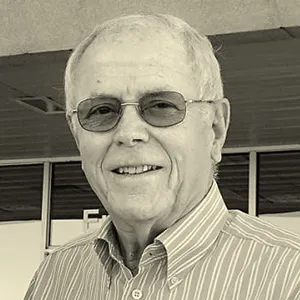
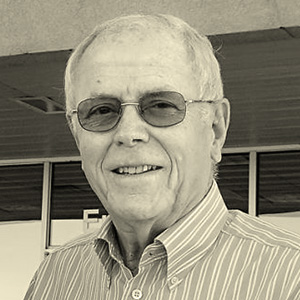
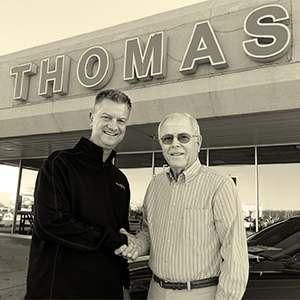
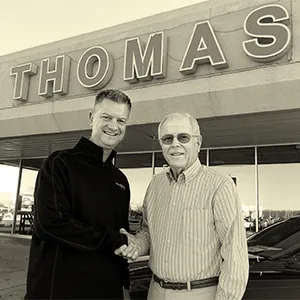
Stillwater's Owen Thomas talks about working his grandfather’s dairy farm at age 14, serving as a Korean War company commander, running a Ford dealership, and overcoming agoraphobia.
Owen Thomas was born in Stillwater, Oklahoma, where he lived most of his 96 years. His grandfather was a dairy farmer, and eventually, 14-year-old Owen and his brother took over the farm, which became the Thomas Brothers Dairy Farm. He graduated from Oklahoma A&M (Oklahoma State University) in 1952.
Owen left Stillwater for the Korean War, where he was commissioned as a second lieutenant, becoming a company commander of a rifle division.
He took over his father’s Ford dealership in 1975 when he was 45 years old, and continued to operate until he was 85. Beyond the dealership, Owen had a vision for real estate. When Stillwater was only about 4 miles wide with mostly dusty or muddy roads, he realized the town would grow, and land would increase in value, so he purchased 35 acres and built several commercial buildings. Through cars and land, Owen Thomas made a positive impact on Stillwater, Oklahoma.
Full Interview Transcript
Chapter 1 - Introduction
Owen Thomas was born in Stillwater, Oklahoma, where he lived most of his 96 years. His grandfather was a dairy farmer, and eventually, 14-year-old Owen and his brother took over the farm, which became the Thomas Brothers Dairy Farm. He graduated from Oklahoma A&M (Oklahoma State University) in 1952.
Owen left Stillwater for the Korean War, where he was commissioned as a second lieutenant, becoming a company commander of a rifle division.
He took over his father’s Ford dealership in 1975 when he was 45 years old, and continued to operate until he was 85. Beyond the dealership, Owen had a vision for real estate. When Stillwater was only about 4 miles wide with mostly dusty or muddy roads, he realized the town would grow, and land would increase in value, so he purchased 35 acres and built several commercial buildings. Through cars and land, Owen Thomas made a positive impact on Stillwater, Oklahoma.
Listen to Owen talk about milking cows, cars of the 1950s, and how he overcame his phobia on the podcast and oral history website VoicesOfOklahoma.com.
Chapter 2 - Day Farmer
John Erling (JE): My name is John Erling, and today's date is May 20th, 2026. So, Owen, would you state your full name, please?
Owen Thomas (OT): Owen Reed Thomas.
JE: And I'm in Tulsa. And where are you when we're recording this?
OT: Stillwater, Oklahoma.
JE: Your birth date.
OT: 03-25-30
JE: And so how old does that make you?
OT: It makes me 96 years old.
JE: (Chuckling) You sound much younger than 96 years old.
OT: Well, I've got to tell you what, my voice isn't quite as clear today as it is some days because, with all these people out here, I think I've caught just a hair of a cold, so my voice isn't quite have the umph that it should.
JE: It sounds great. Where were you born?
OT: I was born in Oklahoma City, and the reason being is they didn't have a hospital in Stillwater, Oklahoma when I was born. And so my mother had to go to Oklahoma City, and I was born down there. And then they lost me, and the name on my birth certificate was “Little Boy Thomas.”
JE: How could they lose you?
OT: I do not know, but I carried that name on my birth certificate until I was about 36 years old. (Chuckling)
JE: (Chuckling)
OT: And then I had to have -- they changed it to one where it’s correct. One of my older sisters and a friend vouched for me that this was true, that that's what -- and then they picked up my name.
JE: What was your mother's name?
OT: My mother's name was Rita Fallows Baumus, B-A-U-M-U-S.
JE: And where was she born and grew up?
OT: She was born in South Dakota. She was born in 1896. Her father moved them to Stillwater, Oklahoma in the year 1900. And he was in the lumber business. And at that particular time, there was a lot of oil action going on in the oil fields close to Stillwater, and they didn't have trucks in those days. And so what they did is they hauled the beams to build the wooden derricks -- they weren't steel in those days -- and they hauled them by a wagon drawn by horses.
JE: So, what was your mother like? Can you describe her personality?
OT: Well, my mother was a well-educated person, and she had gone to Johns Hopkins Hospital back in the east, and she spent 5 years back there to get her degree in med and then practice. And then she came to still back home into Stillwater, where she practiced as a nurse for about several years there before she met my dad.
JE: And what was your father's name?
OT: My dad's name was Harley Owen Thomas. And he came off of a farm close to Tampico, Illinois, and he was a farm kid that came down to Stillwater when he was 20 years old. And the reason he came, his father was one of 10 children. One of the sisters came to Stillwater, Oklahoma, because the man that she married was one of the first two professors at Oklahoma A&M College. And there was one building called Old Central that was sitting out in the middle of a cow pasture, and he died, and she wrote to my dad when he was 20 and asked him, would he come to Oklahoma, down to Stillwater, Oklahoma and take her back to Illinois. And there was hardly a road coming into Stillwater in those days. So she had to come by train into Perry, Oklahoma, which was 24 miles away.
I don't know how he got to Stillwater, but he told me he came down here with $60 in his pocket and to take her back, and I don't know all the story why they didn't go back to Illinois, but nonetheless, she also had a big barn of a house about 3 blocks from this school building, and she opened a bed and breakfast place for the farm kids that lived in the little towns close to Stillwater back in those days, about every 10 to 15 miles, there was a little -- a little town where people had a general store. And people who would go in the shop would have to go 10 or 15 miles, and it took them all day to go and come back and that would be to go to the store to get groceries and supplies. That's what she did.
So my dad decided he would stay and go to school, and he got his degree in agronomy, having been a farm boy, and he taught agronomy for about a year and a half. And then got caught in the World War One and went became an officer in the cavalry in 1919. After awhile, my dad and two of the boys that were living in that house with him at his aunt's, had an opportunity to buy the Ford dealership. And the two men at that time that had the car dealership, why, they were not just trading for used cars because there weren't many of them around. They were trading for horses and cows and pigs and that like, and one of them decided that there wasn't gonna be any future in the car business. And so my dad and his two friends bought the dealership.
JE: What year would that have been about?
OT: December the 21st of 1919.
JE: Your grade school. Where did you go to grade school?
OT: Eugene Field.
JE: In what town?
OT: Right here in Stillwater. In fact, I've already mentioned that I'm 96 years old, and I've lived in Stillwater, Oklahoma for those 96 years. The only time that I was gone was when I went to the Korean War, and I'd gone to ROTC and got a promotion to 2nd lieutenant and became a company commander of a rifle company to take to Korea. I wanted to go. I volunteered to go because I had an opportunity to get an administrative job, and I said, "No, I'll go with the rifle company." And I took sickness just before the time to ship. So I spent all my time in the United States in a training capacity with the National Guard. I got out in 1924.
JE: So then what did you do?
OT: I'll go back in history here for just a little bit -- back to my dad coming down to here in staying. He brought his mother and father off the farm to Stillwater. And built a house for them on a little farm north of Stillwater and put them in the dairy business. And in those days, why, we didn't have all these big dairies that they have today or milking machines or anything of that type, and they milked around 24 head of cattle, which most of the farmers in those days, everybody had 8 or 9 cows and the family milk, not my family, but their own family. My folks' grandparents at about 24, and they would get these college boys off the farm, Kate wanted to go to school, and they would room and board at my grandparents' home for their pay. I think they paid them a little bit of money in addition to that.
My grandparents with bottles of milk in these quart milk jars. They weren't jars, they're actually milk glass milk bottles with a plastic cap on top of them. And my granddad would go door to door peddling this milk. And that, that's how they made their living. My granddad died when I was 6 years old, and my grandmother Thomas died when I was 12 years old. And I had an older brother who was 9 years older, and he said to my father, "Don't sell the cows. We'll have the Thomas Brothers dairy." So when I was 12, and he was older, we started milking those cows by hand, and we did that for 2 years. And he had to go to World War II at that particular time into the medical corps. And he always wanted to be a doctor.
And so my dad said, "Owen, you're 14, you've been milking for 2 years." He said, "I'm going to turn this dairy over to you, and it's going to be your operation, and you're going to learn how to do it. And you're on your own. You'll get to make the money from it. And you can just pay the rest of your way through living here at home." So I did, I took it over and I operate a grade A dairy. The milking county milking inspector came around every month to make sure everything was clean. When I needed to haul hay for the cattle to put in the barn, why I'd borrow a truck, a flatbed truck from one of the local lumber companies. I did that through my sophomore year in college. To tell you the truth, I think there were times that I made more money than some of my friends' fathers did.
Chapter 3 - Military Service
John Erling (JE): What college were you in?
Owen Thomas (OT): Oklahoma A&M College. It's Oklahoma State University now.
JE: OK, so you're in college and you're pursuing a degree. What degree?
OT: Well, having been in the dairy business, I sure wasn't going to stay in the dairy business, but my goal was that I was going to be a rancher in Wyoming. I never made it. So my brother came home in 1950; and my dad at that time -- I mentioned that he had been in the Ford car business with 3 partners, but in 1930, he, when the Depression hit, they weren't doing too well. And since he was the general manager of it, why the bank took him on and told him that they didn't want to repossess anything because they didn't want collateral. They wanted somebody to pay the bills. So my dad took that over in the car business in 1930 and now moving forward back to the 1950, why he decided he would get out. And he wanted to get into the beef cattle business, which he did in a big way. Like I said, my brother and I -- I'm one of 6 children -- he and I formed a partnership.
Now, I was still operating a dairy. I was working down at the dealership, and I was going to school all at the same time. I didn't sleep much, didn't make the best grade on little pop quizzes that they would have. But I'd stay up all night instead of just part of the night and study real hard.
So hat's how I got through. I made some pretty good grades and I got a good education because I took a lot of other things besides agriculture. Yeah, I did graduate. And when I, like I said, I was at an ROTC you had to be to go to Oklahoma A&M College, you had to be in ROTC, your first, your freshman and your sophomore years. That was mandatory for all kids.
And then in the next 2 years -- because everybody was usually out in 4 years -- why, he went into advanced OTC. That particular time was -- Korea had been going on for 2 years, and everybody instead of just going on or getting out of class, if you got out of school while you were immediately drafted. So everybody went to advanced ROTC.
And in the spring of 1952 is when I graduated, why, another fellow by the name of Ralph Snow, we were the first two to get our orders. And so he and I went in the military together. And we were assigned to, like I say, the Ohio National Guard because they had activated them and they were at Camp Polk, Louisiana.
We went down there and everyone was assigned a platoon, the 2nd lieutenants to take their people to the field to teach them. And I don't know. I was very fortunate. People always liked me. And it paid off for me. After I've been there 2 weeks, I didn't have to go to the field anymore. I became the adjutant -- the number 2 person to the company. And in those days, I assume they still are, I don't know. But if you're a company commander, you were responsible for every piece of equipment that was assigned to anybody in your company and that like. And this guy had a mess back there in the warehouse, and I mean, you couldn't find anything. So I got to be the adjutant. I straightened everything out, got everything organized real well, and then before you're an ROTC kid, why then you had to go to Officers Candidate School. So I went to Officers Candidate School those days, I think it was 390 days.
And when I came back, the company commander who had given me that position as adjutant, I think he did ship out. And the next company commander came in and left me in that position. And then they gave me an opportunity to -- and then he moved out and I was made the company commander.
Yeah, that's going on a lot, so a lot of the boys coming in, there's officers and 2nd lieutenant said we're West Point people. They got shipped out and the only reason I didn't is because I got sick just before it was time to go. This was during the Korean War, I wouldn't give anything for that two years because it taught me a lot. It was the first time I'd ever really been away from home.
Then when I came back with a partner with my brother, like I said, in 1950 -- I'm probably the youngest person to ever… I can't say I was the youngest, but I was probably the youngest because and I bought the dealership in January 1st of 1950 from my dad. My brother had come back. Like I said, I had sold my dairy in 1952, so I was still milking cows, I was working at the dealership, going to school as I had mentioned. My brother was my partner for 25 years, and I bought him out. And then I continued to operate till I was 85 years old before I sold the dealership.
JE: OK. What year did you take it over yourself?
OT: It was 1950 when [unintelligible]; I'd be 45 years old, and that would be in 1975.
Chapter 4 - Cars of the 50s
John Erling (JE): But in the 50s. The cars that were selling then -- it was, you were selling Ford. What was your competition, Chevrolet?
Owen Thomas (OT): All this town had several, almost all the dealerships at that time. We didn't have anybody that was making any real expensive cars, but there was Dodge, there's Plymouth, Dodge, and there were, there was Chevrolet and a Buick. There was one other one. I'm trying to think what the other one was, Nash. They were making Nashes in those days.
JE: Were you selling more Fords than anybody or Chevrolets?
OT: Well, I'll tell you what, the Chevrolet was strong in those days, and we were competing pretty hard. The people that owned the Chevrolet dealership were old enough to -- in fact, all the dealers were old enough to be my parents, just to tell you the truth. I was the only kid on the block in those days. And I took advantage of that fact because two of the dealers, the Buick dealer, the Chevrolet dealer's daughters I dated when I was in high school. And so when I took over the dealership there, I used to take them to lunch, and I'd ask them a lot of questions and they helped me. They're always, if you ask people, "Can you help me?" Why, most people, that flatters them and they liked me and so they kind of coached me and brought me on.
So I did a great job. And I got to tell you what, we sold automobiles. I would say, oh, not a lot of them, but it's strange how people will get on a plane and fly 2000, 1500 miles or so and come and buy from you. And once they bought from you and had a nice experience, why you'd sell them another 4 or 5 cars through the years. So, the farthest away was Alaska. A fellow who lived in Nebraska had flown down to our place and bought two vehicles, and his son who lived in Alaska flew all the way from Alaska then down to buy a truck from us.
JE: And why would they fly that far to buy from you?
OT: Well, if people have good experiences, they just do that. I sold a lot of cars. I've sold quite a few cars and the people, believe it or not, in the Houston, Texas. They just become good customers.
JE: How much did the cars cost, say, back in the 50s?
OT: Right after World War Two, they came out with a ‘46 model. They built a ‘42 model that's when they quit building vehicles for the war was in 1942. And in 1946 is when they started building them again. And I can remember the last two-door was like I think it was like $1000. A club coupe was a coupe that had a little back seat in it and it was 10.5 and the four-doors $1100. By the time we got up to about, oh, 1950 … I think automobiles were selling for about $1995 then.
If you think about it, it's just the last 10 years that cars have really, more so in the last five years, that cars have really gotten expensive. Whoever thought that we'd be today -- they're selling Ford pickups for as much as $120,000. Some of these pickups, of course, they have all the things on that cars do now. Speaking of that, I've still got a little 1998 Ranger pickup. That was a small pickup that they built, and it's got little back doors on it and little fold-up seats in the back. But the nice thing about it is, if you're not really a big tall person, or even a big tall person can't reach over the bed, the side of the beds on these new trucks and that like, and you go around the tailgate and you, they're tall enough, you can't turn around and sit down. So I kept this little 1998 pickup of mine. I call it "Little Red," and I could reach over and put my hand on the flat of the bed and turn around, sit out on the tailgate. Yeah, a guy wanted to know how much I'd take for it the other day. He said to give up to $5000 for it. That's more than it sold for, too -- by quite a bit.
JE: Do you think the cars built today are as good as the cars built back there in the 1950s and 1960s?
OT: Well, they weren't built for the durability, of course, they, very few people have ‘em on anything that's not paved today too, as far as quality of that light. There's a lot of those cars that people really drove up to 500,000 miles. I know one person, one customer mine, drove his over a million.
JE: Didn't most people trade their cars in if they hit 100,000 and then they'd trade them in?
OT: Well, they did. Most people would trade somewhere around 65,000 or 70,000 miles. I remember that the second car that I sold when I was in business in 1950 -- the one I gave to my daughter when she was, I traded back for it. They drove it a long time, and I gave it to my daughter when she was a senior in high school. So that's what she drove.
JE: The interstate highway system. Eisenhower established the Interstate highway system. Do you recall when that happened and how that affected cars?
OT: Well, it changed things the way, of course, people started driving a lot more than in those days as far as distances. When I graduated from high school, I graduated with 98 other kids in my senior year. And I would say that there weren’t but about 10 of us that had ever been out of Payne County. Stillwater was in Payne County, Oklahoma, and they had never been out of the county before they graduated from high school.
JE: Were there any times when the economic situation in Oklahoma was not good and people weren't buying cars and you had a difficulty in your business?
OT: There was a time. Our business probably stayed pretty good, pretty even. Our town, when I graduated from high school, where they put a little sign out on the east side of our town, that said, our population was 8000. And until about 10 years ago, I think our population was still somewhere around 19-18 or 19,000. Today, why our population is somewhere around 50 -- the 50 mark -- 50,000. And we have people pouring into our town.
In fact, we've made the comment, those of us who lived to be old. That we wish to go back to the old days. We've got too many people, they're building over 100 houses a year in our town. They were selling as fast as they put them up. And that's another sad part about it. The quality of the material today and the quality of crafting people is pretty poor.
JE: Did you have some special salesmen that were really great?
OT: We did. We did, and I will tell you this. That I just had lunch with the day with a woman that worked for me as one of my secretaries that's out here at this retirement home. And I met another lady who was a hairdresser out here, and her mother had worked for me as a secretary.
But I will tell you what, most of my mechanics that I personally spent time teaching them -- I'd hire farm kids in those days. You could hire these farm kids and they had some mechanical knowledge because they had worked on machinery and that like. But you'd bring them in and every week, why I had class at night, and we had films that showed how to do things that I bought, and we'd sit there and then I taught them how to be technicians.
And many of them, I'd say, stayed anywhere with me from 18 to 20 years. As technicians, and then what would happen, they would just burn out because a lot of things they didn't have the equipment they have today, and things were heavy. They just wore their bodies out. And so then they would do something else.
But as far as administrative people, I've had people work for me as long as 38 years. Oklahoma City was always trying to steal my technicians away because they were well-trained. And the boys, sometimes they were young, they just hire young people. And they'd say, "Well, Mr. Thomas, I got to leave because I could just make more money in Oklahoma City." And I'd say 90% of them would always come back and I'd say, "What brought you home?" And I said, "Well, you for number one, and number two, it's just different. This is a nice place to work."
I've kept our place like a family. We always operated for a big family. And I'd have a big Christmas for them. I always gave, not a chicken or something or a turkey or something, I gave them money and we would have a big Christmas party and Santa Claus would come in and we'd decorate the tree for Christmas and that like. It was just home. I run into these people all the time. And like I say, I live in this town today, and I don't think you'll find a soul. I'm sure there's somebody. I didn't -- you can't please everybody, but I'd say that the majority of the people you'd have a very hard time in my town finding anybody to say anything bad about me.
Chapter 5 - Owen’s Family
John Erling (JE): Did you ever visit the Ford factories in Michigan?
Owen Thomas (OT): I did. I went up there. They had a six-weeks class up there to kind of bring us on and teach us in their manner. Yeah, I went to that. I went over there in 1956. And the fellow that flew back there with me, we both bought the new cars right off the line and drove them home. My wife was going to have -- that 6 weeks that I was gone was the last 6 weeks of my wife's pregnancy with our first child, when she called me on the phone and she said, "I hope you're coming home soon because I think we'll have that baby anytime."
So this kid went to Paul's Valley, Oklahoma where he had gone into business with his dad down there. And we started for home and we went through --, I think we went to Indianapolis that had one of these round circles that you go around, and he turned at the wrong place. And so I, when I realized he had done that, well, I spun around and took it out to chase him, and he thought I was in front of him, so he's just driving 100 miles an hour in places trying to catch up with me. I waited till he ran out of gas after we traveled about half a day, and I pulled up behind him and he said, "Where'd you come from?" I said, "Man, I'm trying to catch up with you."
Well, anyway, we went through another large city on the way home. I can't remember which one it was, and it's a school zone. Fortunately, the kids weren’t out on the street that like -- I wasn't going through there, but I went past there pretty fast. And the cop stopped me and he said, "Where the hell do you think you're going?" And I said, "I'm going to Stillwater, Oklahoma." I said, "If you get out of my way, I'll take off." And he said, "What's the rush?" And I said, "My wife is having a baby." I said, "It'd probably be born before morning." He said, "Get going, boy." And so I, he let me go and I got home at 9 o'clock that night. I walked in the door and I said to my wife, I said, "Whatever you do, don't have that baby tonight." But sure enough, at 7 o'clock the next morning, the baby was born.
JE: And you were there.
OT: And I was there.
JE: What is your wife's name?
OT: Well, her name is Earleanne Thomas, E-A-R-L-E-A-N-N-E. She was named after one of her dad's good friends whose name was Earl. He didn't have an E on the end of it, but said she was an E when they put an E on the Earl and an E on the end of “Ann.” But I kid her sometimes. I call her "Early Annie."
JE: How many children did you have?
OT: We have 4 children. We were married for 2.5 years before we had any. And the first one was a daughter. Her name is Deborah, D-E-B-O-R-A-H, Deborah Scott Thomas.
JE: And then you had three other children.
OT: And then I had three others, and I'll tell you why I named her Scott. While I was up there to that Ford School, why, there was a gal that was like a Sonja Heaney, that was one of the top ice skaters, and I went to see her performances a couple of times.
And so when I got home, I told, we were talking about what we're going to name her. And I said, "That's, let's put Scott in there and I'll tell you what we're gonna do. We'll call her Debbie while she's up to 16. And when she's hits 16, while we're going to call her, start calling her Scott, because in those days, they weren't, it was harder for women to get into a lot of good jobs and things.
And so, she's just take over the name of Scott." I said, "They'll think when she turns in an application or something, why they'll think that she's a male and they'll interview her." And it worked. Most everybody from then on calls her Scott. We still call her Debbie.
JE: And then your other two?
OT: Well, we had a our first son was born about 20 months later. What he did when he got out of school, he said, "Dad, you go to work at 6 o'clock in the morning and you don't get home till 6 or 8 o'clock at night." And he said, "I want to work for you for about 6 years." Well, that 6 years turned into the fact that he came in and he worked at our sales department, and then the sales manager and then I gave him an ownership in it.
Our other, our second son, he is just 1 year or a week younger than the older boy. Two total personalities, total two personalities completely.
He's a little bit of a momma's - not a momma’s boy as an adult -- but he was kind of a mama's boy when he was a little boy. When he got out of college, I told him, I said, "The town's just not big enough for all of us." And I put him in a Bronco. I said, "I want you to get that thing and start driving west and don't stop till you get out of sight." He'd call his mother sometimes and say—not me—and he'd call his mother and say, "How come I can't come home and be at the car dealership now like this since David is?" And we said, "Well, you're doing well, so just stay where you are." But I finally caved in and let him come home. So that he worked in and took over our sales department when he came back to Stillwater.
Then we had another child come along and he's just 53 years old. And I said, "I, we should have called you ‘Oops’", I've got to tell you what, he is a really a well-educated person, that kid is. He's got a high IQ.
Chapter 6 - Real Estate
John Erling (JE): You got into real estate in a big way.
Owen Thomas (OT): I did get in for Stillwater anyway, I did. The town was small. The town probably wasn't but about 4 miles. Yeah, that's a stretching it -- maybe more like 3.5 miles in circumference. When it started growing and that like, I knew some of these old muddy streets that are on the outskirts of Stillwater would someday be worth something. So I bought property at a major intersection. I bought up about 35 acres of this town while it was growing, and all the main highways and corners and that like. So, and I built 8 different buildings, commercial buildings. And I ran into the US Department of Agriculture and I rented it to the university and to a junior college that came here and I think I said the Department of Corrections.
JE: You saw the value in buying land and real estate. Not everybody would see that, but you saw that vision -- had that vision.
OT: Well, I had that vision. I did. And another nice thing about it was, I remember I had to borrow a lot of money. I did all this on borrowed money, and we didn't have but two banks then The Stillwater National Bank, that's the name of it. And then there was the First National Bank. Of course, my parents knew the people that owned those banks when I was growing up. I had to start a little savings account when I was 6 years old. I could borrow money from them. And I could go in. In those days, you go to the bank and you don't see the president of the bank. He's either up on an upper floor or he's not down in the mezzanine where they used to walk around, greet hands. They were greeters of the people that came into the banks, shook their hands and thanked them for coming in in that light.
And I can remember I could go in and if I needed to borrow some money, and I'd go in and come over, well, "What do you need today? What are you doing?" I said, "Well, I got to tell you what, I'm about to run out of money, and I've got to have some money to move forward." And they'd say, "Well -- how do you -- what do you need?" I'd say, "Well, I need $300,000." Today that $300,000 would be a whole lot more than that, just because of inflation. They say, "Well, how soon do you need it?" I said, "Well, I think in the next 15 minutes will be maximum time I've got." And then walk over there and pull out a deal out of check the thing there on the counter and flip the pen out of their pocket and then sign it and say, "Well, OK." And I'd say, "You know what, how come you never asked me for collateral?" They said, "We were interested in the people who pay their bills on time. We don't want your collateral. We usually lose money on those."
JE: Oh, that's a great story. Your reputation is—
OT: It is a great story, and I've got to tell you, it's a true story. Let's go back to when I was in the milking business and that like. I had several of the prominent people in town who were usually my milk customers that came out to the barn. That they got these gallon jugs that I took the other to town to the creamery like having these… I had my own bank account. I wrote my own checks. I went to the sales where they sold cattle and I bid against men in those days, and I can remember they said, I can hear them say sometimes. They’d say -- Harley was my dad's name -- they’d say, "Harley's just too hard on that son," but I've got to tell you what, it was very good training for me.
And when I first started, I used to go out to these little towns at least one day out of every week. And I started at the end of the street, I'd go to every single store and go in and shake hands with not just the owner, but the people that were working in there that I like, every one of those stores. I'd go to a different one as far as 10-15 miles away. And I used to go out to farms that I could talk about farms and that like, because going back before I got into the dairy business, when I was 6 years old, right, we were still trading for things like livestock and the like. And Dad traded for this mother pig, the sow pig, and most of them with a feral that's having the babies. It was 8 to 10 pigs at the most. "I'm going to give you that sow pig. That's gonna be your start."
So I had to take -- I had that 18 -- I took 8 of them and then we in the basement of our house, why, fixed a little brooder down there with a big round wash pad that I drilled a hole of. I didn't drill it, someone drilled it for me. I didn’t do that. And we put a light bulb in there, we put up a little pen down there and I fed those, I fed those little pigs with milk and a nipple, a bottle of the nipple till they got big enough that they could drink milk out of a trough. We sold those. And when we got rid of those, well I got 3 more sows that came in and they have about 8 or 9. So I had 3 sows and all those little piglets. By the time I was 12, so I've been in 4H, the 4H business that like clubs. I learned how to castrate hogs and that like when I was little and that I had my responsibility. I had a little red wagon and I'd get these 5 gallon -- it was all I could reach and carry. I could barely get them up in the wheelbarrow, not the wheelbarrow, but a little 4-wheel wagon. And it was about a block from the house down to the hog shed. And I'd go down there and feed those hogs. We had a garden that's about 1 acre, now about 1 acre and a half. In those days, nothing was by power. You pushed a little hand plow in the hole, that's what you did.
JE: Did you always have electricity and plumbing?
OT: We always had that where we lived. Yeah. The source of water in those days were cisterns. And the water ran off the roof down through charcoal, down a pipe into a little charcoal thing that filtered the water and it ran into a cistern. And then you had wells and windmills and things where you got your water. But we did have the electricity and we also had natural gas where we were there that went to that right at the edge of town.
Chapter 7 - Agoraphobia
John Erling (JE): Now during the course of our interview, Owen just started talking about a fear he had of driving short distance or long distance. This anxiety disorder is known as agoraphobia, when people fear being in situations where escape might be difficult or help might not be available if they experience panic, anxiety, or distress. And it's hard to believe this very outgoing salesman's personality was dealing with this disorder. So here is Owen.
Owen Thomas (OT): I think, I'll tell you another thing that I ran into, down in my late twenties.
One day I was just driving down the road to go see another little town, just go down to see the people. It was about 12:20 in the morning that something just came over me and I thought, I think I'm going to die right here on the road. It scared the hell out of me.
Well, it turned out that the top doctor in town lived in this little town. He was a Jewish fellow from back east that had worked at the little country doctor in this little town. He had one of these units -- medical center -- where they're overseas in World War II, and this Jewish fellow, I met him and through him met this country doctor's only daughter and married him and moved back here from Chicago and moved into that little town.
And so I knew that his office was going to be down there, which by the way, his secretary was my service manager's wife. And that last 5 miles down to that little town, I mean, I was driving 100 miles an hour, whipped in the driveway and honked on the horn and nurses ran out there going, "What's the matter? What's the matter?" I said, "I don't know. I think I'm dying."
And so I remember going in and standing on the little gurney there. And the doctor came in and said, "What's wrong? What?" I said, "I don't know." I said, "I just think, my gosh, I'd be -- I'm about to jump off of this thing. And I don't know. I just, I'm in bad shape. I can't get control of myself."
He said, "Don't worry about it. I'm going to hit you in the damn head with a hammer and I'll straighten you up." (Laughing)
Well, anyway, then I had to go to a fellow in Oklahoma City, this doctor used to take the time off. He gave one week -- one day out every week to this, the OU school down there, medicine, medical school.
And so he and his wife put me between them and then they drove me down and took me to this doggone doctor down there, psychiatrist. And I found out that other people were having some mental problems also.
So I was walking out the front door one day out of my house, and I heard about this guy on the radio from Dallas, and he was citing the fact that he was a wealthy person that had an office in downtown Dallas, but he was listening to the radio and he had gone to some high-powered psychiatric place there in Dallas.
He was telling the story and he was telling his story how that one day that he was at his office. And he just thought all of a sudden that he was just fear came over and grasped him, and he called his mother, who was a widow and he said, "I don't think I'll ever see you again” and that like. And he said, "I think I'm going to die." Well, it turned out that he went to this psychiatric place down there, and he was telling that story how they helped cure him.
I just got to thinking about that, about 3 or 4 months later, I said, "Maybe I need to see that fellow down there, but how do I find out where he is?" So I called the guy who I had heard on the radio and I said, "Tell me the name of that place." And he did. And what was ironic to think that I could call on the phone and the man answered the phone, not some secretary or something, but he referred me to this psychiatric hospital and then the head man that ran it, I picked up the phone, called, and that guy happened to be the one that answered the phone too.
So I got to speak to him in person and I said, "I appreciate you, but I know I've just called you out of the blue. God bless you, hooked me up. Why else wouldn't you have answered the phone?" I told him about how this fellow had referred me to him. And I said, "Would you consider coming to Stillwater?" I said, "One of the things is I'm having a hard time traveling right now." And he said, "Well, what you need to do is just have somebody throw ya in the trunk of a car and haul you down here." And then he laughed and he said, "Well, if you could do that, you wouldn't be calling me, would you?" I said, "No, I want you to come to Stillwater." He said, "Mr. Thomas, I get requests like that every day. I can't do that. Can't do that at all." I said, "Well, I want you to think about it." So I hung up.
A week went by and he called me. And he said, "I've been thinking about you." He said, "If you could get some of the doctors there in Stillwater to get a location where we get about 250 people in there, why, I'll come up there. And I'll bring some people with me." I said, "Well, that sounds like a deal. I think I could do that." Well, I knew the guy that's running the church -- the hospital at that time -- and I knew every doctor in town. And so I got a large building where they had an area there where you can hold that many people, sent out some notices and that like. And we had, I think we had 155 people show up. They had come from all over the state in Stillwater to be there. And some of them couldn't even get out of their cars to get up to the door. They were so anxious, but everybody had a safe person. So they gave quite a talk to him and that like, and etcetera, etcetera. and people could ask him questions.
And then when they got through, I stood up and I said, "Well, you've told everybody what they could do and that like is such and such and so forth. But what I want to know is what are you going to do? We need somebody to come up here." So they said, "Well, if you can meet with the board, with the hospital, why, we'll consider doing that."
So, again, I knew most of the people in town. So I met with about 40 people out at the hospital. They were on the hospital board and all that business and spoke for about an hour and everything was quiet. They thought I was lying because nobody knew I had this problem. And, but sure enough, since I was kind of a main person in the Presbyterian Church, I said, "Well, we'll just meet at the Presbyterian Church." And we did that. And they sent 4 people up here to interview people. We advertised for people to come in who were having these problems. And like I say, we had about 100 people show up. And they flew a man up here every Thursday for the next 5 years. And we had them come from as far as 150 miles away into the Presbyterian Church there.
Some of them, it was hard for th. For one lady lived over in Cushing, which was about 25 miles away, a little town, and she told when she started out, it took her an hour to get across the river before we got here because she -- that's all the farthest she could make it. We'd have somebody else, we'd have people sitting outside the doors because they couldn't do it; they were too anxious to come in. And so we did that for some time and then we moved it up at the high school. We had an assembly hall down there. And I don't know. I got up and spoke one day, and I got to tell you what, when it was over, you thought I was Jesus. I had people coming up there talking to me and like, and then I finally got over that crap.
JE: Well, I think it's amazing. You admitted you had a mental health problem and you were open about that and look how you influenced all these other people.
OT: Well, I'll tell you what I learned that you had to do: you could go to a psychiatrist forever, which a lot of people do, and they can help you to a point. But it's, I -- and I'll tell you -- I came out of it, I say this kind of crazy like, but God must have been on my side because I listened to another person who was back in the east who had gone before the US Senate and spoke to try to get them to help with the mental situations.
And I called her and I called another guy like he's out in California. And for some way, I always got to talk to him and I got to know him on a first name basis. And then, one of them told me that there was a fellow over in Tulsa, that he was the only one in the whole state that was really doing any good.
So I contacted him and when I spoke with him, he said, "I've just started this thing." He said, "The reason I'm getting into it," he said, "I'm actually in the head of the children's hospital, but," he said, "I've got a 5-year-old son that's got this problem, and I've got a 35-year-old wife that's got this problem. And so I'm, I've started this one." I said, "Well, I'd like to come to you."
So he did, and he started the thing on every Thursday night over there. And we had, oh, probably about 75 people in there. And they would come in and when he would, and he said, "We're going to learn how to live with all this stuff together." He said, "I can't wave any magic wand or anything." As time went by, why, people would start venturing out, trying certain things to do to get them to move. And then they would come back in and they would tell about how they made a 75 mile trip where they've done such and such and so forth.
And I said, "It's like the tiger in the circus. There's nothing that they fear more than fire, but they can train that tiger to jump through this hoop that’s burning. And you could go to see a psychiatrist forever, but until you jump through that hoop and get, that's getting down in the car to go somewhere, why, you're never going to be well."
Well, at that one thing, back to the Presbyterian Church, when we're walking out of the car after one meeting, why, this little college girl walked up to me and she said, "Mr. Thomas," she said, "I can travel, but I have a lot of fear and a lot of problems. But," she said, "if it'd help you, I'll ride with you."
And that little girl and I, for 3-and-a-half years -- I would drive. We started out, I could make it 9 miles out. I went through a period where it was hard for me to leave town. We would drive 9 miles out, I turn around and come back. Then we finally made it out to the turnpike, which was 15 miles, yeah, about 15 miles. And we'd get up on it and I could drive about 3 miles, then I'd come back. And then finally we'd make it into some little town out there, and we'd get out and walk around, right up and down the streets of the town and come back. And my gosh, we did that, like I said, for about 3-and-a-half damn years doing that. And that's how I overcame it.
JE: So this was a phobia about leaving your neighborhood.
OT: Leaving the city limits, I got down to where it's hard to leave the city limits of Stillwater. That's pretty hard to be a car dealer to do that, ya know?
JE: Right. And it's amazing as outgoing as you were and knew all these people, they would have thought you'd be the last person in the world who would have this phobia.
OT: Most people wouldn't even believe it, but the guy that was the head of the department, I had about 5 people that would volunteer the damn time besides this little girl to go with me and ride and do these things until I could overcome it. One of the things -- the final -- one of the things is when my sister lived in Denver, Colorado, and she said her husband was dying and she'd like for me to come out there. And I said, "Well, it's hard for me to drive." She said, "I'm just telling you."
So I told my wife, I said, "I'll tell you what we're going to do." I said, "We're going to get in the car and we're going to drive out there." We took my younger son. And I said, "If I get frightened and you have to take over, just put a stick in my mouth and I'll bite down on it. And when I say stop and turn around and go back, just don't stop." That's how I overcame it.
JE: Wow. How old were you? How old were you then?
OT: It left me for a while, but then it came back, and I was probably about 50 then.
JE: So that is Owen Thomas talking about a form of mental illness: agoraphobia, the fear of traveling even short distances, even leaving the house because of the anxiety that comes over some people. And if you know someone with this disorder, it can be helpful to encourage them to seek professional help, as treatment is often very effective. You've got to admire Owen, who at 96 years old, was willing to share this part of his story.
Chapter 8 - Hard Work Story
John Erling (JE): What advice would you give to young people listening to this, young entrepreneurs or what they want to do in life? What advice would you give to them?
Owen Thomas (OT): I'd say, if you like people, they'll like you. They just -- I don’t know. You just… I can't answer it. I've been blessed in that manner. I really and truly have.
JE: Do you think the younger generation misunderstands hard work, that the younger generation is not into hard work?
OT: I'll tell you what, I think everybody should know how to work and have a responsibility. I think that's it. I think you have to have responsibilities. And if you can measure up to it, well, that's the answer. If you can't measure up to it.
JE: But then in 2015, you did sell your dealership.
OT: Yes, I did sell it to Bill Knight.
JE: Bill Knight Ford here -- and he's in here in Tulsa. And so he said, and then he renamed it Bill Knight in Stillwater, right?
OT: Yes, yeah, it's Bill Knight in Stillwater.
JE: It's hard to believe as I've been talking to you that you're 96 years old, 96 years old, and you remember all these details. It's absolutely amazing. Did anybody else in your family -- anybody else live to be 96 at least?
OT: Well, I will tell you what, my wife is 95 on the 24th in just 4 days now. And we've been married for 74-and-a-half years.
JE: How would you like to be remembered?
OT: Well, I'll tell you what: I’d just like to be remembered as just a nice person. I think that's it. And I think I've already told you, I don't know why, but I have that personality. I do.
JE: And I appreciate you telling us these stories and your openness about everything. And so, yes, you want to be remembered as a nice guy, and I understand that. I want to thank you for talking to us today so that others can listen to your hard work story and be inspired by it.
OT: I've had a good, charmed life.
JE: Yeah, you have.
OT: I hate to say it. I wish it wasn’t about me but somebody else because I'm not into that. And I sure don't think I'm any better than anybody else. And somebody has told me this: "What do you think success is?" And I said, "Don't sit down."
JE: There you go! (Laughing)
OT: (Laughing)
JE: Thank you, Owen.
OT: Well, I've got to tell you what, I don't know what I told you what you -- I know it just kind of stumbled around and all of this, so I don't know if I give it anything that is worthwhile to you, but it was nice for you to even consider calling me. I think that's quite a compliment right there.
JE: Well, it's a compliment for us to listen to it. So again, thank you very, very much. I appreciate it. I'm gonna applaud you.
OT: Thank you for your time, sir.
JE: Absolutely. Goodbye.
OT: Bye.
Gallery
Production Notes
Owen Thomas
Program Credits: Owen Thomas — Interviewee John Erling — Interviewer Mel Myers — Announcer
Owen Thomas. "Owen Thomas: Entrepreneur & Korean War Veteran" Voices of Oklahoma, July 2, 2026, https://www.voicesofoklahoma.com/interviews/thomas-owen/, Accessed October 19, 2026