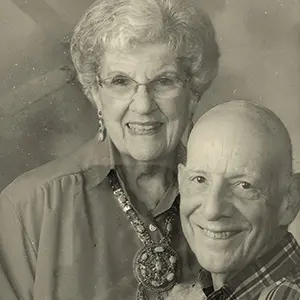
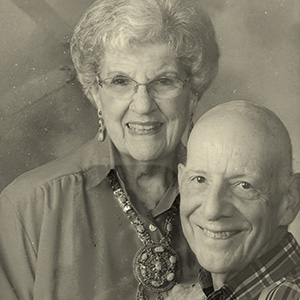
Ministers & Community Leaders, Richard and Peggy Ziglar talk about their youth and adult ministries and the challenges they faced when they supported the LGBTQ community.
Rev. Richard V. Ziglar was born in Winston-Salem, North Carolina. He attended Atlantic Christian College in Wilson, North Carolina, and Brite Divinity School at Texas Christian University in Fort Worth, Texas, where he and Peggy were married in 1958.
Peggy also graduated from Brite Divinity School. After serving the Christian Church in various roles, they moved to Tulsa in 1975, where Richard served as Minister of Christian Education at First Christian Church in downtown Tulsa until 1994.
In the 1980s, the Ziglars became involved with PFLAG as the only ministerial couple participating. Richard was a co-founder of the OASIS Adult Day Care Center, founder of Northeast Active Timers, and a board member of the Centenarian Club of Oklahoma.
Throughout his ministry, he published many articles on children’s ministry and ministry for older adults. In 2006, he received the PFLAG Swan Award in recognition of his leadership and support.
Full Interview Transcript
Chapter 1 - Introduction
Announcer: Rev. Richard V. Ziglar was born in Winston-Salem, North Carolina. He attended Atlantic Christian College in Wilson, North Carolina, and Brite Divinity School at Texas Christian University in Fort Worth, Texas, where he and Peggy were married in 1958.
Peggy also graduated from Brite Divinity School. After serving the Christian Church in various roles, they moved to Tulsa in 1975, where Richard served as Minister of Christian Education at First Christian Church in downtown Tulsa until 1994.
In the 1980s, the Ziglars became involved with PFLAG as the only ministerial couple participating. Richard was a co-founder of the OASIS Adult Day Care Center, founder of Northeast Active Timers, and a board member of the Centenarian Club of Oklahoma.
Throughout his ministry, he published many articles on children’s ministry and ministry for older adults. In 2006, he received the PFLAG Swan Award in recognition of his leadership and support.
In this oral history, Richard and Peggy talk about their youth and adult ministries, and the challenges they faced when they supported the LGBTQ community, on the podcast and website VoicesOfOklahoma.com.
Chapter 2 - Family Story
John Erling (JE): My name is John Erling and today's date is May 8th, 2026. So Richard, would you state your full name, please?
Richard Ziglar (RZ): Richard Vance Ziglar.
JE: Your birthdate?
RZ: September 22, 1934.
JE: And your present age?
RZ: 91 and-a-half.
JE: All right, yes, where were you born?
RZ: Winston-Salem, North Carolina, and I was born in the family home.
JE: Your family would be your mother and father --
RZ: So my grandfather—
JE: Oh, your grandfather's home.
RZ: Yes, it was. My mother was very young. She got married at 15, and I came along when she was 17, but we were in the, lived in the parent, the grandfather's house.
JE: So your mother's name, maiden name, where she was born, her maiden name?
RZ: Virginia Brown Joyce, Winston-Salem, North Carolina.
JE: And she grew up in that area, obviously, right.What do you remember of her? Can you describe her personality? What she was like?
RZ: She was a very lovely, beautiful lady. And petite, 5’2”, I think her mother had divorced her dad after she was born. Because she wanted to go to Washington to be a playgirl, so to speak, enter into the high society life and she -- I think she and my grandfather just were not compatible in their upbringing. He was born in a log cabin type. He established a business in Winston-Salem, Joyce Brothers. Which was a candy place, candy and sundries. My mother did not want to go off to college, so she chose to get married so that she wouldn't have to leave home.
JE: All right then, your father's name?
RZ: William Henry Ziglar.
JE: He came from Winston-Salem. That's—
RZ: Winston-Salem, Old Salem, which was a Moravian-established community.
JE: And so his personality, what was he like?
RZ: He was very outgoing -- had a temper. He was -- could sell anything, and he did end up being a salesman.
JE: So then your mother and father were married and you've said she was 15 when she was married and—
RZ: He was 17.
JE: So she wanted to stay, so she went looking for a guy to marry her, is that it?
RZ: Sort of so she could stay home. She was very much a homebody and very fond of her dad. Who was raising her, really. That and the black maid, Nora was her name.
JE: That was common to have black maids in that time, I suppose, right? So then he was a salesman for many different products or—
RZ: He worked; he first established a meat market in the city market of Winston-Salem, was a butcher and would sell meat products. And there were probably a dozen or so of these in a big market. He went to work for the Famous Foods of Virginia -- FFV -- and sold cookies; and then he went to work for Palmolive -- Colgate-Palmolive Company -- and was a soap salesman for years and elevated himself to be a supervisor. And at one time he was in the office of the national headquarters in New Jersey. And did ads for them.
JE: So do you feel you drew from him his personality? I mean, you're a real people person and obviously he was.
RZ: He was a very much of a people person. I do not have the temperament of my dad. Thank goodness. He would always be of high strung, so to speak. Had a temper and I got caught in that temper a lot.
JE: Yeah, I think you heard a voice in here, and that's the name of Peggy. And your wife is sitting at the table to join us, keep us on the straight and narrow. So Peggy, a little bit about your parents, where they came from, and your mother, what was she and what was her mother's name?
Peggy Ziglar (PZ): Rosa Mason. Julia Rosa Mason, her mother's name was Julia. So when she passed away, my grandfather refused to let anybody use her name again, so Mama was called Rosa. And I vowed and declared if I ever had a little girl, her name was gonna be Julia.
JE: OK, and that did happen.
PZ: That did happen. Daddy was one of 12 and he was a butcher. But he owned a grocery store when I was growing up. I learned the business very early and spent many an hour down there just because there wasn't a maid in the house to take care of me, so I was at the grocery store.
JE: What was your father's name?
PZ: Donald McKenzie Nicholls with two L's,
JE: OK. And did you think you were going to end up being in that business growing up?
PZ: Early on I decided I wanted to go into Christian education work, so I knew I wasn't gonna take over the grocery store or anything like that,
JE: Richard, you said you'd be 91 and-a-half. And so Peggy, you are how old?
PZ: 92. I'll be 93 my next birthday
JE: Which is when?
PZ: July 11th.
JE: OK, so did either one of you had, as we say, "long livers"? Your parents, did they live to be a long.
PZ: Well, I'm adopted, so I don't know.
JE: OK. All right. Richard?
RZ: My grandfather liked 1 month in being 100 on my mother's side. And my grandmother and grandfather both lived to be around 85.
JE: So you almost had to start a centenarian club way back when, didn't you?
RZ: My dad lived to be 97.
JE: OK. All right, so you do have that.
RZ: I have longevity, and we had an aunt, my mother -- grandmother's sister -- who lived to be 108. I know some longevity runs in the family
JE: Yes. Indeed, right.
Chapter 3 - Christian Education
John Erling (JE): Let's talk about your education. Where did you go, beginning with grade school? Where did you go to school?
Richard Ziglar (RZ): I went to West End school for my first grade. School was closed down and then torn down for Sears to move in.
JE: Oh, really?
RZ: Yeah. So I went to Wiley School, elementary school, and then to RJ Reynolds High School.
JE: And what year did you graduate from high school?
RZ: 1952.
JE: So, Peggy, where did you start your first year education, grade school?
Peggy Ziglar (PZ): I went to grade school at the training school and for years that was called The Training School because it was on East Carolina campus. And they were training teachers. And I never had a male teacher until the war was over and I was in high school and they began to accept men into the college after the war.
JE: You say the war, World War…?
PZ: Two. Then I went to Greenville High School.
JE: OK. And then you graduated in what year?
PZ: 51.
JE: All right, so then both of you may remember Pearl Harbor Day, December 7th, 1941. You were 7, 8, 9 years old. Either one of you, Peggy, you have a remembrance of that day?
PZ: No, except my brother was in the Navy. He was considerably older. Mama used to joke and say she took that long to convince daddy to adopt another child, so there was considerable age difference in my brother, but he was in World War II in the Navy, so I can remember the principal came to the door and told everybody. And she apparently had gone from room to room and told everybody that the war was over.
JE: Oh, that it was over. Yes, right. Well, there was jubilation then. Richard, any recollection of that?
RZ: No, I don't. The only thing I can remember about World War II is the air raids that we had to experience and pulling down the shades and or closing the blinds. In complete darkness would have to come over our community. It was a practice session for in case we were ever bombed.
PZ: I'm surprised that far west that you all had to do that. Greenville is closer, much closer to the coast.
JE: Interesting.
RZ: But I remember the blackouts and somebody coming to our door and knocking. And we wouldn't open it.
PZ: The air raid wardens, they were called.
RZ: Yes, the air raid wardens.
JE: Well, really, why would they be knocking on your door?
PZ: Be sure all your lights were out and if they saw any light whatsoever, they would come knock on the door and tell you. But I think they were probably just checking on us to be sure we were OK.
RZ: It created a little fear.
JE: Well, sure it did. 8, 9 years old.
RZ: Right. But I remember the jubilation of when it was over..
JE: OK, so after high school, what did you do then?
RZ: I enrolled in Atlantic Christian College, never been on the campus before, but I got a scholarship there. And it was one of our denominational colleges. When I went, it was a brand new territory to me. I'd never seen anything in Eastern Carolina, period, because I've not been beyond Raleigh, the capital. So that's where I met Peggy.
JE: I should ask you then about your church. Was church life important to you when you were a child?
RZ: Yes, I was very much involved in the church and in all phases of it. But particularly with the youth program and went to Cairo camp and to CYF conference. They were very pivotal times in my life and influenced me to ministry.
JE: All right. What denomination? What church was that?
RZ: Christian Church Disciples of Christ.
JE: OK, where you have been for the rest of your life.
RZ: (In the affirmative) Mm-hmm.
JE: Right. And Peggy, you went to Atlantic Christian College too.
PZ: Yes. And I already knew that that's where I was going because being in the eastern part of the state, our conferences were held at Atlantic Christian. I knew that's where I wanted to go.
JE: And that's where you met.
PZ: Yes.
JE: Was it the first day on campus or how did you meet?
RZ: No, she was a year ahead of me, so I remember in the dining room we were sitting family style and the dishes were, the food was put on the table for us. When I had finished dinner, I happened to walk over to this table and met her. I think I was just reaching out to meet people, who your classmates are and maybe I'd seen her in our class. I don't remember that part, but I remember distinctly going. It was after dinner and going over to her table and introducing myself to her, and then we became lifelong friends.
JE: So Peggy, do you corroborate that?
PZ: No, I don't remember it.
JE: An introduction she doesn't remember.
PZ: But being -- both being -- religion majors we were in a lot of classes together we did a lot of activities together religious wise and when there was a youth meeting somewhere else, Richard had a car and usually we all piled in his car to go wherever the youth meeting was. There was a lot of interaction.
RZ: I ended up being called to her church to serve as the youth minister.
JE: Oh, really? How old were you then?
RZ: Probably 18 or 19.
JE: That was before you went to Brite Divinity.
RZ: OK.
JE: And your training was at the Christian College, Atlantic Christian College, and so based on that training, they felt you were ready to be a youth minister?
RZ: Right. And I was contacted by the church. Accepted that call to go there, so I provided weekend transportation for her.
PZ: That year I was working because I had to work a year in order to get money to go to seminary. So I would go home occasionally and he would give me a ride back. Mama always invited him to dinner on Sunday and then he would take a nap on our couch.
JE: So obviously then you grew up in the Christian church yourself, right?
PZ: Yes.
JE: So was that unusual that both of you had that, or was that predominant in Winston-Salem? The Christian church, not necessarily because you had other denominations too, didn't you?
PZ: Oh, yes.
JE: Right, right. So it's just by coincidence that both of you grew up in the church, the Christian church—
RZ: Disciples of Christ, because we didn't know each other till we got to college.
JE: I guess this was meant to be then, right?
RZ: Yes, right. I think after 68 years…
JE: Yes, apparently—
RZ: It’s meant to be.
JE: Sign off on that, right. So Richard, was it a call to ministry? Did that happen to you at what age and where did that happen?
RZ: I was about 5 years old. I was called to be a garbage collector.
JE: (Laughing)
RZ: But I ended up collecting a lot of garbage otherwise in counseling. I felt that push to go to ministry. I was very religious, very devoted. My family was … encouraged me to do that and I could walk to church for various events. I didn't have to depend on them to take me.
JE: Were you more proactive in that than your parents?
RZ: I would say yes.
JE: OK. Did you have brothers and sisters?
RZ: No. Only child.
JE: OK. So for some reason at the age of 5, you knew you liked the church and its activities.
RZ: (In the affirmative) Yes.
JE: And Peggy, you?
PZ: I think because I went to so many camps and conferences, I was just drawn to be a Christian educator and I knew that Atlantic Christian was where I wanted to go. They've changed the name since to Barton College. I just knew that that's the direction I wanted to go.
JE: I have to comment because I hear accents. I hear a Carolina accent.
RZ: Yes.
JE: And I've talked to you before and I didn't, but I hear you talk now and it is there. And Richard, you don't seem to have that.
RZ: Yeah, I'm from the Piedmont area.
JE: Oh, and there's a difference?
RZ: There was a difference as you went east, there was more Carolinian accent. Because they were near the coast and I think that made the difference.
JE: Right, right. It's interesting how you still have that. I like the sound of it.
PZ: Thank you.
Chapter 4 - Youth & Adult Education
John Erling (JE): So after Atlantic Christian, then you go to a seminary.
Richard Ziglar (RZ): We both went to seminary, Brite Divinity School at Texas Christian University, enrolled to get a master's of religious education degree.
JE: Both of you? You were married in there somewhere.
RZ: We got married two days before graduation.
JE: So you were married in…?
RZ: 1958.
JE: OK, in the chapel there on campus you were married.
RZ: We got married on May 28th and the 29th was the senior banquet which we had to be present for. And then the 30th was graduation and we moved on—
Peggy Ziglar (PZ): On the following Monday.
RZ: The following Monday, which we think was Memorial Day. I want to tell you a funny story though, John. As we were leaving Fort Worth to go to our first ministry in Richmond, Virginia—oh, the 7th Street Christian Church, which was established by Thomas Campbell himself, the founder of the Christian church—I said to Peggy, "Mark my word, we'll be back here and within 10 years,” because the larger churches that would have multi-staff were in the Texas area and we didn't have many back East and I went on to say, "But Lord deliver me from ever going to Oklahoma," because of their conservativism. And we've ended up living in Oklahoma 56 years now.
JE: Well, that's good, of course, but if you hadn't said that to God, he probably wouldn't have sent you there.
PZ: I said he had a long, God had a long time to laugh until he got us here.
JE: And then you were ordained in the Christian church in about in 1956 or '7 in there?
RZ: 1956 before I went to Brite.
JE: But then were you—
PZ: I was never ordained.
JE: OK. But your degree was in—
PZ: Christian Education.
JE: Christian education, right. Some may not know the Disciples of Christ, the Christian Church Disciples of Christ. Would you say that, how does it stand out different from, say, some of the mainline denominations? Probably more focused on unity than doctrine, would that be right?
RZ: That's true and around the Lord's table, particularly, it's an open table and anyone can come to that table.
JE: And it's less rigid probably than many denominations, and you welcome a wide range of beliefs, so many can come from different backgrounds.
RZ: Right. And we don't all have to be the same, believe the same. It's OK for you to stand on your belief and for me to stand on my belief, but we accept each other in love.
JE: Let's track you then from 1958. Where do you go then?
RZ: Our first church was the 7th Street Christian Church in Richmond, Virginia.
JE: Were you both on staff there?
PZ: No, no, I was just a wife, but very active. I usually -- we usually left in the morning on Sunday and we didn't get home until after the youth group on Sunday night. We had one car, so I either went with him and stayed all day or didn't go at all if I was sick.
JE: OK, so how long were you there that first call?
RZ: Four years. And then we accepted the call to go to Wilson, North Carolina, where Atlantic Christian was located. And we served there as Minister of Education for 5 years.
JE: You knew your calling was an education ministry. You never wanted to be the lead pastor of a church.
RZ: No.
JE: And why was that?
RZ: I just felt strongly that I wanted to educate, help to educate children and youth and adults. I did not want the responsibility of having to lead the church as such as the senior minister does.
JE: Right. But you must have also felt a connection there that this works, that children and young adults listen to you, and so you knew that was happening.
RZ: Yes. So then do I bring you to Tyler?
RZ: After the 5 years in Wilson, we accepted the call to go to Tyler, Texas, to the First Christian Church. The difference in that and the previous calls had been that a man came to me who was in Kinston, North Carolina and said he had this opportunity to go to Texas and would I go with him. So it was a different kind of an arrangement.
JE: Was he a minister?
RZ: Yes.
JE: He was called to be the lead pastor.
RZ: Pastor, the lead pastor.
JE: And would you come along?
RZ: Come along with him. And we had directed conferences together, so I knew of his leadership style. And I thought, well, this would be exciting. We ended up having a very good ministry in Tyler of 7 years, I think.
JE: And so Peggy, then, were you working in the church then too, or were you…?
PZ: I was at home and I knew that he had gone to Kinston. And I told him before he left, I said, "If Fred wants you to move over there, I am not moving to Kinston." And in high school, Greenville and Kinston were archrival rivals, and so I didn't want to go to Kinston.
RZ: North Carolina.
PZ: So when he came back, I said, "Fred didn't ask you to move to Kinston."
RZ: "No, he asked me to move to Texas."
JE: OK, how did that go over with you?
PZ: Fine. I didn't mind going back to Texas.
JE: Because you didn't know whether you liked them or not, did you?
PZ: But I didn't mind going back to Texas.
RZ: But that fulfilled my prediction of it.
JE: Right.
RZ: 10 years, we'll be back in Texas.
JE: Right. Yes, because you'd been in Fort Worth for TCU, right? So that was a good ministry for you.
RZ: Yes, it was, and it was a brand new church that had moved out from downtown and built new facilities, so I had the joy of getting it furnished and provisions and making use of the building.
JE: Yeah, that was fun.
RZ: That was fun. And we had a very fruitful ministry there.
JE: But you were and have been active in the community. You were president of the Tyler Community concert series. What was that all about?
RZ: Yes. We didn't have a large enough group to have opera and symphony in town, so community concerts you hook up with and you engage, they work with you engaging concerts in your community and so that's what we did.
JE: And so music was important to you.
RZ: Music's always been important to me.
JE: All right.
RZ: I was a drum major in high school.
JE: Oh, OK.
RZ: So from that point on, I tried to offer leadership. I was never an outstanding singer or anything, but we gave support to all the musical groups in town and brought to town what was void.
JE: It had been classical and opera and that type. You were a founding member of Meals on Wheels in Tyler.
RZ: Right. And that came about through our church becoming involved in trying to meet the needs of the elderly. I've always been drawn to the elderly too, as you know. There was a void of no meal service for these people in town and so that's when Meals on Wheels was beginning to be established in various communities so I helped to get it started in Tyler.
Chapter 5 - Time to Stay
John Erling (JE): Did somewhere in here you begin to have children?
Peggy Ziglar (PZ): We had our first one in Richmond, Virginia, and our second one in Wilson, North Carolina.
JE: OK, your first one—
PZ: Is a boy, Vance—Richard Vance Ziglar the 2nd.
JE: All right.
PZ: And a funny story about that is in the hospital when the lady came in to take all the statistics, she informed me that I could not name him the 2nd. That he had to be junior, and the very reason Richard wanted him the 2nd was so he wouldn't be called Junior. So about that time the phone rang and it was a dear friend from the church who happened to be a lawyer and I said, "Paul, tell me, can I name Vance the 2nd or does he have to be a junior?" And he said, "Peggy, you can name him Podunk Corner if you want to, but absolutely you can name him the 2nd. Remember, I have Paul the 2nd." So politely the lady had stepped out of the room and when she came back in she had filled out everything. And I told her what my friend on the phone had said, and she had to scratch out Junior and put the 2nd. She was not a happy camper.
JE: No, no, no, no. So then, OK, Vance is your first born son, and then your second child?
PZ: In Wilson, North Carolina.
JE: And her name then is?
PZ: Julia Joyce, after her two grandmothers.
JE: And you named her Julia for sure, didn't you?
PZ: Absolutely.
JE: Right. But you were a faculty of the TCU Brite Divinity School, training ministry students to teach in the church school.
Richard Ziglar (RZ): Yes.
JE: How does that work?
RZ: They were conducted over a two-week period that they would bring people in from churches who were very skilled in training ministers to teach various age groups. And I always did the youth, some phases of the youth. So that's what it was called and it was the last two weeks and we would go home in between time over the weekend. So I did that for years.
JE: Yes, you were, so you were teaching these students to go back to their church, home church to teach.
RZ: They were ministers in training at Brite Divinity School, and so they had the experience of getting some Christian education in how to teach children and youth. Then after I left the church in Tyler, I went to the regional staff of the Christian church in the Southwest. But it was only Texas when I went and then it merged with New Mexico so it became the Southwest and we had to travel over many miles for training events and teaching events, but I created what was called training workshops and growth, and it would move around every weekend to a different location and church to train teachers. One of the times that I came home, my daughter put her hands on her hips and says, "Where do you have to go now?" And I read the message and I said, "I don't think I have to go anywhere right now." So we're going to stay home for a while, but then I told Peggy, I said, "I need to get back in the local church because we were not having any family involvement in a church." Because I was on the road all the time and so I decided I'd always wanted to do regional work, but I decided it should be before children or after children.
JE: Did you enjoy it?
RZ: I enjoyed it, yeah, I learned needlepoint.
JE: How? Why?
RZ: Because I was riding in a car so much. It was during the time that the gas shortage came too. And so we couldn't fly to places. We had to take a car.
JE: So somebody was driving, I hope, while you were doing needlepoint.
RZ: Yes. There were three of us in the team from the regional staff.
JE: And so Julia told you to stay home.
RZ: So I got the message and I always resented my dad traveling. Because I felt like he was never a homebody. Just in and out on the weekends and that's not being a real dad.
JE: So am I bringing you then to Tulsa?
RZ: The opportunity came shortly after that that I decided I was going to make a change and then go back into the local church. Then the minister from Wichita Falls called me and said, "I have this opportunity to go to Tulsa and I want you to go with me," and I said, "OK, as long as we can just go through the interview process to make sure that they want me." And so we did. And he began in August, and I started in September.
JE: What was his name?
RZ: Gene Bryce.
JE: So then, Peggy, did you sign off on that and say, "OK, Tulsa's fine"?
PZ: I was willing to go wherever he had a job.
JE: Right, right, right. Had you ever been to Tulsa before?
RZ: No, it was completely new, but we did come up for the interview and felt comfortable with it. And even though I'd made this statement, "Lord deliver me from Oklahoma.”
JE: Did you tell them that?
RZ: No, I don't think I told them that.
JE: Yeah, and so then that was First Christian Church.
RZ: That was the First Christian Church.
JE: Downtown, right? And that was a nice facility for you to come in.
RZ: 1,840 members.
JE: Yeah. So that was probably the biggest congregation that you were on staff of. So that was a nice experience for you.
RZ: Right. A big promotion in salary too, because the regional staff was having difficulty at the time. The regional minister called me in and said, "No matter how good you do or how bad you do, you're not going to get any increases for 2 or 3 years," and I just couldn't see that either. That was another factor that entered in as a regional person. I wasn't gonna be able to go anywhere salary-wise. And things were going up at that point.
JE: Right. So then, how long were you there in downtown, First Christian Church?
RZ: We were there 20 years.
JE: Let's talk about that experience because that was in 1975 then when you came there. And times changed and evolved, and can you talk about maybe programs or things that you did for the church?
RZ: One of the best things that I probably did for the church was bringing them new insight to the season of Advent and the hanging of the greens, and that made a lot of impression on the congregations, and it had in the past congregations I had served too, where the people come together and they make the wreaths and they actually gather the greens in and…
PZ: And make the garlands, too.
RZ: … and make the garlands and everything that's a part of the decorations of the sanctuary.
JE: So yeah, that helped them working together and probably getting to know each other better too.
RZ: And it had a lot of benefits and people looked forward to it. It was a lot of work, but it paid off. And that was the one time that the sanctuary would be full, other than Easter.
JE: Right, which seems to be traditional in churches, we all come to Easter and Christmas, don't we?
RZ: Right. But the special service for the hanging of the greens was always in the evening.
JE: OK. So the hanging, OK, you made the wreaths and then that was a special service to actually hang the wreaths where, in windows or in…?
RZ: Sanctuaries, they hung on the balconies of the First Christian. We had some other innovative programs that were created. We needed to tend to facilities and renovation because we needed to get it looking more modern. They had done the sanctuary, but they'd not done anything else in the children's area, particularly, or in the fellowship hall. So we got about doing that to update it and make it look stronger, more appealing to young families. And then we started a Child Development Center, which was new in Tulsa, and we were the only downtown church that had a daycare for a long time, and it's now over at the Trinity Episcopal.
JE: Why would it move to the Episcopal Church?
RZ: Because the church thought it was losing money on it and so they told them to move—a bad decision.
JE: The Child Development Center meant child care?
RZ: Well, it went through first grade.
JE: Oh, that was a school?
PZ: Yeah, it was mainly for the people downtown who worked and had children. It was convenient for them to bring their children downtown to the church and then go to work.
JE: And that probably brought maybe some people into your church too to attend.
RZ: Well, we had hoped it would. It did not bring the numbers that we had hoped for and the church felt like that it was subsidizing it and it was costing them money where they were putting money in each month to the expenses of it. The Child Development Center was putting money into it. I think it was just mismanagement and misunderstanding. The church has taken a turn and it's gone downhill considerably.
JE: So the Episcopal Church, Trinity, does that maintain that today?
RZ: Yes.
Chapter 6 - LGBTQ
John Erling (JE): So then there was a point when you were told by your son Vance that he was gay. How did both of you accept this, and did you, had you ever questioned it? Did it come as a big surprise, or how did that happen?
Peggy Ziglar (PZ): I think as far as I was concerned, I just said, "OK." It didn't upset me. He was still my son. I don't remember being bothered or upset.
Richard Ziglar (RZ): He was in college when he told us.
JE: Richard, how did you accept that? Was that a surprise?
RZ: No, I thought maybe he might be. It just caused us to get more involved in the AIDS and in the LGBTQ community.
JE: So he must have had great relief when he told you and realized how accepting both of you were?
RZ: Yes, I think so. We've never rejected him in any way.
JE: Right. Maybe at this point I could ask, parents are listening to this and maybe that will happen in their family too, or it has. What kind of advice do you give parents who hear this news?
RZ: Well, I think no matter what your child does, you may not love the action, but you love the child, and they've got to have the assurance of their parents that you care for them and love them no matter what.
JE: It's sad, isn't it, that some will actually reject.
PZ: The stories we've heard…
RZ: The stories we've heard, yeah.
PZ: And it really is sad.
JE: Right, and it's never healed. They will go to their grave, an estrangement like that.
RZ: So saying, it caused us to become more involved in helping the community. And as it was surprisingly, we never hid that our son was—we didn't broadcast it, but I think people began to know it because of our actions and our thoughts and the way we expressed ourselves. That people did begin to come to us seeking advice and just a confirmation maybe or an assurance that all is well.
JE: Right, right. So that's when you became involved with PFLAG: Parents, Families, and Friends of Lesbians and Gays.
RZ: Right. And Nancy McDonald was the one who really was heading that up and because they had a gay daughter. I called her, contacted her, and she invited us to a meeting. And that's how it was, meeting in Joe's office to start with.
JE: With her husband? In Joe's office. I've interviewed Nancy McDonald for this series on Voices of Oklahoma, and of course we talked about that and the other various volunteer issues that she was involved with in our town. So now it has a broader mission to support the entire LGBTQ community. In your church then when news came out about this, how did that go over?
RZ: Well, we were rejected by some people. And they would never tell us face-to-face. But we suspected what it was because we became involved more with RAIN, Regional AIDS Interfaith Network. We had the first training group at First Christian for training people to work with people with AIDS.
JE: Was that care teams, congregational care teams?
RZ: Congregational care teams. We had elderly involved, we had young involved. So the gamut was there for a cross section of people who cared.
PZ: Members of the church.
RZ: Members of the church, yeah, they were made up of—
PZ: Members of the church.
JE: But were there gay members of the church and you didn't know they were, and then they—
PZ: Well, we did. I don't know that everybody in the church knew it, but they didn't try to hide it.
RZ: And we brought gay people to church.
JE: Because of your involvement. They heard about—
RZ: Our involvement.
PZ: Right. And some people did not like that at all.
JE: Do you think anybody had left the church because of it?
RZ: They could have, John, and I not knowing it.
JE: Right. Did anybody directly talk to you about how they were?
RZ: Oh, yes. I was let go because of that.
JE: Really?
PZ: (In the affirmative) Uh-huh.
RZ: They came to me one day and said my leadership style was no longer accepted.
JE: And this was after 19 years? In 1994 that happened and you were let go because of your stance.
RZ: Yeah, they would never say that because that would have gotten them into trouble. I knew the bottom line. And it was a painful experience.
JE: I can imagine.
RZ: And our son was also in prison during this time.
JE: In prison? Tell us about that.
PZ: Well, he was working for a company that apparently he had access to some money. And he would help gay people with that money. The owner was very kind, but there was just no way to get around the fact that Vance had stolen the money, so to speak, and so he went to prison for 2 years.
JE: In Texas?
PZ: No, he was all the way up in—where did we go?
RZ: Pennsylvania. Allentown, Pennsylvania.
JE: Well, that had to be awful for you as a mother and father.
PZ: Oh, it was traumatic.
RZ: Traumatic. It was traumatic. It was certainly not our strongest time in ministry. Our challenging time.
JE: And during those two years you were a minister where?
RZ: And I was still at First.
JE: So did you visit him in prison?
RZ: Yes, several times. He served less than a year because he got out on probation and could live with this person that they approved. No, he had to go to a halfway house to be protected and guarded and sign in and out, those are things that prisoners do, for a half a year, I think.
JE: So does he pick up then and start a life after prison?
PZ: Oh, yes.
JE: So today tell us what he's doing.
RZ: He just lost his partner of 28 years with pancreatic cancer two weeks before Christmas, so he's having to sell the house, which is sold. And today they're coming to move the things out that he's keeping in storage and moving him to an apartment that he's going to be using in Timonium. The owners of the apartment happen to live in Mexico City, so they're not—it's a gay couple and they're not home much. So they've consented to let him stay there until he can work things out.
JE: Is he working? Does he have a—
RZ: Yeah, he's in real estate, travel business, and is a church organist. He has been full-time in various churches—in full-time in the sense of their organist.
JE: So he's going through a tough time right now, isn't he?
RZ: He is having to dismantleand handle the estate.
JE: And we should mention, what is Julia doing these days?
PZ: Well, right now she's in Timonium with Vance. She was able to take some vacation time and go up and help him since we were not able to go.
JE: But does she have a career?
PZ: Yes, she is in hotel assessment, I guess I can call it. She got her degree from OSU in hotel management and managed a hotel for several years and so now she goes around for her company and assesses the hotels.
RZ: On Sunday I was doing the communion. I had made a reference that this table could go wherever it needed to go. And I had taken it to one of our AIDS members who was dying—
JE: You mean the communion table?
RZ: Yes, right. When I got back from practicum—it was during the time that I was doing practicum.
JE: What is practicum?
RZ: In the training of ministers for teaching. I was informed by the senior minister that I was on probation. I could not participate in the services for the remaining of Lent through Easter, and because I had made a reference to a person with AIDS at the communion table, so there was that conservativism.
JE: Weren't you one of the first to conduct a commitment ceremony for a gay couple?
RZ: Yes, I was, and I had discussed this with the staff. And I said, "I've been asked by two members of the church to do a service of commitment." They all agreed that that was fine. It was going to be held at Harwelden. It wasn't at the church. So I was criticized for that. But they were two members of the church who wanted to make a commitment to each other.
JE: Right. So was that near the end of your—before they fired you?
RZ: Well, they didn't fire me. They gave me a choice.
JE: And that was?
RZ: To leave within two weeks or two months and to find another place to serve, or they would fire me.
JE: And again, they couldn't bring up the issue of—
RZ: They did not bring up the issue.
JE: But you knew and they knew and you knew that's why it was.
RZ: Michael Kinnaman came to town who was very noted and outspoken for the gays in our Christian church, Disciples of Christ. He was—I don't remember what channel it was—but he and I were both interviewed and I simply stated my point, where I stood on it. Then I was criticized for that because I'm— And the church called me into a meeting and said, "If you appear on TV anymore, you will definitely be fired." I said, "Well, I didn't choose to be on TV. They chose me to come in with Michael Kinneman and to be interviewed." There was no more issue of that because I didn't appear on TV anymore, but they had me to move out of my office. They extended my time. And they halved my salary. Paid my pension—they did do that—and the healthcare, thank goodness. It was a difficult time.
JE: Did you ever question, "Why did I get so deep into all this?" Did you ever question that?
RZ: Yes, I probably did need to be honest with myself. I had a son out there who needed to be loved and wanted to be, and I did not want him rejected.
JE: So why should the others be rejected, and you were going to help them as you helped your son. Do you think there are those in the church who do not believe gays are born but they're nurtured, that God would not create a gay person and that's why they're so adamantly opposed? Where does that come from? Why?
RZ: I don't know, John. I wish I knew. We're taught to love one another. God's creation is good. But we know there are wars and battles and things like that that are not good, so I guess there's always going to be controversy and conflict of some sort.
JE: I can tell you and Peggy that I had a brother. He's no longer living, who was gay. And this is in North Dakota, where we lived, and he was a church organist, had been for 40 years, and a high school teacher. Same amount of time. And he was afraid that if he came out publicly, that the church was going to fire him. And he told me, "At my funeral, I want you to tell the congregation that I was gay." And so I did that. And I told them, "The reason he didn't tell you is, he was afraid you were going to fire him." And that was part of my speech at his funeral. But he lived for many, many years before he came out to me. I often wondered about it, but we just never asked him about it. And of course I've always been open about that and embraced it as a lifestyle that we don't understand. And sometimes I think it's easy to criticize people when you don't have a struggle with it. If you're not struggling with it, but if you're sure that you're a heterosexual, then it's easy for you to point down on somebody who is gay. And that's the end of my sermon to you two, because this is about you, not me, but I just thought I'd share that and I want my audience to know it too, right.
Chapter 7 - Centenarian Club
Richard Ziglar (RZ): Out of it came some good because I created OASIS and NEATS.
John Erling (JE): All right. OASIS and NEATS. Let's talk about that. What is OASIS?
RZ: OASIS is older adults.
JE: An adult daycare center?
RZ: An adult daycare center, yes. And Marlene Galusha and I went to a conference and that's where we picked up the name, OASIS. The church sent me out. They had me to move out of my office. And I went to South Side Christian where they welcomed me and they knew all that was going on, but they welcomed me, let me set up an office there for the development of OASIS which was going to be in their children's section because they had no more children—or they did, they had so few that they weren't using their facilities. So I went out. Spent half a year getting that remodeled and up to specs so it would be approved as an adult daycare center and it thrived for about 15 years. It was mismanagement of monies that caused it to go down the drain.
JE: So were you on their staff then, or did you do this?
RZ: No, I was not continued staff. I was only a volunteer.
JE: OK, and then tell us about NEATS: Northeast Active Timers.
RZ: In the Northeast Active Timers, the area came to me and wanted to know if I could develop a program for congregations that were small, particularly in the Christian church—develop a program similar to what I had as Happy Timers in Tulsa first, provide a ministry to our older adults in smaller churches who could not afford somebody to be employed to carry on a program for them. So that's what I did.
JE: What was Happy Timers?
RZ: Happy Timers was the senior group at First Church. But First Church had its own numbers of older people ---
Peggy Ziglar (PZ): --- retired people who traveled and did things in groups and had programs.
RZ: So NEATS hooked onto the Centenarian Club of Oklahoma, which started in 1991, I believe. And through Richard Amend, a staff member at the Catholic Church in Oklahoma City, he had a centenarian that was turning 100 soon, so he wanted to be able to create something that gave her special honor and recognition, so he established the Centenarians of Oklahoma and it was called a club first, Centenarian Club, and I became involved in that because I had 5 at my church that were over 100, so that's what got us started on that, and it's continuing—
JE: In that vein, you had a passion for the "chronologically gifted." What is "chronologically gifted"?
RZ: Older people. I just thought it was a nice term to put to it. (Laughing)
JE: (Laughing) Are we chronologically gifted?
RZ: Yes, we're chronologically gifted.
PZ: (Laughing)
JE: Is that because—right, because we know so much, gain so much knowledge and long-living?
RZ: Well, I think that could be. It was just a positive term to put on people who are aging. I picked that up from somewhere and I don't remember where, but I thought it was good.
JE: Both of you are around the 90 mark. But you were around centenarians when you were in the early 70s, and now you're approaching that yourself. Could be a member of the club.
RZ: I hope to be. I hope to be. Because longevity runs in my family, so I would hope I can make it.
JE: Somebody told me that the only person who wants to be 100 is the person who's 99. (Laughing)
RZ: (Laughing)
PZ: (Laughing)
RZ: Well, I think the closer you get, the more you want to hang on to reach it.
JE: In that area, I was reading The New York Times this morning and it was about a pianist, Seymour Bernstein, 99 years old, that he died. I love reading the obituaries in The New York Times because they bring to light people you've never heard about, and he had stage fright at 50, so he quit playing the piano in public. But at the end of it was he advised people to ignore the stereotypes about old age. He said, "For me, life is beginning at 90. I'm just learning to play the piano properly."
RZ: Well, that's—at least he's doing something that I always wanted to do was play the piano.
JE: Oh yeah. And why didn't you? Didn't have time probably.
RZ: Just didn't take the time to do it.
JE: Right.
Chapter 8 - Life of Service
John Erling (JE): First Christian downtown closed its doors last year, 2025. You weren't around to witness that or be at the last service or anything or…
Richard Ziglar (RZ): No, we did not go to the last service. We went to the centennial celebration of the sanctuary which was built in 1920. And that was just like the Sunday before the COVID closed down. And that was the last time that I think that we went. It still holds a special place in our hearts, having served that long, and I knew probably as much if not more than most people who are around there and still do.
JE: But about the church when you were going through this hard time because of your involvement with PFLAG and all... There had to be members of the church who came to you and supported you. Did they?
RZ & PZ: (In unison) Yes.
JE: So you felt some love from the church.
RZ: Right. Not as a group, but as individuals. Yeah, one man came to me who had left the church already and said, "I'm going to pay for your pension until you retire…
JE: Really?
RZ: …So I don't want you to have any less income than what you would anticipate had you remained here full-time." I thought that was great.
JE: It was absolutely great.
RZ: So we had many affirmations of people who said, "I just don't understand the church," and I think that is what caused the demise of the church.
JE: Congregation numbers went down, down, down, didn't they? So at the end, there's just, I don't know, probably a handful of people showing up.
RZ: 50.
JE: And it was 1,800 when you came.
RZ: Yeah, a lot of those people had died because I did so many funerals. I think I averaged a funeral a week while I was there.
JE: Of members dying in the church. Yeah. Both of you have given your life to service to the church and community. You haven't just been in the church, you've been in the community as well.
RZ: We always thought it was important for us to be involved in the community as a witness to the church. Because that's when you affect our lives and influence lives. We drew a lot of people into the church.
JE: Any particular service that you're most proud of?
Peggy Ziglar (PZ): I think hanging of the greens probably is one of yours.
RZ: Yes, but I'm proud of what we did in PFLAG and awards that I've received from that, it ends up being a positive witness down the road somewhere.
JE: I see where Brite Alumni Association Advisory Committee established scholarships at Brite Divinity, Phillips Theological Seminary and Barton College in Wilson in your name.
RZ: But we established them.
JE: You established them and gave scholarships to youngsters who probably wouldn't be able to attend there.
RZ: They control that, but we don't have any say-so.
PZ: No, but they know who needs it, whereas we wouldn't.
JE: My final question will be this, unless is there anything that you want to mention that we haven't talked about or…?
RZ: We've felt, I have felt that we've had good ministries all through our life, and some have been harder than others and some have been more hurtful than others. I remember in our first ministry, one of the elders came to me and said, "You're not to do anything unless the senior minister tells you to do it." Well, you don't like to work under those circumstances. We have had our ups and downs in ministry, but we've hung in there.
JE: Look how fortunate you both are to have each other at this age.
RZ: Yes, we are.
PZ: We are.
RZ: It's 68 years, May 28th.
JE: Right, congratulations. Congratulations to both of you, right. So, Peggy, how would you like to be remembered?
PZ: I think just as a good wife and a good mother and an active member in society. I don't know that I have any particular thing that I want to be remembered for.
JE: Don't you have grandchildren now?
PZ: Yes, two. We're proud of them.
JE: Right. And I'm sure they'll be proud of you too as they listen to this story. Richard, how would you like to be remembered?
RZ: Well, I'd like to be remembered as one who is faithful to my calling. Who has given of my best to making people feel in a strong relationship to God.
JE: I've known you now for many years through our Centenarian Club and Harvard Avenue Christian Church. So I want to thank you for sharing this story, and I'm sure it'll be helpful for others in our communities as they listen to it. So thank you, Peggy, and thank you, Richard, for sharing your story.
RZ: Thank you, John, for interviewing us.
JE: Yes.
PZ: We appreciate it very much.
Gallery
Production Notes
Richard & Peggy Ziglar
Program Credits: Richard & Peggy Ziglar — Interviewee John Erling — Interviewer Mel Myers — Announcer
Richard & Peggy Ziglar. "Richard & Peggy Ziglar: Ministers & Community Leaders" Voices of Oklahoma, June 1, 2026 https://www.voicesofoklahoma.com/interviews/ziglar-richard-peggy/, Accessed October 11, 2026